
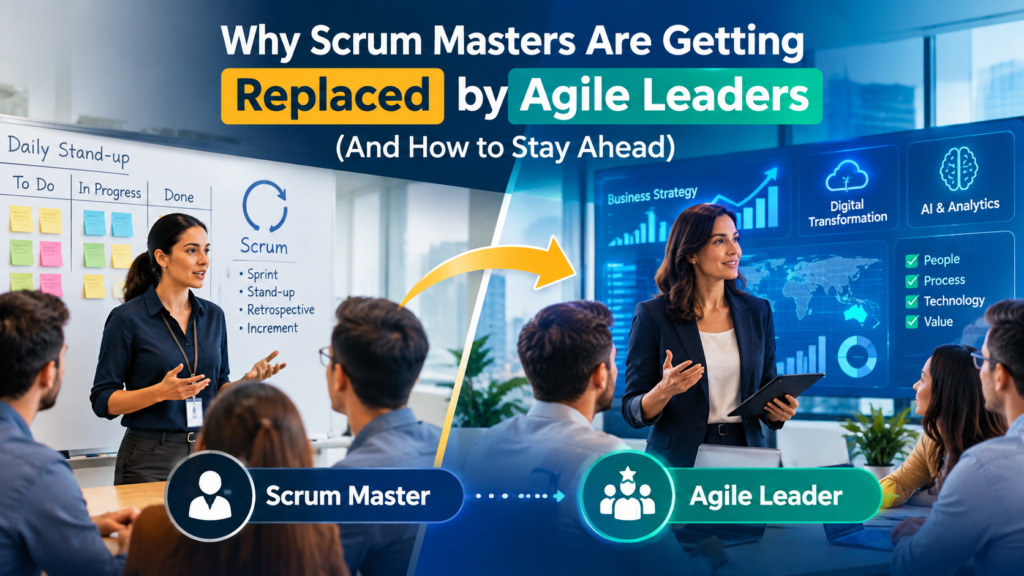
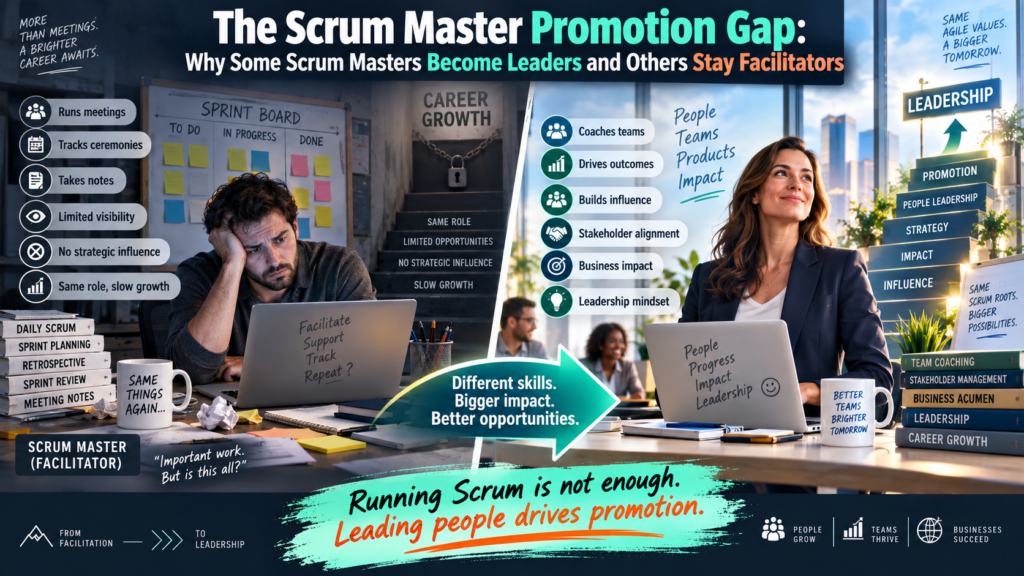
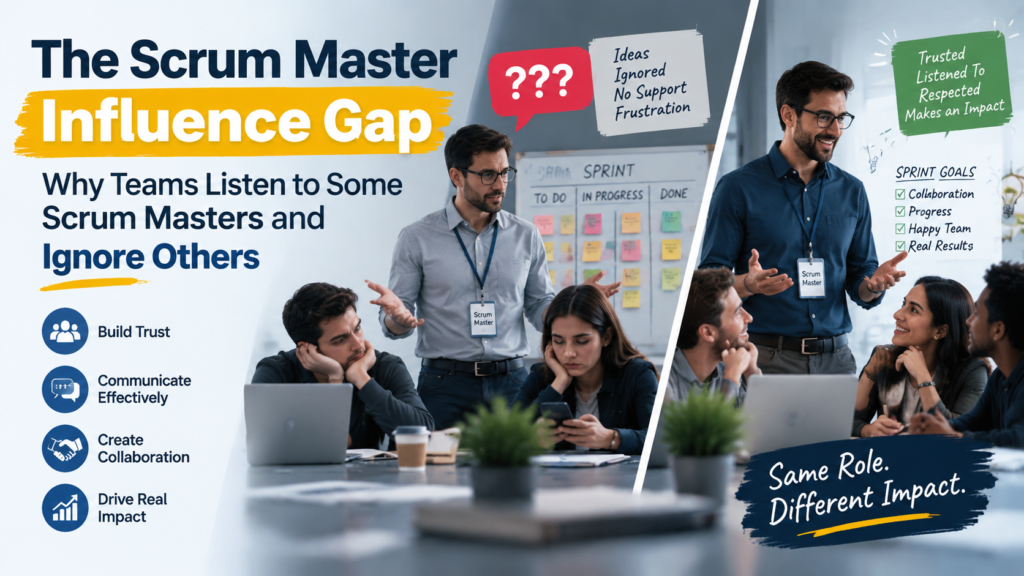
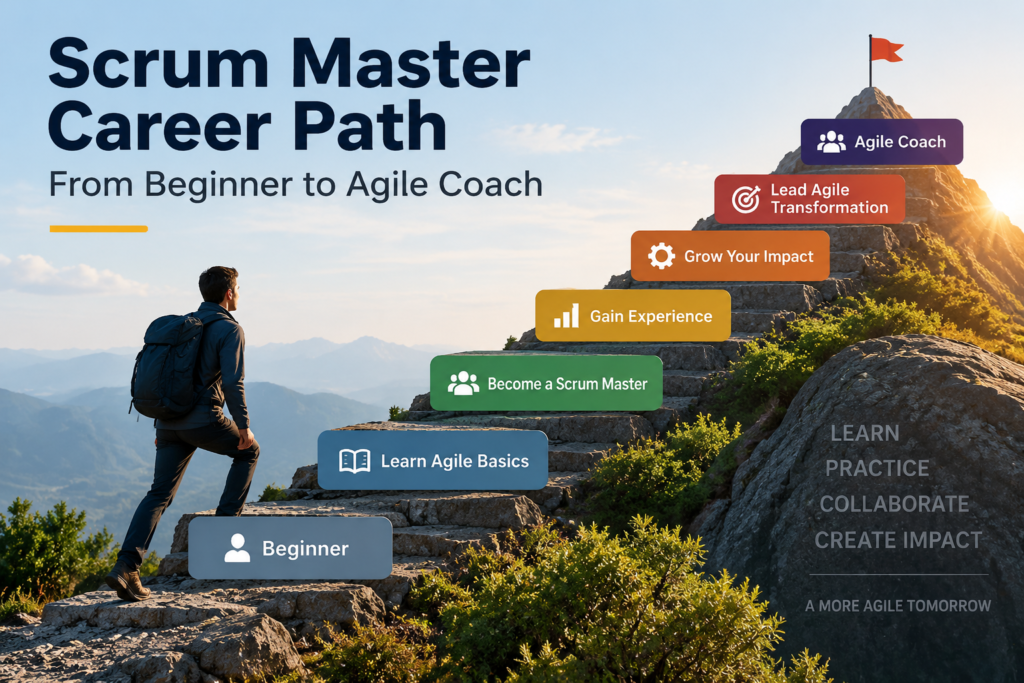
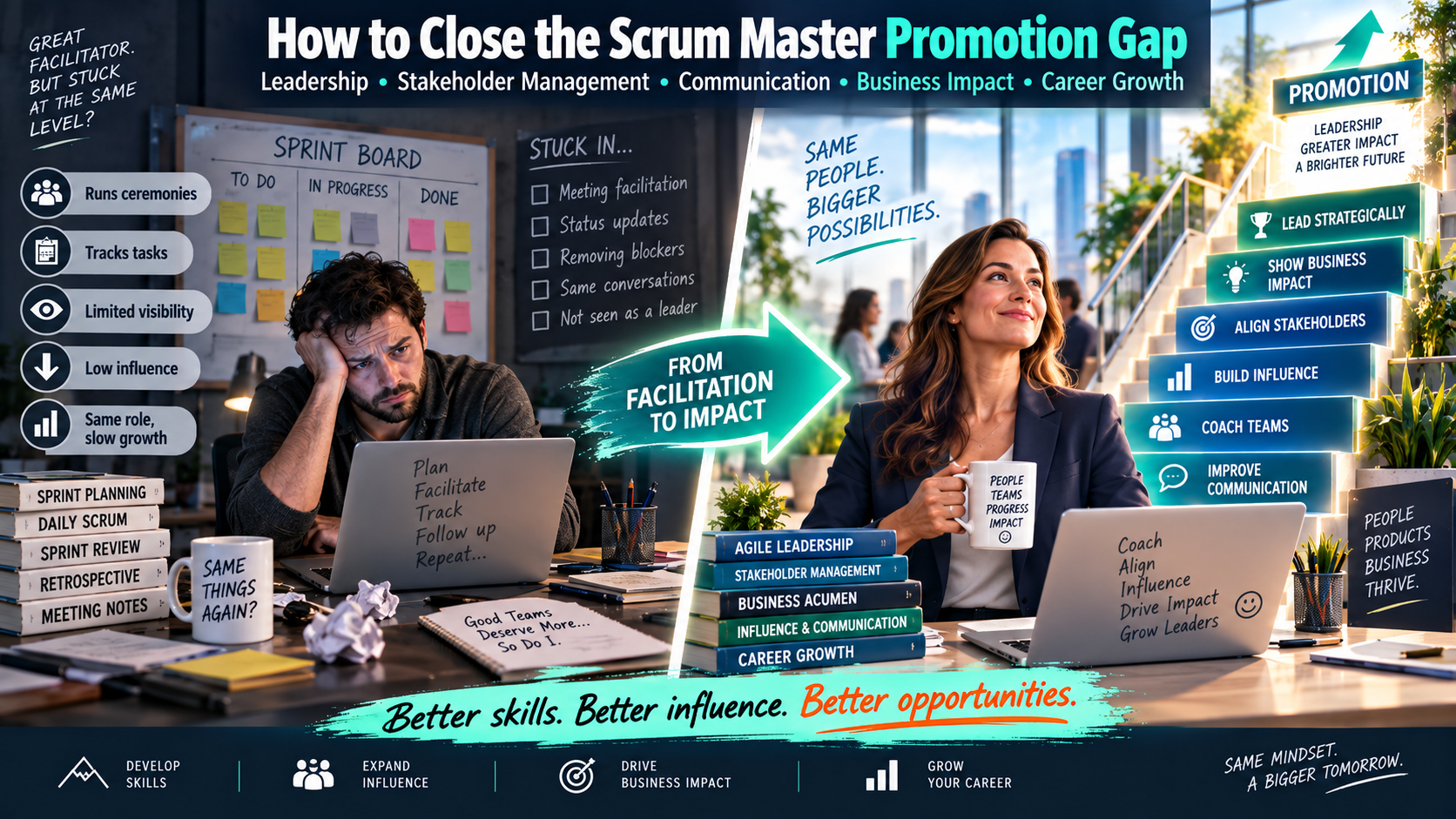
Two Scrum Masters can run equally smooth stand-ups, equally clean sprint reviews, and equally healthy retrospectives and still end up in very different places three years later. One moves into an Agile Coach, Chapter Lead, or Head of Agile Delivery role. The other keeps facilitating the same ceremonies for the same team, competently, indefinitely. That’s the Scrum Master promotion gap: it rarely comes down to who runs better ceremonies. It comes down to a specific set of skills that certification introduces but day-to-day facilitation rarely forces you to practise.
Closing the Scrum Master Promotion Gap: Facilitator vs Leader
CSM, PSM and SAFe all teach the mechanics of Scrum well the events, the artifacts, the accountabilities. That’s the floor, not the ceiling. The promotion gap opens in the layer above ceremony facilitation: influencing beyond the team, coaching instead of directing, and connecting agile practice to actual business outcomes.
1. Team Facilitation vs Organisational Coaching
A facilitator keeps one team’s ceremonies running smoothly. A leader coaches multiple teams, product owners, and even managers on agile thinking helping them solve their own problems rather than solving problems for them. That shift, from doing to coaching, is the single biggest differentiator.
2. Process Guardian vs Business Outcome Partner
Facilitators measure success by whether the sprint ran to plan. Leaders measure success by whether the product and the business actually moved forward and they’re comfortable challenging the process itself when it’s not serving that outcome. Rigid process-first thinking is a ceiling, not a strength, at senior levels.
3. Reactive Impediment Removal vs Proactive Organisational Influence
Removing blockers as they appear is core Scrum Master work. Leaders go further: they identify systemic, recurring impediments a dysfunctional dependency between teams, a broken prioritisation process and influence change at the organisational level, not just within their own team’s sprint.
The table below lays the pattern out clearly:
| Skill Area | Scrum Masters Who Stay Facilitators | Scrum Masters Who Become Leaders |
| Scope of influence | One team’s ceremonies and blockers | Multiple teams, product owners, and managers |
| Approach | Directs and facilitates process | Coaches others to solve their own problems |
| Success measure | Sprint ran smoothly | Product and business outcomes improved |
| Impediments | Removes what’s in front of them | Proactively fixes recurring, systemic issues |
| Certification use | Treats CSM/PSM as the finish line | Builds coaching and business skills on top of it |
Why Certification Alone Doesn’t Close the Gap
CSM, PSM and SAFe Scrum Master remain the strongest signal that you understand Scrum properly, and Scrum.org’s own description of the Scrum Master accountability explicitly frames the role as a true leader who serves the team, the product owner, and the organisation not simply a meeting facilitator. Most certification study, understandably, concentrates on the mechanics that are testable in an exam. The coaching and organisational-influence side of that same definition is acknowledged but rarely drilled with the same intensity.
How to Close the Scrum Master Promotion Gap
Practise Coaching, Not Just Facilitating
- In retrospectives, ask questions that help the team find their own solution instead of proposing one yourself.
- Offer to coach a struggling Product Owner or a newer Scrum Master informally coaching outside your own team is what gets noticed.
Connect Your Work to Business Outcomes
- Learn to explain your team’s velocity and delivery in terms of product impact and business value, not just story points.
- Volunteer to sit in on roadmap or prioritisation conversations, even if you’re not asked to.
Look for Systemic Impediments, Not Just Sprint-Level Ones
- Track recurring blockers across sprints patterns point to organisational, not team-level, problems.
- Propose a fix at the process or organisational level, even a small one, rather than waiting to be asked.
Where This Shows Up Across Australia
The pattern holds nationally: Scrum Masters who plateau tend to stay squarely inside their own team’s ceremonies, while those who advance visibly extend their influence and coaching beyond it.
| City | Common Plateau Point | What Tends to Break the Ceiling |
| Sydney | Senior Scrum Master | Cross-team coaching and Agile Coach exposure |
| Melbourne | Scrum Master (mid-level) | Product/business outcome framing |
| Brisbane | Scrum Master (single team) | Proactive systemic impediment fixes |
| Perth | Senior Scrum Master | SAFe-level, multi-team program exposure |
| Adelaide | Scrum Master (mid-level) | Coaching Product Owners and new Scrum Masters |
| Canberra | Scrum Master (government) | Organisational-level process influence |
Where to Build These Skills Deliberately
The certification foundation still matters it’s the credibility platform the coaching and leadership skills get built on top of. CSM Certification and PSM Certification both build that Scrum foundation, while SAFe Scrum Master extends it to multi-team, program-level scale exactly the exposure that tends to break the promotion ceiling. For salary and career-path context once you’re weighing the jump, see Scrum Master Salary Australia 2026. The full course catalogue is available at logitrain.com.au.
Frequently Asked Questions
Why do some Scrum Masters get promoted to Agile Coach and others don’t?
Certification proves you understand Scrum mechanics, but promotion into coaching or leadership roles depends on coaching skills, business outcome framing, and proactive organisational influence skills day-to-day facilitation doesn’t automatically build.
Do I need SAFe to move beyond a single-team Scrum Master role?
It helps significantly, since SAFe explicitly trains multi-team, program-level thinking, but it’s not the only path deliberately practising coaching and organisational influence in your current role matters just as much.
Is CSM or PSM enough on its own to get promoted?
Both are strong, necessary foundations, but rarely sufficient alone pairing certification with deliberate coaching practice and business-outcome framing is what tends to break the plateau.
Final Thought
The Scrum Master promotion gap isn’t a talent gap it’s a practice gap. Certification builds the mechanics; coaching and organisational influence only get built if you deliberately go looking for the chances to practise them. If you want the certified foundation in place while you build the rest, explore Logitrain’s Scrum Master training and start closing the gap.