
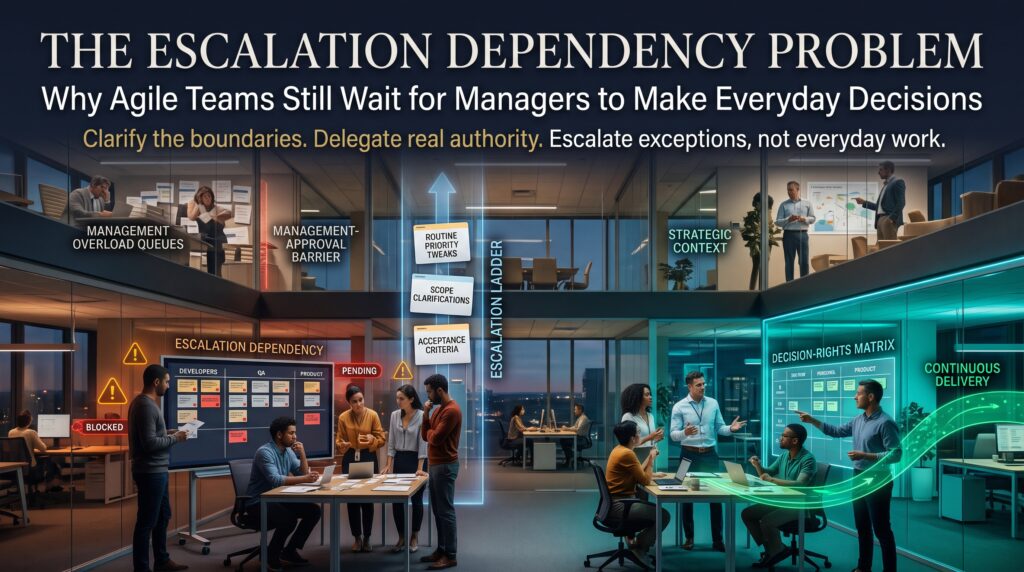
Agile teams are meant to organise their own work, yet many of them still stop and wait whenever a small decision appears. Which library should we use? Can we change the order of these stories? Is this wording acceptable? Instead of deciding, the team sends a message upwards and the sprint quietly slows down. That habit is the escalation dependency problem.
In this guide we explain why it happens, what it costs, and how to build real decision-making power into your team. If you work in Sydney, Melbourne, Brisbane, Perth, Adelaide or Canberra, you will find practical steps you can try in your very next sprint.

Illustrative example only. Not measured data.
What Is the Escalation Dependency Problem?
Escalation dependency is the pattern where a team keeps pushing everyday decisions to a manager, even though the team has the knowledge to make them. It looks like caution, and sometimes it feels like respect. In practice it turns a self-managing group into a queue waiting for approval.
The irony is that the team may use every Scrum event on schedule and still behave like a traditional command-and-control group. The ceremonies are Agile. The decision-making is not.
Why Agile Teams Still Wait for Managers
Almost nobody wants to work this way. The habit survives because several quiet forces keep it in place.
1. Decision boundaries are unclear
When nobody has defined what the team may decide alone, escalating feels like the safe default. People would rather ask permission than guess wrong.
2. Mistakes are punished
If past decisions led to blame, teams learn to hand risk upwards. A culture that punishes errors trains people to stop deciding.
3. Managers find it hard to let go
Many managers earned their role by solving problems themselves. Stepping back and coaching feels slow, so they answer the question instead of asking the team what it recommends.
4. Hidden approval gates remain
Change boards, procurement rules, ticket approvals and security reviews often predate the Agile transformation. The team is told to be autonomous, then meets a gate on every path.
5. Roles are fuzzy
When the Product Owner lacks real authority over priorities, or the Scrum Master becomes a messenger between the team and management, decisions drift upward by default.
What the Scrum Guide and Agile Manifesto Say About Self-Managing Teams
The Scrum Guide describes Scrum Teams as self-managing, which means the team itself decides who does what, when and how. That is a design principle, not a nice extra.
The Agile Manifesto principles say something similar: the best designs and requirements emerge from self-organising teams, and projects should be built around motivated people who are trusted to get the job done. If agile teams must ask a manager before every move, they are not following either idea.
The Real Cost of Escalation Dependency for Agile Teams
Waiting looks harmless on any single day. Over a quarter, it adds up.
- Slower flow: work sits in a blocked column while the team waits for an answer.
- Lower ownership: people stop caring about outcomes they are not allowed to shape.
- Manager overload: leaders become the bottleneck for dozens of small questions.
- Weaker learning: teams that never decide never build judgement.
- Higher attrition risk: capable people leave when they are treated as order-takers.
Warning Signs Your Agile Teams Depend on Managers
Look for these patterns in standups, retrospectives and chat channels.
- Blockers in the standup are usually “waiting for approval” rather than technical problems.
- The same few managers appear in most team threads.
- The team says “we will check with” before answering routine questions.
- Sprint goals change after management meetings, not after team discussion.
- Retrospective actions end with “raise with leadership” every time.
7 Ways to Reduce Escalation Dependency
You do not need a big restructure. Start with small, visible changes that move decisions closer to the work.
- Write a decision-rights agreement. List common decisions and agree who makes each one. Tools such as delegation poker make this conversation quick and practical.
- Set guardrails, not gates. Give the team clear limits on budget, risk and scope, then let it decide freely inside them.
- Use the advice process. Anyone can decide after consulting the people affected and those with relevant expertise. The decider stays accountable.
- Keep a decision log. Record what was decided, by whom and why. It builds confidence and makes learning visible.
- Coach instead of answering. Managers can reply to every question with “What do you recommend?” until the habit changes.
- Empower the Product Owner. Give one person real authority over priorities and scope, and back that person publicly.
- Review escalations in retrospectives. Ask which escalations were truly needed and which the team could have decided alone.
A Simple Decision Delegation Guide for Agile Teams
Adjust this table to your own organisation, then agree it with managers before you roll it out.
| Decision level | Example | Who decides | Escalate when |
| Task level | Who picks up a story, how to build it | The team | Never, unless blocked by another team |
| Sprint level | Adjusting scope to protect the sprint goal | Team with the Product Owner | The goal itself must change |
| Product level | Backlog order and priorities | Product Owner | Priorities clash with company strategy |
| Tools and small spend | A small tool or licence within an agreed limit | The team | Spend exceeds the agreed limit |
| Organisation level | Budget, headcount, compliance and legal risk | Managers and leaders | Always raised with context and options |
The Role of the Scrum Master in Agile Teams
A Scrum Master is not a go-between who carries questions to management. The role is to coach the team, coach the organisation and remove impediments, and escalation dependency is a major impediment. A strong Scrum Master helps managers see that stepping back is a form of leadership.
If you want to build those skills, our Scrum Master certification courses are a good place to start.
Agile Teams Across Australian Cities
The pressure to move decisions closer to the team shows up in every major city, shaped by the industries around it.
- Sydney: finance and technology organisations often run large Agile programs with layered governance. See our Sydney training options.
- Melbourne: a big market for Agile delivery roles across technology, health and services. Explore Melbourne.
- Brisbane: growing technology and infrastructure teams adopting Agile ways of working. Visit Brisbane.
- Perth: resources and engineering firms bringing Agile into traditional project environments. See Perth.
- Adelaide: defence, health and public sector teams balancing autonomy with accountability. Check Adelaide.
- Canberra: government agencies working to combine formal governance with empowered delivery teams. Read about Canberra.
Compare every option on our locations page. Training is also available online across Australia.
Build the Skills to Lead Self-Managing Agile Teams
Changing how decisions flow takes skill as well as good intentions. Our courses cover Scrum roles, events, backlog management and stakeholder communication, so you can lead the change with confidence.
- Start with fundamentals: the Agile Scrum Foundation (BCS/EXIN) course introduces Scrum roles and events.
- Go deeper in practice: the Agile Scrum Practitioner (BCS/EXIN) course builds on the foundation.
- Aim for the Scrum Master role: the iSQI Scrum Master Pro Certification prepares you to lead Scrum teams.
Learn more about us, read the blog, check the FAQs or contact our team on 1300 649 299. For free community resources, Scrum.org is another helpful reference.
Agile Teams: Frequently Asked Questions
Why do agile teams still escalate decisions to managers?
Usually because decision boundaries are unclear, mistakes are punished, managers find it hard to let go, or old approval gates were never removed.
What does it mean for agile teams to be self-managing?
It means the team decides internally who does what, when and how, within clear guardrails. Managers set direction and limits instead of approving every step.
How can a Scrum Master reduce escalation dependency?
By clarifying decision rights, coaching managers to ask questions instead of giving answers, and using retrospectives to review which escalations were unnecessary.
Do agile teams ever need to escalate?
Yes. Decisions involving large budgets, legal or compliance risk, or other teams belong with the right leaders. The goal is fewer, better escalations, not none.
Final Thoughts
Escalation dependency does not mean people are lazy or managers are controlling. It means the system never made it safe or clear for the team to decide. Define the boundaries, back the team when it decides, and learn together from the results. Ready to lead that change? Explore our courses and start today.