


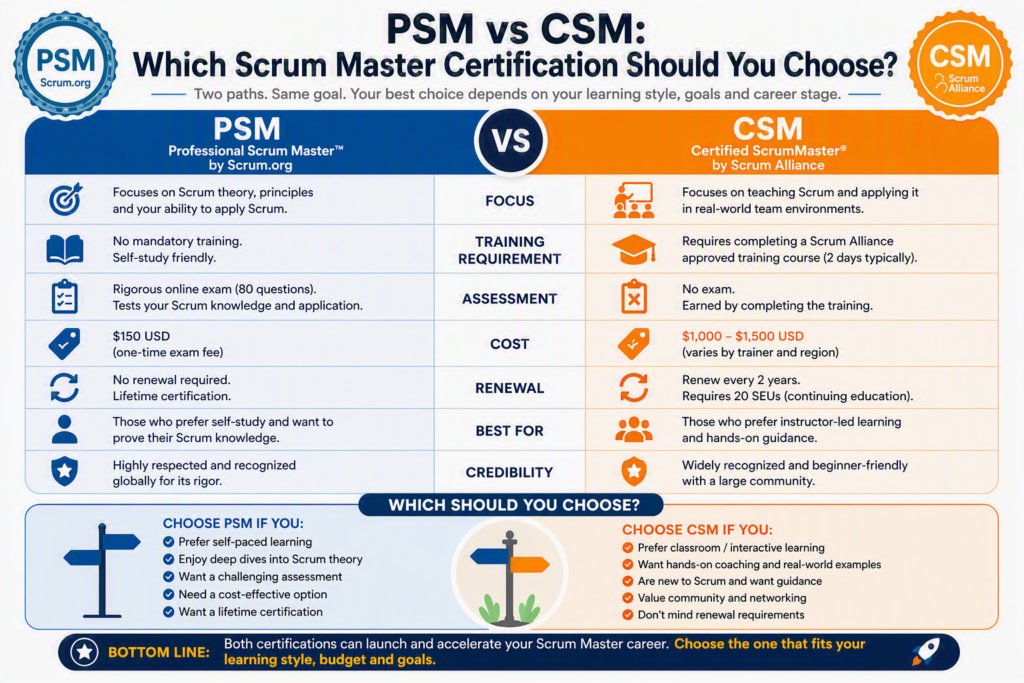
If you’re comparing PSM vs CSM to decide which Scrum Master certification to pursue, you’re facing one of the most common questions in agile career planning. Both are widely recognised in Australia, both open doors to Scrum Master and agile coaching roles, but they differ significantly in cost, format, and how they’re maintained.
This guide compares PSM vs CSM in plain terms governing body, cost, exam difficulty, and job demand across Australian cities so you can choose the certification that actually fits your career goals and budget.
What Are PSM and CSM?
PSM (Professional Scrum Master) is issued by Scrum.org, a certification body founded by Ken Schwaber, one of the original co-creators of Scrum. CSM (Certified ScrumMaster) is issued by Scrum Alliance, founded by the other Scrum co-creator, Jeff Sutherland. Both organisations teach the same core Scrum framework the real differences lie in how each certification is earned and maintained.
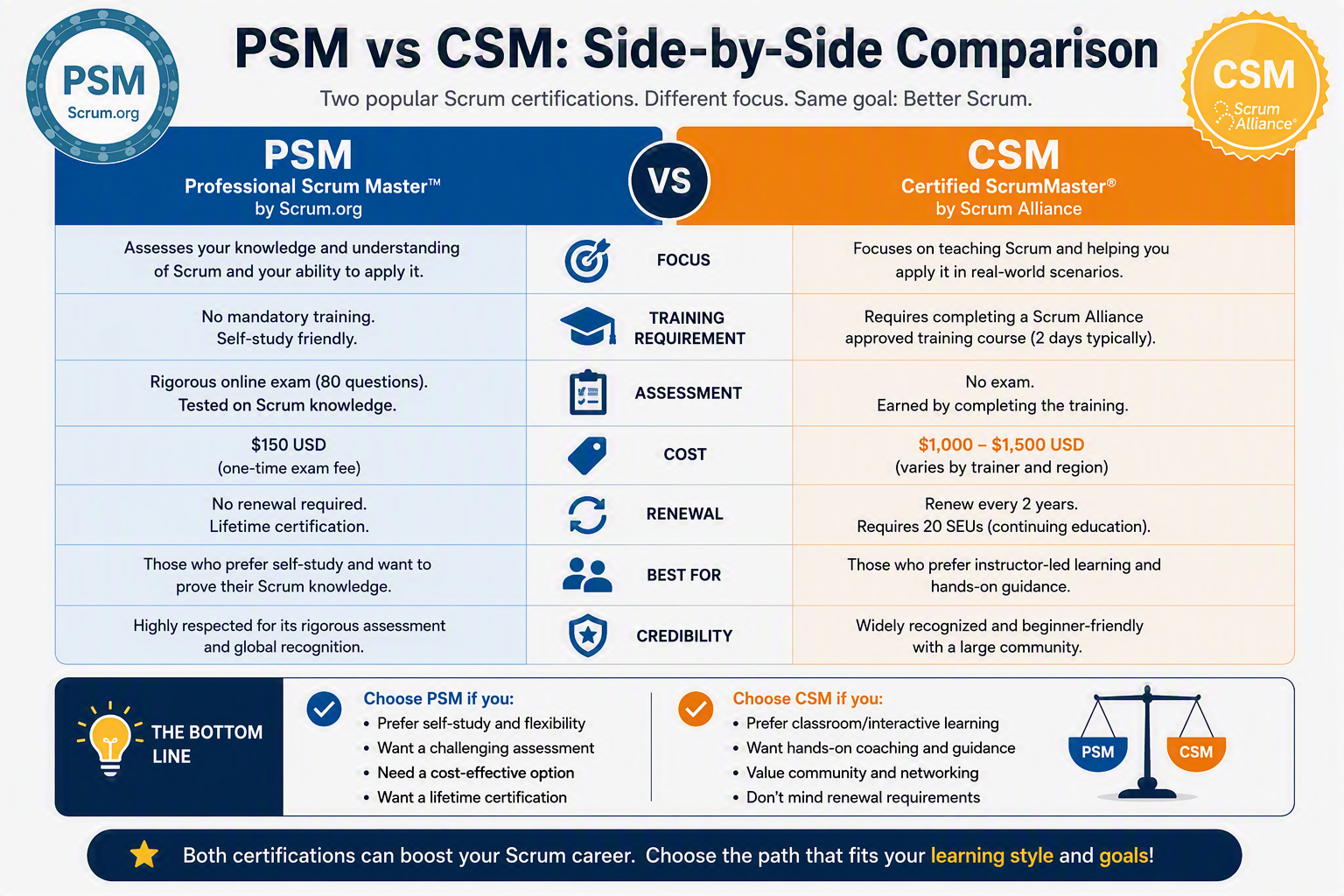
PSM vs CSM: Side-by-Side Comparison
Here’s how the two certifications compare directly:
| Factor | PSM I (Professional Scrum Master) | CSM (Certified ScrumMaster) |
| Issuing body | Scrum.org | Scrum Alliance |
| Training required | Not mandatory (self-study allowed) | Mandatory 2-day accredited course |
| Cost (AUD) | ≈ $200–250 exam only; $1,200–2,000 with training | ≈ $1,500–2,200 (training + certification included) |
| Exam format | 80 questions, 60 minutes, 85% pass mark | 50 questions, 60 minutes, 74% pass mark |
| Certification validity | Lifetime — no renewal required | 2 years — renewal fee required |
| Difficulty | Higher — harder pass mark, tricky scenario questions | Moderate — course attendance is the main hurdle |
| Australian recognition | Very high, especially in tech and product teams | Very high, especially in enterprise and government |
The clearest practical difference in the PSM vs CSM comparison is renewal: PSM I never expires once earned, while CSM requires renewal every two years with an associated fee, plus ongoing professional development units.
Which Is Harder: PSM or CSM?
PSM I is generally considered the more difficult exam — it has an 85% pass mark compared to CSM’s 74%, and its questions are known for testing nuanced scenario-based understanding rather than straightforward definitions. CSM’s main barrier is different: you must attend a mandatory two-day accredited course before you’re even eligible to sit the exam, which is comparatively short and less demanding once you’ve completed the training.
PSM vs CSM: Which Is Cheaper?
If budget is your main concern, PSM is significantly cheaper for self-directed learners you can sit the exam alone for around $200–250 AUD without any mandatory training. CSM requires you to pay for the accredited two-day course, which typically pushes total cost to $1,500–2,200 AUD including certification. That said, many employers cover CSM training costs directly, since the format is built around live, instructor-led sessions.
PSM vs CSM: Job Demand and Salary by Australian City
Employer preference between PSM and CSM varies slightly by region and industry. Here’s how demand and typical salaries compare across Sydney, Melbourne, Canberra, and Brisbane:
| City | Scrum Master Salary Range | More Common Certification |
| Sydney | $105,000 – $140,000 | PSM and CSM roughly even |
| Melbourne | $100,000 – $135,000 | CSM slightly more common |
| Canberra | $110,000 – $145,000 | CSM (government/enterprise preference) |
| Brisbane | $95,000 – $125,000 | PSM slightly more common (tech sector) |
| Perth | $95,000 – $128,000 | PSM and CSM roughly even |
In practice, most Australian job ads for Scrum Master roles list “PSM or CSM” interchangeably, meaning either certification will satisfy the requirement in the vast majority of applications.
So, Which Should You Choose PSM or CSM?
Choose PSM if:
- You prefer self-directed study over mandatory classroom training.
- You want a lower-cost path and are comfortable studying independently.
- You’d rather avoid ongoing renewal fees — PSM I doesn’t expire.
- You’re confident with harder, scenario-based exam questions.
Choose CSM if:
- You learn better in a structured, instructor-led environment.
- Your employer is willing to fund the training cost.
- You value the Scrum Alliance community and ongoing professional development network.
- You’re comfortable with periodic renewal in exchange for that structured support.
There’s genuinely no wrong answer in the PSM vs CSM decision both are respected across Australian industries, and many experienced Scrum Masters eventually hold both.
How to Prepare for PSM or CSM
- Study the current Scrum Guide thoroughly it’s the foundation for both exams.
- Use official practice assessments from Scrum.org before attempting PSM I.
- For CSM, choose an accredited trainer with strong reviews from Australian participants.
- Apply Scrum concepts to real or simulated projects, not just theory, to handle scenario-based questions.
If you’d like structured guidance choosing and preparing for either path, our Scrum Master certification course at scrummastercertification.au covers both PSM and CSM exam objectives with practice questions and mock scenarios.
Frequently Asked Questions
Is PSM or CSM more respected by employers in Australia?
Both are equally respected. Most job ads list either certification as acceptable, so the choice generally comes down to cost, learning style, and renewal preferences rather than employer bias.
Does PSM expire like CSM does?
No. PSM I is a lifetime certification with no renewal required, while CSM must be renewed every two years along with a renewal fee.
Can I get PSM without taking a course?
Yes. Unlike CSM, PSM does not require mandatory training — you can self-study using the Scrum Guide and official practice assessments before sitting the exam.
Which is cheaper, PSM or CSM?
PSM is significantly cheaper if you self-study, at roughly $200–250 AUD for the exam alone. CSM requires a mandatory paid course, typically bringing total cost to $1,500–2,200 AUD.
Can I hold both PSM and CSM at the same time?
Yes, and many experienced Scrum Masters do exactly that, particularly if they’ve worked across organisations with different certification preferences.
Final Thoughts
The PSM vs CSM decision ultimately comes down to how you prefer to learn and how much you’re willing to spend upfront. PSM suits confident self-directed learners looking for a lifetime credential at lower cost, while CSM suits those who want structured, instructor-led training and don’t mind periodic renewal.
Ready to start preparing? Explore our Scrum Master certification course at scrummastercertification.au and get exam-ready for either pathway.