
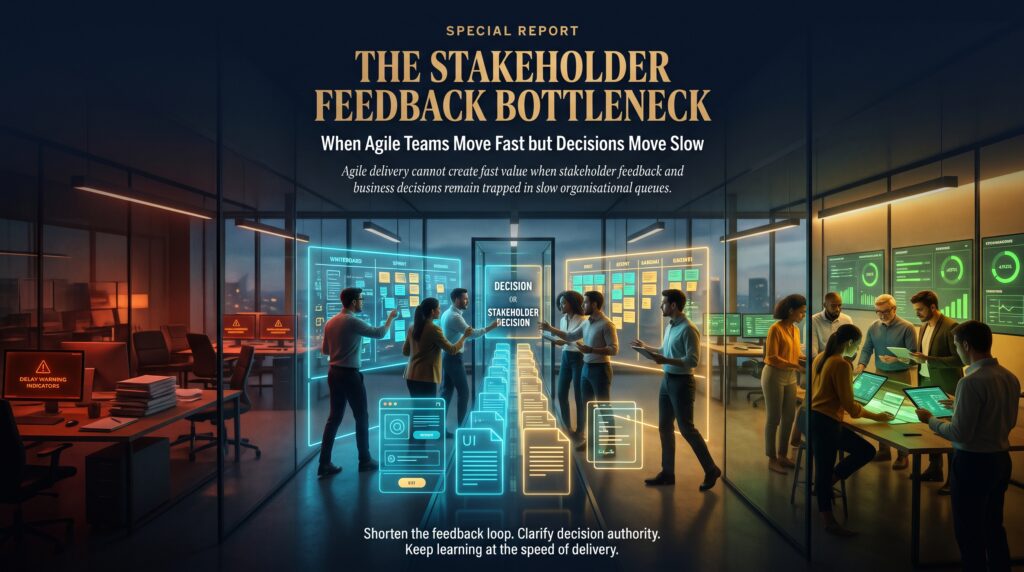
Stakeholder feedback is the input, review and approval that people outside the team give about the work the team is building, and when it arrives slowly, even the fastest Agile team grinds to a halt. The stakeholder feedback bottleneck is the gap between how quickly a team can deliver and how quickly the organisation can decide whether that work is right.
It is one of the most frustrating problems in Agile delivery. The team plans well, builds in short sprints and shows working software every two weeks. Yet the finished work sits for a month waiting for someone to say yes. Velocity charts look great. Real outcomes barely move. This guide explains why the bottleneck forms, what it costs and how Scrum Masters, Product Owners and leaders can clear it.
| Quick answer
Decisions move slowly in Agile teams when the right people are not in the room, decision rights are unclear, approvals pass through too many layers and feedback arrives in big, late batches. Fix it by empowering the Product Owner, agreeing who decides what, shortening feedback loops and making waiting time visible. |
What Is the Stakeholder Feedback Bottleneck?
The stakeholder feedback bottleneck is a delay in the flow of work caused by waiting for reviews, answers or approvals from people outside the delivery team. The team itself is not slow. The queue in front of the decision is.
A stakeholder can be a customer, a senior executive, a compliance officer, a legal adviser or a department head. Each has a legitimate interest in the product. The trouble starts when their input is collected late, from too many voices, or through a process that was designed for a slower way of working.
The Stakeholder Feedback Bottleneck: A Story Many Agile Teams Recognise
Picture an Adelaide health services team building a patient scheduling tool. They work in two-week sprints, hold tidy ceremonies and finish most of what they plan.
But every significant change needs approval from a steering committee that meets monthly. Delegates attend the sprint review, nod politely and say they must “take it back to their manager”. Finished features sit in a queue. Developers move on to new work, and by the time feedback arrives, they have forgotten the details. Some of it contradicts feedback from the previous month.
The team is busy and productive on paper. Yet patients and staff see little change for months. (This scenario is an illustration, not a real case.)
Why Stakeholder Feedback Gets Stuck: Common Causes
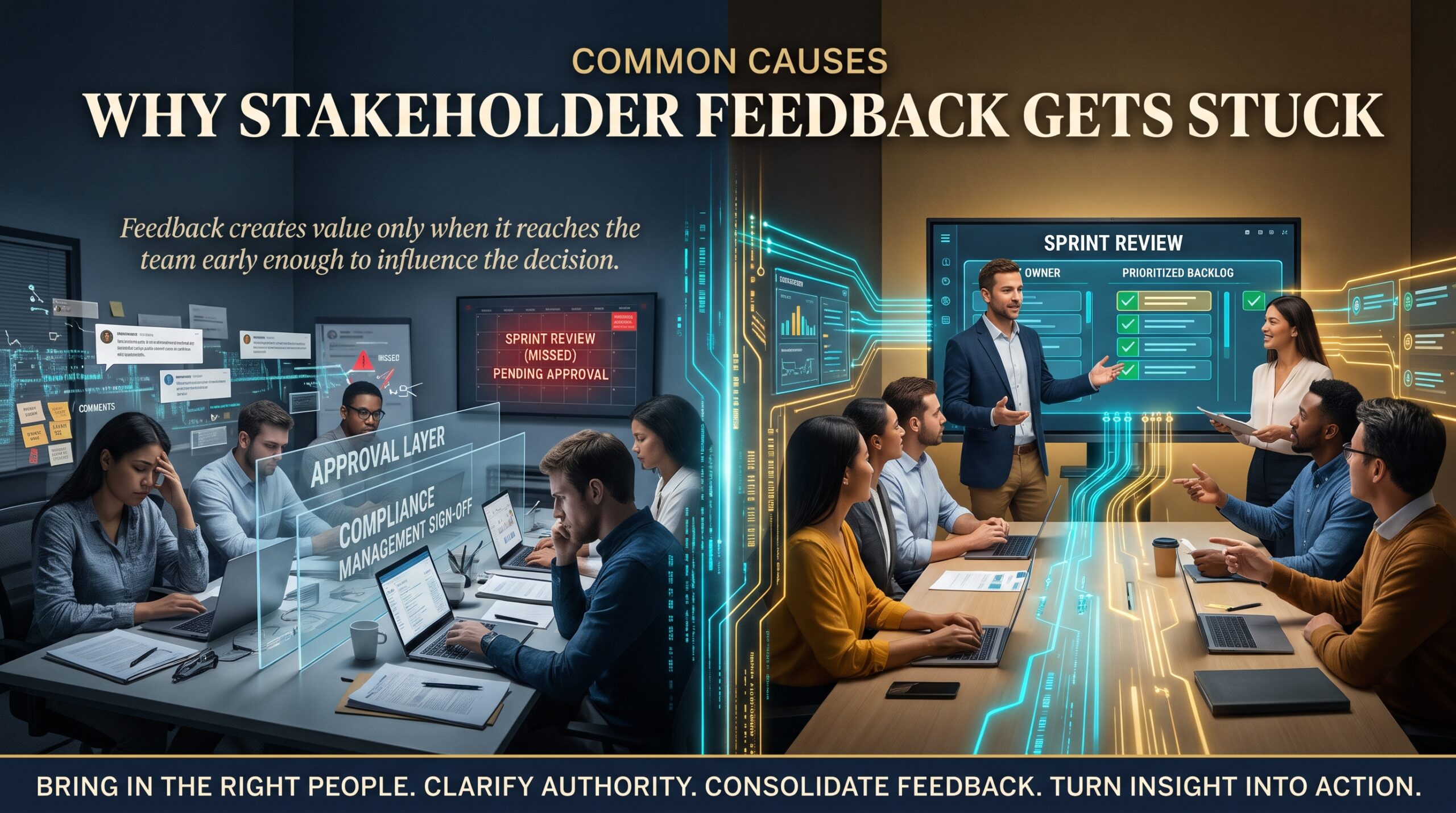
1. The wrong people attend the Sprint Review
The Scrum Guide describes the Sprint Review as a working session where the team and stakeholders inspect the outcome and adapt the plan. If attendees cannot make decisions, the session becomes a demo and real feedback is postponed. You can read the details in the official Scrum Guide.
2. The Product Owner lacks real authority
When the Product Owner must check every decision with someone else, the team inherits their delays. The Scrum Guide expects the organisation to respect the Product Owner’s decisions about the product backlog.
3. Too many approval layers
Governance built for long projects often wraps around Agile teams. Each added sign-off adds waiting time, even when each approver responds quickly.
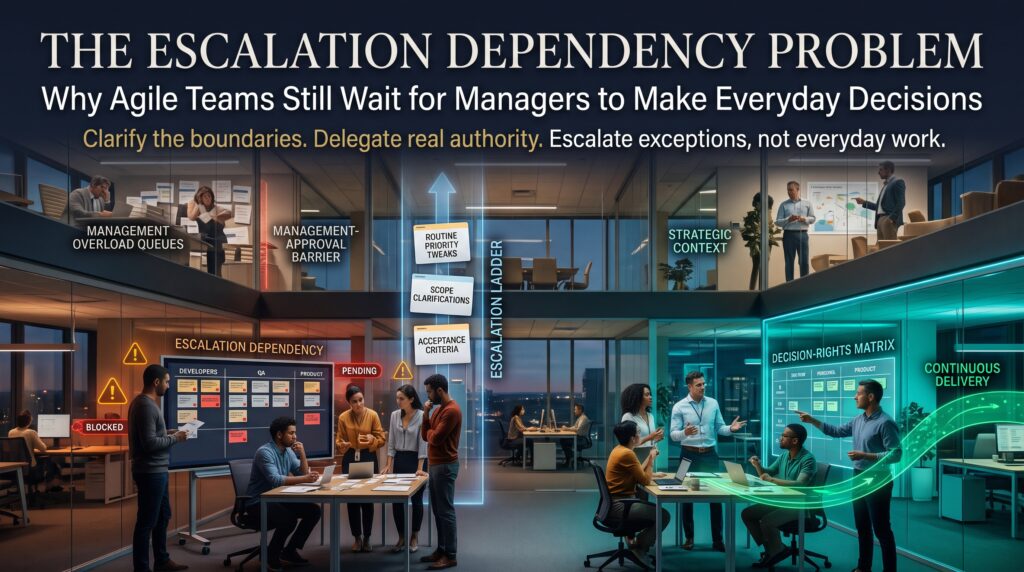
4. Decision rights are unclear
If nobody knows who can say yes, everyone asks everyone. Questions bounce between people, and decisions drift.
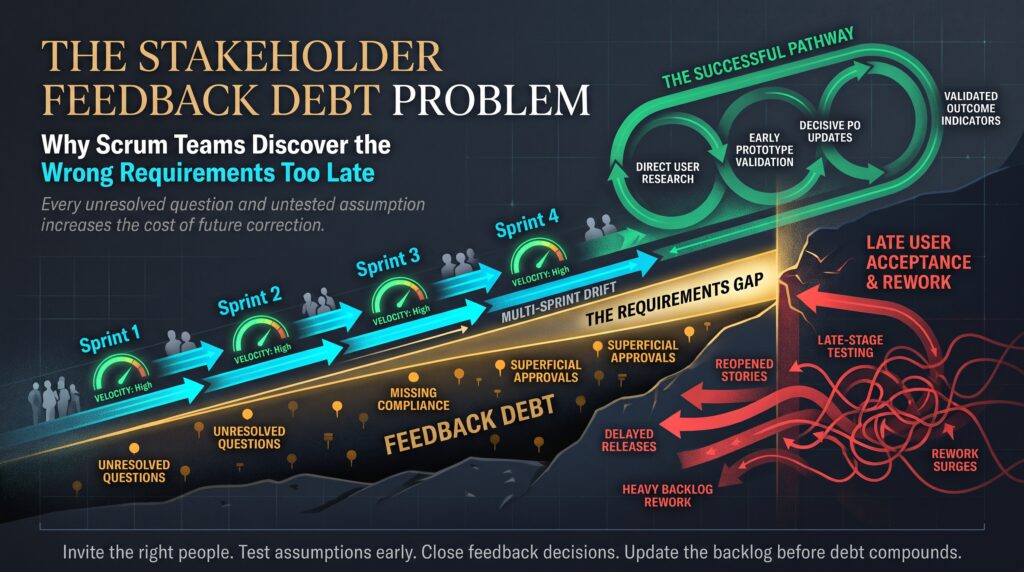
5. Stakeholder feedback arrives in large, late batches
Saving stakeholder feedback for a big milestone means a mountain of changes at once. Smaller, more frequent reviews are easier to digest and cheaper to act on.
6. Specialist reviews happen at the end
Security, privacy, legal and accessibility reviews often appear after the work is finished. Late discoveries lead to rework and long delays.
7. Stakeholder feedback is vague, conflicting or opinion-based
Comments such as “make it pop” or conflicting requests from different departments leave the team guessing. Without a single route for feedback, resolving contradictions takes days.
8. Stakeholders are simply unavailable
Busy leaders have crowded calendars. Without agreed windows for stakeholder feedback, requests wait in inboxes.
9. Nobody measures the wait
Teams track how long they spend building, but rarely how long work waits for a decision. What is not measured stays invisible.
Cheat Sheet: Symptoms, Causes and Fixes for Slow Stakeholder Feedback
| What you notice | Likely cause | Quick fix |
| Work is done but not released for weeks | Approval queue outside the team | Make waiting visible and set a response time |
| Sprint Review feels like a presentation | Wrong attendees, no decision authority | Invite decision-makers and run it as a working session |
| Product Owner keeps saying “I’ll check” | Limited delegated authority | Agree clear decision limits for the Product Owner |
| Feedback contradicts earlier feedback | Many voices, no single route | Route feedback through the Product Owner |
| Big rework after compliance review | Specialist review comes last | Involve reviewers in refinement and add checks to the Definition of Done |
| Team is busy but outcomes lag | Work piles up waiting for decisions | Limit work in progress and unblock the queue first |
What the Stakeholder Feedback Bottleneck Costs
The first cost is time. According to Little’s law, the more work sitting in a system at once, the longer each item takes to flow through it. Work waiting for approval is work in progress, and it stretches lead time for everything else.
There is also waste. Features go stale, context fades and requirements change while they wait. Teams lose motivation when finished work never reaches users. Leaders lose trust in Agile when results do not match the promise. Finally, the organisation misses windows of opportunity. The Agile Manifesto’s principle of delivering working software frequently is hard to honour when approvals take longer than building. See the Agile Manifesto principles.
How to Diagnose a Stakeholder Feedback Bottleneck: A Seven-Step Routine
You can start this sprint with a whiteboard and an honest conversation.
- Trace one finished item. Follow a single story from “done” to “in the hands of users” and note every wait along the way.
- Measure the waits. Record how many days the item spent waiting for feedback, approval or a decision.
- List the decisions and the deciders. Write down each decision the team needs and who can actually make it.
- Check who attends Sprint Reviews. Ask whether attendees can approve, reject or redirect the work on the spot.
- Test Product Owner authority. Identify which decisions the Product Owner can make alone and which need escalation.
- Find the late reviews. Look for compliance, security, legal or brand checks that arrive after the work is built.
- Agree a feedback standard. Set a target response time, a single route for feedback and a rule for what happens when nobody responds.
How to Speed Up Stakeholder Feedback in Agile Teams
- Empower the Product Owner. Give them clear authority, defined limits and organisational backing.
- Document decision rights. A simple chart of who decides, who advises and who is informed removes much of the confusion.
- Run the Sprint Review as a working session. Invite people who can decide, show working software and collect decisions in the room.
- Offer regular feedback windows. Short weekly office hours or fixed review slots give busy stakeholders a predictable way to engage.
- Release smaller increments. Smaller changes are quicker to review and easier to approve.
- Involve specialists early. Bring security, legal and compliance into backlog refinement and add their checks to the Definition of Done.
- Use time-boxed asynchronous review. For low-risk items, share a short demo or prototype and agree that no response by a set date means go ahead.
- Make waiting visible. Add a “waiting for feedback” column to the board and limit work in progress.
- Keep a decision log. Record what was decided, by whom and why, so decisions are not reopened.
The Scrum.org community and Mike Cohn’s Mountain Goat Software publish practical articles on stakeholder engagement and product ownership if you want to explore further.
The Scrum Master’s Role in Unblocking Decisions
The Scrum Master is more than a meeting facilitator. They coach the team and the wider organisation, and they help remove impediments that slow delivery. Decision bottlenecks are impediments.
A strong Scrum Master makes the delay visible with data, coaches stakeholders to give clearer stakeholder feedback, helps the Product Owner build authority and works with leaders to simplify approval paths. They do not take over decisions. They help the right people make them sooner.
Stakeholder Feedback Metrics Worth Tracking
- Feedback turnaround time from request to response.
- Decision latency, meaning the days between “ready for decision” and “decided”.
- Lead time from done to released.
- Decision-maker attendance at Sprint Reviews.
- Rework caused by late feedback, as a share of total effort.
Scrum Courses That Build Stakeholder and Facilitation Skills
Improving stakeholder feedback needs Scrum knowledge, facilitation skill and the confidence to influence senior people. These programs at Scrum Master Certification are a good fit.
- Agile Scrum Foundation (BCS/EXIN) introduces the Scrum framework, roles and events, and is a strong starting point.
- Agile Scrum Practitioner (BCS/EXIN) builds on the foundation to apply Scrum in realistic scenarios.
- iSQI Scrum Master Pro Certification suits Scrum Masters who want a professional-level credential.
See every option on the courses page, find answers in the FAQs, learn more about us or read the Scrum Master Certification blog.
Scrum Master Certification Training Across Australian Cities
Agile teams in every city struggle with slow decisions, and demand for skilled Scrum Masters is strong across the country.
- Melbourne: finance, health, government and technology teams. See Scrum Master certification in Melbourne.
- Sydney: banking, insurance and technology delivery teams. See Scrum Master certification in Sydney.
- Brisbane: growing technology, infrastructure and public sector teams. See Scrum Master certification in Brisbane.
- Perth: resources, energy and engineering organisations. See Scrum Master certification in Perth.
- Adelaide: defence, health and education programs. See Scrum Master certification in Adelaide.
- Canberra: government agencies with layered governance. See Scrum Master certification in Canberra.
Training is offered live online across Australia, with in-house options for teams. View all locations or contact the team to arrange training for your delivery group.
Frequently Asked Questions About Stakeholder Feedback in Agile
What is stakeholder feedback in Agile?
Stakeholder feedback is the input and review that customers, sponsors and other interested parties provide about the product, usually gathered at events such as the Sprint Review and through regular conversations.
Why do decisions move slowly in Agile teams?
Common reasons include unclear decision rights, a Product Owner without authority, multiple approval layers, unavailable stakeholders and late specialist reviews. The team may be fast, but the organisation around it is not.
Who is responsible for getting stakeholder feedback in Scrum?
The whole Scrum Team shares responsibility, with the Product Owner leading engagement with stakeholders and the Scrum Master helping the organisation understand and support the process.
How do you speed up stakeholder approvals?
Clarify who decides, empower the Product Owner, involve specialists early, release smaller increments, agree response times and make waiting visible on the board.
What is the Sprint Review?
The Sprint Review is a Scrum event where the team and stakeholders inspect the outcome of the sprint and discuss what to do next. It is meant to be a working session, not a one-way presentation.
How often should you collect stakeholder feedback?
Often enough that no piece of work waits long for a response. Many teams gather feedback at every Sprint Review and add shorter check-ins during the sprint for important decisions.
Which Scrum course should I take first?
Most people begin with the Agile Scrum Foundation course, then move to the Agile Scrum Practitioner level or the iSQI Scrum Master Pro certification.
Final Thoughts: Make Decisions as Agile as Delivery
The stakeholder feedback bottleneck is a reminder that agility is an organisational trait, not just a team practice. A team that delivers every two weeks cannot create value if the organisation takes two months to respond.
Make waiting visible, clarify who decides, bring decision-makers into the room and shorten every loop you can. When decisions move as fast as delivery, Agile finally delivers on its promise. If you want structured, practical Scrum training, speak with an advisor at Scrum Master Certification on 1300 649 299, or explore the full course list to find your starting point.