
If you’re weighing up Agile Scrum Foundation Certification in Australia, you’re probably trying to work out three things: what it actually costs, whether it’ll bump your salary, and whether it’s still worth doing in 2026 when so many job ads simply say “Agile experience required” without naming a specific credential. Short answer: for project coordinators, team members, and anyone moving into Scrum team roles for the first time, yes it’s a well-recognised, affordable way to formalise Agile knowledge employers actually look for. Here’s the full breakdown.
What Is Agile Scrum Foundation (BCS/EXIN) Certification, Exactly?
The BCS EXIN Foundation Certificate in Agile Scrum is an entry-level qualification jointly recognised by BCS, The Chartered Institute for IT and EXIN. It’s designed to build a broad understanding of the Agile mindset and the Scrum framework covering Scrum roles, events, artefacts, planning and estimation, and how teams monitor progress across a sprint.
Unlike some Scrum credentials that are tied to a single training provider’s proprietary framework, this one sits under a recognised professional body, which is part of why it’s often listed as a preferred or required qualification in Australian job ads for delivery and coordination roles. The exam is closed-book: 40 multiple-choice questions in 60 minutes, with a 65% pass mark, and there are no formal prerequisites. You can review the full syllabus and enrol through our Agile Scrum Foundation (BCS/EXIN) course page.
Agile Scrum Foundation Certification Cost in Australia (2026)
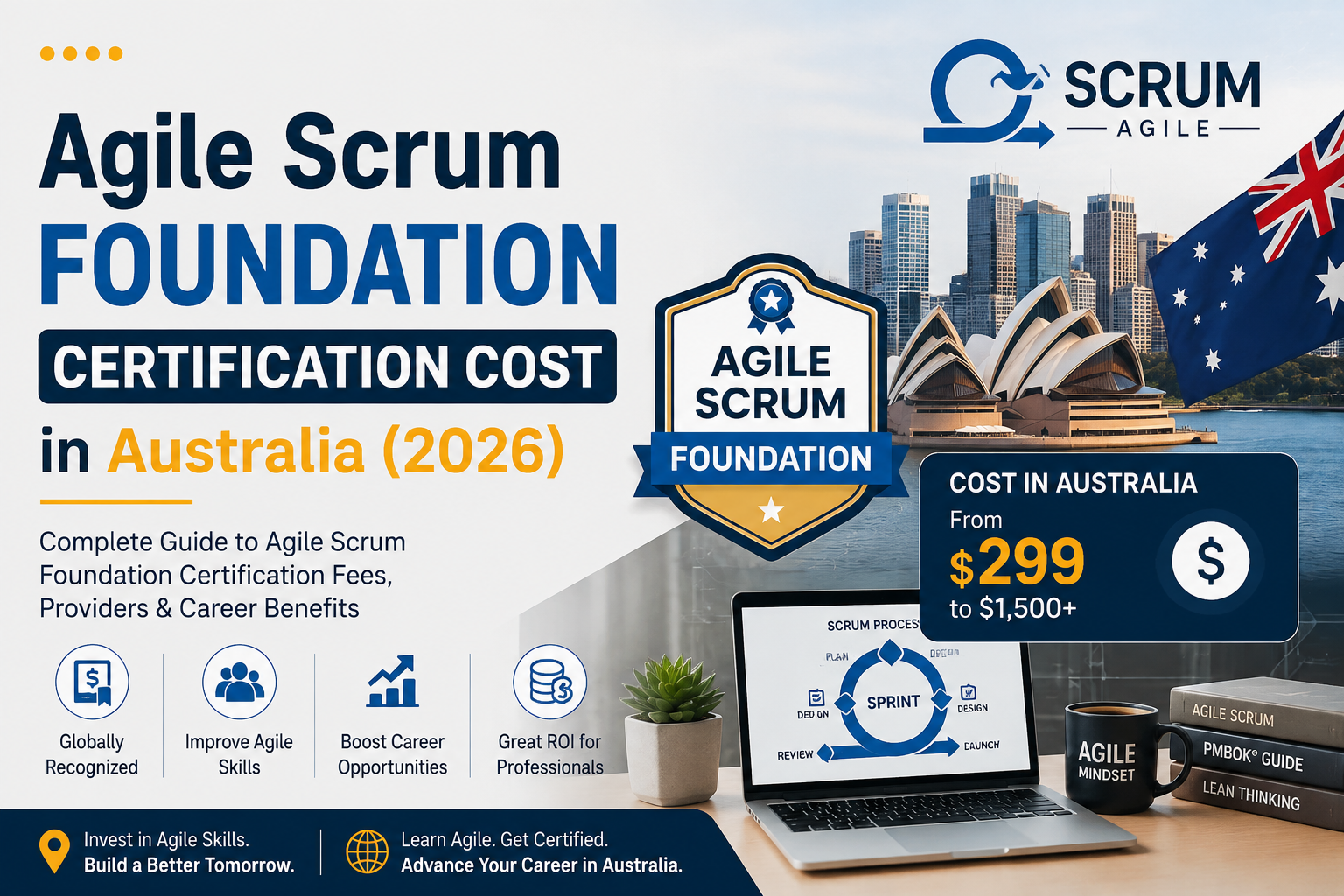
Pricing for Agile Scrum Foundation Certification in Australia varies depending on delivery format and what’s bundled into the course fee:
- Self-paced online: roughly $900–$1,400 AUD, exam included
- Instructor-led virtual classroom: roughly $1,600–$2,200 AUD
- Face-to-face classroom training: typically around $2,000–$2,700 AUD, reflecting the two-to-three day format most Australian providers run, including course materials and the exam voucher
Always confirm the exam fee and study materials are included before booking, since some listings only cover tuition and charge the exam separately. You can compare formats and get current pricing through our Courses page, or contact our team for upcoming intake dates across Australia.
Is Agile Scrum Foundation Certification Worth It? The Honest Answer
This certification pays off most clearly in three situations:
- You’re moving into a Scrum team, project coordination, or delivery support role for the first time. It gives you a shared vocabulary for sprint planning, backlog management, and daily stand-ups, and demonstrates to hiring managers that you understand how Agile teams actually operate day-to-day.
- Your organisation runs Agile or hybrid delivery. Technology, finance, healthcare, and government employers across Australia increasingly list Agile and Scrum knowledge as a baseline requirement, even for roles that aren’t formally titled “Scrum Master.”
- You plan to progress toward the Scrum Master role itself. Foundation-level knowledge sets you up for the Agile Scrum Practitioner (BCS/EXIN) certification, which goes deeper into facilitation, coaching, and applied Scrum leadership the level employers weight most heavily for dedicated Scrum Master hires.
Where it’s less valuable: if you’re already an experienced Scrum Master with years of applied delivery experience, Foundation-level content will likely feel introductory, and a Practitioner-level or iSQI Scrum Master Pro Certification is a better fit for demonstrating advanced capability.
Agile Scrum Foundation Salary in Australia: What to Realistically Expect
Salary expectations need calibrating here, as with most Foundation-level certifications. On its own, Agile Scrum Foundation rarely produces an instant pay jump it’s one signal among experience, industry, and seniority. That said, here’s what the broader Scrum and Agile delivery salary landscape in Australia looks like in 2026:
- Junior Scrum Team Member / Project Coordinator: roughly $70,000–$95,000
- Scrum Master (national average): roughly $160,000–$170,000, according to SEEK’s Scrum Master salary data, though other sources put the typical range closer to $120,000–$155,000 depending on industry and seniority
- Senior Scrum Master / Agile Delivery Lead: roughly $150,000–$190,000+
- Agile Coach / Program-level roles: often $180,000–$220,000+
Agile Scrum Foundation is most useful for getting your first foot into an Agile team environment, or for signalling structured Scrum knowledge when you’re competing against candidates without any formal training. The larger salary jumps come from combining Foundation knowledge with hands-on Scrum team experience and progressing to Practitioner-level or Scrum Master Pro certification.
Agile Scrum Foundation vs Practitioner: Which One Should You Do First?
Foundation isn’t a formal prerequisite for Practitioner, but it’s strongly recommended, since Practitioner builds directly on Foundation-level concepts:
| Agile Scrum Foundation | Agile Scrum Practitioner | |
| Focus | Broad understanding of Agile and Scrum fundamentals | Applied facilitation, coaching, and Scrum Master leadership skills |
| Exam format | 40 questions, closed-book, 1 hour | Case-study-based, applied assessment |
| Best for | First-time team members, coordinators, analysts | Practising or aspiring Scrum Masters |
| Employer weight | Useful entry-level credential | More heavily weighted for dedicated Scrum Master roles |
If your budget allows it, progressing straight from Foundation to Practitioner is usually the smarter long-term path, particularly if your goal is a Scrum Master title rather than just general Agile literacy. Compare both course structures on our Courses page.
Career Paths After Agile Scrum Foundation Certification
Agile Scrum Foundation Certification in Australia typically opens doors into:
- Scrum Team Member or Project Coordinator roles
- Junior Business Analyst positions within Agile delivery teams
- Delivery Support or Agile Support Officer roles
- A stepping stone toward Scrum Master positions via Agile Scrum Practitioner or the iSQI Scrum Master Pro Certification
- Broader Agile project management and product ownership tracks as your experience grows
Where to Study Agile Scrum Foundation Across Australia
Training is available both online and in person in every major city, so location doesn’t need to be a barrier:
- Agile Scrum training in Sydney
- Agile Scrum training in Melbourne
- Agile Scrum training in Brisbane
- Agile Scrum training in Perth
- Agile Scrum training in Adelaide
- Agile Scrum training in Canberra
Live virtual delivery is also available for professionals in Hobart, Darwin, Gold Coast, Newcastle, and regional areas see the full Locations page for current formats and dates.
How to Get Agile Scrum Foundation Certified: 4 Simple Steps
- 1. Choose your delivery format self-paced, live virtual, or in-person based on your budget and schedule.
- 2. Enrol in an accredited course through our Agile Scrum Foundation (BCS/EXIN) course, which includes the exam voucher.
- 3. Study the syllabus and practice questions. Most candidates need around 15–20 hours of preparation on top of course time.
- 4. Sit the 60-minute, 40-question exam. Results are typically available shortly after you finish.
Frequently Asked Questions
Is Agile Scrum Foundation Certification worth it in Australia in 2026?
Yes, for most people it is particularly if you’re moving into a Scrum team, project coordination, or Agile delivery support role for the first time. It’s a recognised, low-cost credential that gives hiring managers confidence you understand how Agile teams actually run day-to-day, and it’s often listed as a preferred or required qualification in Australian job ads for delivery roles. It’s less critical for experienced Scrum Masters who already hold Practitioner-level qualifications, since the content will feel introductory at that point.
How much does Agile Scrum Foundation Certification cost in Australia?
Expect to pay roughly $900–$2,700 AUD depending on the delivery format. Self-paced online courses sit at the lower end (around $900–$1,400), instructor-led virtual classrooms run $1,600–$2,200, and face-to-face classroom training typically delivered over two to three days is usually $2,000–$2,700, including course materials and the exam voucher. Always confirm the exam fee is bundled in before you book, since some cheaper listings charge it separately.
Does Agile Scrum Foundation guarantee a salary increase?
Not on its own. Employers weigh it alongside your experience, industry, and the rest of your skill set rather than paying a fixed premium for the certificate itself. It strengthens your application and demonstrates structured Agile knowledge, which matters most when you’re competing against candidates without any formal training. The bigger salary jumps tend to come from combining Foundation knowledge with hands-on Scrum team experience and progressing to Practitioner-level or Scrum Master Pro certification.
How long does it take to get Agile Scrum Foundation certified?
Most candidates complete their course and exam within 1–2 weeks. The training itself typically runs two to three days (or a self-paced equivalent), and most people spend a further 15–20 hours reviewing the syllabus and practice questions before sitting the 60-minute exam. You’ll usually get your result and access to your digital certificate within minutes of finishing.
Do I need prior Agile experience before enrolling?
No. There are no formal prerequisites for Agile Scrum Foundation, which is exactly why it’s such a popular entry point for career changers, recent graduates, and professionals moving into Agile roles from other disciplines like project support, business analysis, or software testing. The course is designed to build your Agile knowledge from the ground up.
What is the difference between Agile Scrum Foundation and Scrum Master certification?
Agile Scrum Foundation gives you a broad understanding of Agile principles and the Scrum framework roles, events, artefacts, and how a sprint runs from planning to review. A dedicated Scrum Master certification, such as the Agile Scrum Practitioner (BCS/EXIN) or iSQI Scrum Master Pro Certification, goes further into facilitation, coaching, conflict resolution, and applied Scrum leadership. Foundation is the knowledge base; Practitioner-level credentials are what employers weight most heavily when hiring specifically for a Scrum Master title.
Is Agile Scrum Foundation recognised by employers in Australia?
Yes. Because it sits under BCS, The Chartered Institute for IT, and EXIN both established professional bodies rather than a single training vendor’s proprietary scheme it’s widely recognised across technology, finance, healthcare, government, and professional services employers in Australia. It’s commonly listed as a preferred or required qualification in job ads for project coordination, business analysis, and junior Agile delivery roles.
Can I do Agile Scrum Foundation online, or do I need to attend in person?
Both options are available. You can complete the course entirely online through self-paced study or a live virtual classroom, or attend in-person training at a physical location in cities including Sydney, Melbourne, Brisbane, Perth, Adelaide, and Canberra. Live virtual delivery also covers Hobart, Darwin, and regional areas, so the format comes down to how you prefer to learn rather than where you’re based.
What happens if I fail the Agile Scrum Foundation exam?
Most training providers offer a resit option if you don’t pass the first time, though policies and any resit fees vary by provider, so it’s worth checking this before you enrol. In practice, failure is uncommon for candidates who complete the course and put in the recommended 15–20 hours of study, since the exam draws directly from the syllabus covered in training. If you’re unsure how a specific course structures resits, our team can walk you through it when you get in touch.
Which industries in Australia value Agile Scrum Foundation certification most?
Technology and software development remain the biggest employers of Agile-certified professionals, but demand has broadened significantly. Financial services, government departments, healthcare, telecommunications, and professional services firms across Australia now run Agile or hybrid delivery models for major projects, and increasingly list Agile and Scrum knowledge as a baseline expectation not just for Scrum Masters, but for business analysts, project coordinators, and product-adjacent roles as well.
Ready to Get Started?
If you’re ready to move forward, explore the full Agile Scrum Foundation (BCS/EXIN) course details, browse all courses, check our FAQs, or get in touch with our team on 1300 649 299 for current pricing and upcoming Australian intake dates.