
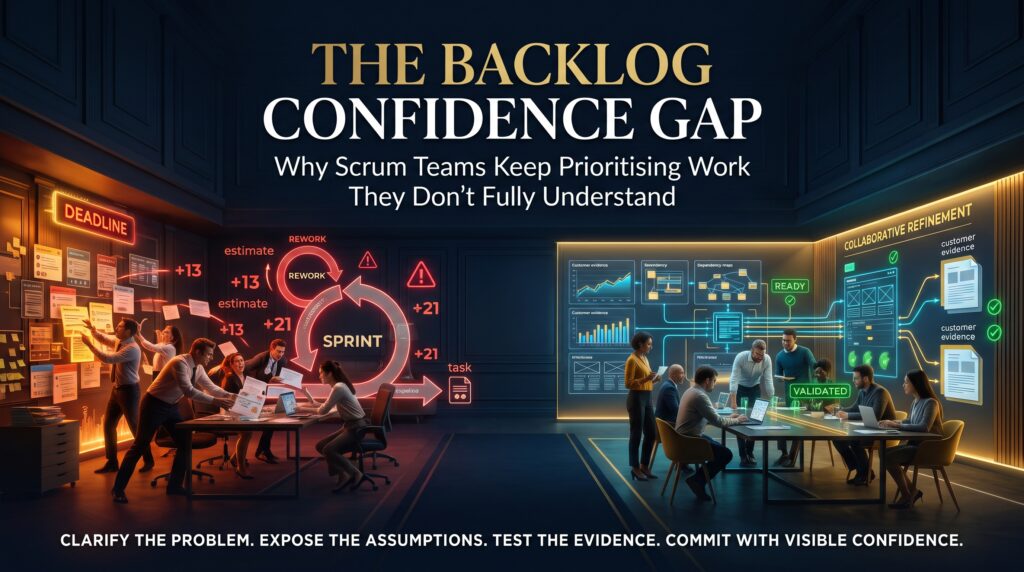
The backlog confidence gap is what happens when a Scrum team ranks, schedules and commits to work it does not truly understand. The items are in the backlog, they have a priority number and they look ready. But ask the team what a story really means, how big it is or what could go wrong, and the answers get vague. Confidence in the order of the backlog is far higher than confidence in the content of it.
This guide explains why the backlog confidence gap appears, how to spot it, and what Product Owners, Scrum Masters and developers can do to close it. If your sprints are full of surprises, unfinished stories and mid-sprint questions, it is probably the cause.
What Is the Backlog Confidence Gap?
In Scrum), the Product Backlog is an ordered list of everything the product might need. Ordering it well is a core part of the Product Owner’s job. The backlog confidence gap appears when the order looks confident but the understanding behind it is thin.
A team may rank an item near the top because a stakeholder asked for it loudly, because it sounds valuable or because it was on last quarter’s plan. Nobody has checked whether the value is real, the scope is clear or the technical approach is known. The priority is firm. The knowledge is not.
Why the Backlog Confidence Gap Happens
Teams are not careless. The gap grows from ordinary pressure and habit:
- Refinement is rushed or skipped. When sprints are busy, refinement is the first meeting to be shortened, so items arrive at planning half-understood.
- Stakeholder pressure. Senior voices push their requests up the list, and the team assumes someone else has examined them.
- Value is assumed, not tested. Items are prioritised on opinion because nobody has time to gather evidence.
- Estimates feel precise but are not. Story points create the impression of certainty even when the team has only a guess.
- Hidden dependencies and risks. Technical or business unknowns only appear once work starts.
- The backlog is too large. A backlog of hundreds of items cannot be understood in depth, so most of it is ranked on instinct.
- Nobody feels safe saying “I don’t understand”. Developers nod along in planning to avoid slowing the group.
Signs of a Backlog Confidence Gap
- Stories are pulled into a sprint, then questions start on day two.
- Carry-over work is common, and the same items roll from sprint to sprint.
- Estimates change dramatically once developers begin the work.
- Different people give different answers to “what does done look like for this item?”
- Stakeholders are surprised by what is delivered, even though they approved the story.
- The top of the backlog changes often, because new information keeps overturning the order.
The Real Cost of the Backlog Confidence Gap
- Unfinished sprints. Teams commit to more than they can deliver because the work is bigger than it looked.
- Building the wrong thing, or the right thing in the wrong way, burns capacity.
- Lost trust. Missed sprint goals damage the team’s credibility with stakeholders.
- Low morale. Developers become frustrated when they are asked to commit to the unclear.
- Wasted value. High-priority slots go to work that turns out to matter less than assumed.
In short, the backlog confidence gap makes a plan look reliable while hiding how uncertain it really is.
How to Close the Backlog Confidence Gap
You do not need to change frameworks. Strong Scrum practice already offers most of the tools. The Scrum Guide describes backlog refinement as ongoing work of adding detail, estimates and order to items, and these steps put that into practice.

- Protect refinement time. Treat it as essential, not optional. Many teams set aside regular, short sessions every sprint.
- Check value before ranking. Ask what outcome the item should achieve, how you will know, and what evidence supports it.
- Write clear stories. Use a simple user story format with acceptance criteria that testers, developers and stakeholders read the same way.
- Bring the right people together. Have the Product Owner, a developer and a tester discuss each item before it is ready, so three viewpoints shape it.
- Add a confidence check. Ask the team to vote on how well they understand each item, for example with a quick one-to-five scale. Anything low goes back for more discussion.
- Use spikes for unknowns. When the team does not know how to approach something, plan a short, time-boxed investigation before committing to the full story.
- Slice work small. Smaller stories are easier to understand, estimate and finish.
- Estimate as a team. Techniques such as planning poker reveal disagreement early, which is exactly the information you need.
- Include confidence in prioritisation. Models such as RICE score reach, impact, confidence and effort, so a weakly understood item does not automatically win.
- Use a team agreement for readiness. Many teams use a Definition of Ready. It is not an official Scrum artefact, but it can help by agreeing what “understood enough to start” means.
- Make it safe to say “we do not know”. The Scrum Master can model this and protect those who raise doubts.
A Simple Backlog Confidence Check
Before moving an item into sprint planning, run it through a quick table like this. Any “No” is a signal to refine further:
| Backlog item | Value clear? | Scope clear? | Risks known? | Action |
| Customer login with SSO | Yes | Yes | No | Run a spike |
| Improve search results | No | No | No | Refine with stakeholders |
| Export report to PDF | Yes | Yes | Yes | Ready for planning |
| Redesign dashboard | Yes | No | Partly | Split into smaller stories |
Even a basic check like this makes the backlog confidence gap visible, which is the first step to closing it.
Mistakes That Widen the Backlog Confidence Gap
- Letting the loudest stakeholder set the order of the backlog.
- Treating story points as proof of understanding.
- Keeping a huge backlog that nobody can review properly.
- Refining only the items due in the next sprint, with no look-ahead.
- Using the Scrum Master as a meeting scheduler instead of a coach for better practice.
- Punishing teams for raising uncertainty.
Scrum Skills That Help You Close the Gap
Strong facilitation, clear thinking about value and a solid grounding in Scrum practice make the difference. Our certification courses build those skills:
- Agile Scrum Foundation (BCS/EXIN) covers Scrum roles, events, artefacts and backlog basics.
- Agile Scrum Practitioner (BCS/EXIN) builds the skills to apply Scrum in real situations.
- iSQI Scrum Master Pro Certification develops advanced facilitation and coaching for Scrum Masters.
Compare every option on our Scrum Master certification courses page, read the FAQs, learn about us or browse more articles on the Scrum blog.
Learn Scrum in Your City
Whether you want to fix the backlog confidence gap in your own team or start a Scrum Master career, training is available in person and live online:
- Scrum Master certification in Melbourne
- Scrum Master certification in Sydney
- Scrum Master certification in Brisbane
- Scrum Master certification in Perth
- Scrum Master certification in Adelaide
- Scrum Master certification in Canberra
See all locations or contact us for advice on the right course and dates.
Frequently Asked Questions About the Backlog Confidence Gap
What is the backlog confidence gap?
It is the difference between how confident a Scrum team is in the order of its backlog and how well it actually understands the items in it.
Why do Scrum teams prioritise work they do not understand?
Common reasons include stakeholder pressure, rushed refinement, assumed value, imprecise estimates and a culture where it feels unsafe to admit uncertainty.
How often should a team refine the backlog?
Refinement is ongoing in Scrum. Many teams hold short sessions every sprint so the items near the top are well understood before sprint planning.
What is a spike in Scrum?
A spike is a short, time-boxed investigation used to reduce uncertainty, such as testing a technical approach, before committing to a full story.
Which course helps with backlog management?
Agile Scrum Foundation covers backlog basics and Scrum events, while Agile Scrum Practitioner and iSQI Scrum Master Pro build applied facilitation and coaching skills.
Final Thoughts
The backlog confidence gap is not a sign of a weak team. It is what happens when ordering outpaces understanding. When teams protect refinement, check value, expose unknowns early and feel safe saying “we do not know yet”, their priorities start to rest on real knowledge, and their sprints become far more predictable.
Ready to lead better backlogs and calmer sprints? Explore our Scrum Master certification courses and build the skills to guide high-performing Scrum teams.