
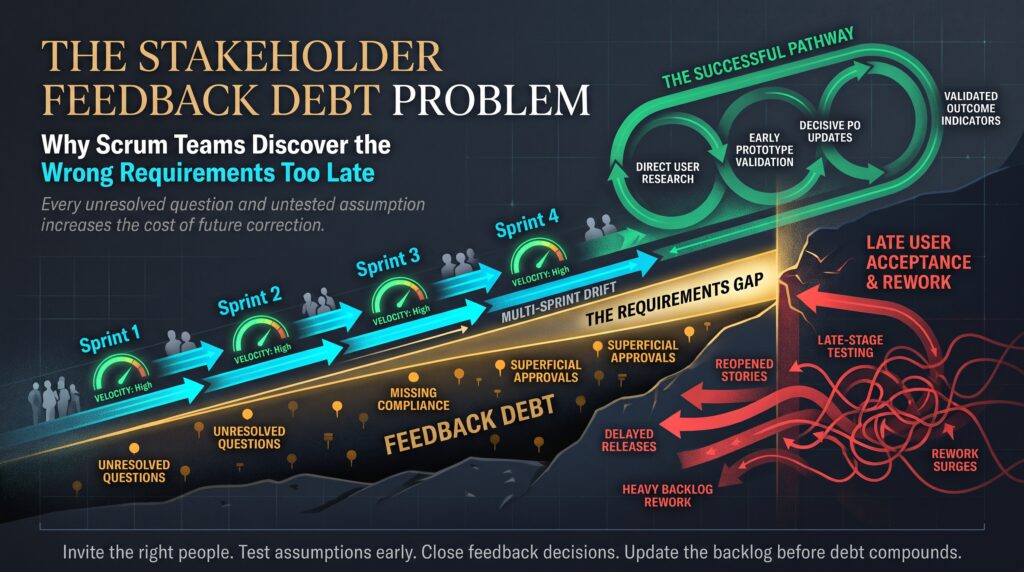
Stakeholder feedback debt is what builds up when a Scrum team keeps building from requirements that nobody has checked with the people who will use the result. Every unvalidated story is a small loan against the future. The interest is paid later, usually at the Sprint Review or after release, when a stakeholder looks at finished work and says, “That is not quite what we meant.”
If you work in Agile delivery in Sydney, Melbourne, Brisbane, Perth, Adelaide or Canberra, you have probably seen it. The sprint goal was met, the Definition of Done was satisfied and the team was busy. Yet the product still missed the mark. This guide explains stakeholder feedback debt, why it accumulates, how to spot it early, and how Scrum Masters, Product Owners and developers can pay it down.
| Quick answer: Scrum teams discover wrong requirements too late because stakeholder feedback arrives in large, infrequent batches. Each sprint adds more work built on untested assumptions. The fix is to make those assumptions visible, validate them before building and use the Sprint Review as a decision-making session rather than a demo. |
What Is Stakeholder Feedback Debt?
Technical debt describes shortcuts in code that make future changes harder. Stakeholder feedback debt works the same way, but for understanding. It is the growing pile of backlog items, designs and features that were built on assumptions rather than confirmed needs. The longer those assumptions go unchecked, the more expensive they become to correct, because new work gets stacked on top of them.
It helps to separate it from related ideas. Feedback latency is about how long it takes for a lesson to arrive. Feedback debt is about how much unvalidated work has piled up while you wait. A team can have fast tools and still carry heavy debt if it simply never asks the right people the right questions.
The idea sits at the heart of Scrum. The Scrum Guide builds the framework on empiricism: transparency, inspection and adaptation. Stakeholder feedback is the main input for inspection. When it is thin, adaptation is guesswork.
Why Scrum Teams Discover the Wrong Requirements Too Late: 7 Causes

1. Requirements arrive as finished solutions
Stakeholders often hand over a solution (“add a dropdown here”) instead of a problem (“customers cannot find their account number”). The team builds what was asked, not what was needed, and the real problem stays unsolved.
2. Refinement happens without the people who know the problem
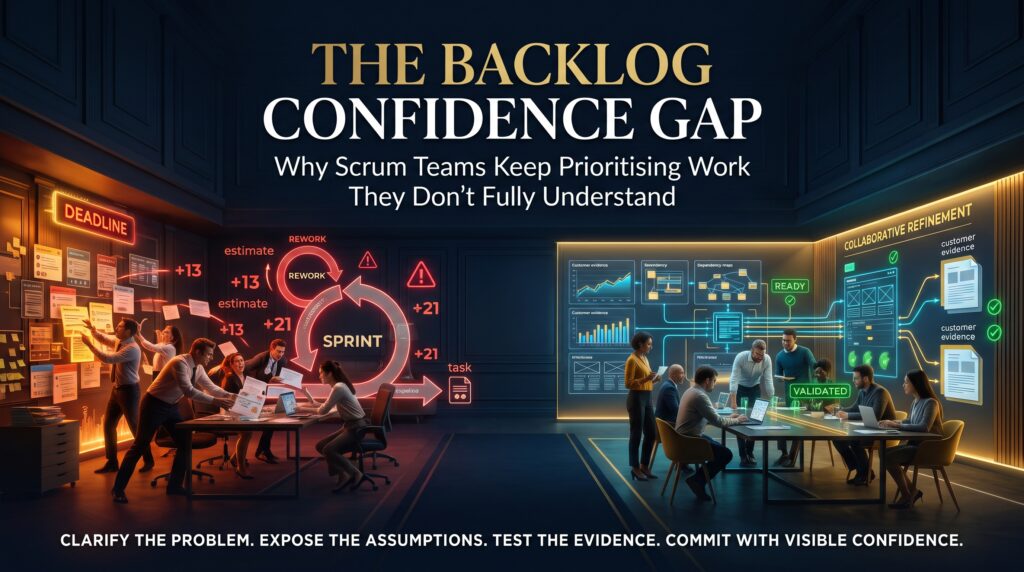
Backlog refinement run by the team alone turns knowledge gaps into confident-sounding stories. Estimates look neat, but they rest on guesses about users the team has never met.
3. Sprint Reviews become demos instead of decisions
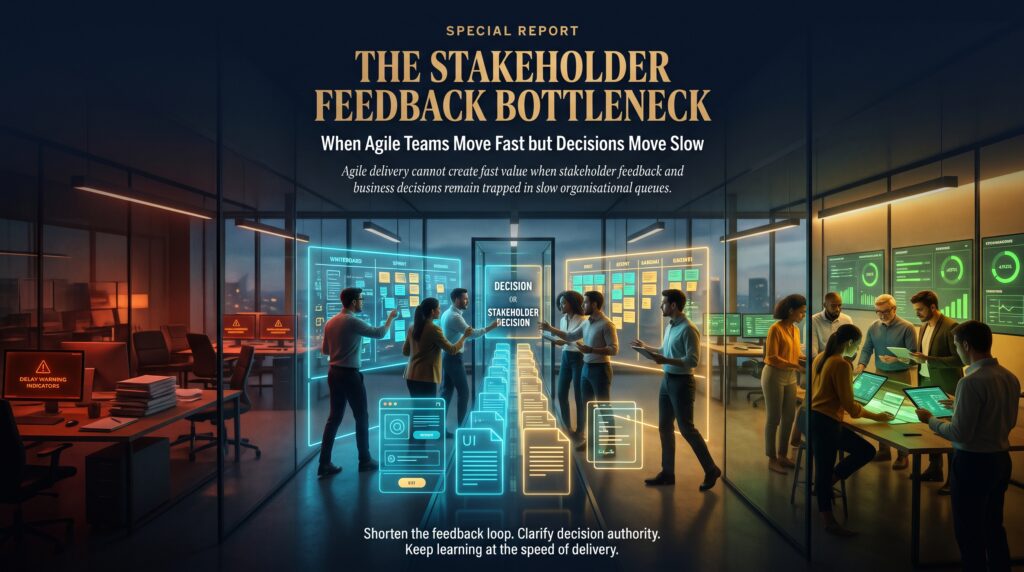
When the review is a one-way presentation, stakeholders nod politely and say nothing useful. The Scrum Guide describes the review as a working session to inspect the outcome and adapt the backlog. A polite demo creates the feeling of feedback without the substance.
4. Proxies replace real stakeholders
A Product Owner, business analyst or project manager often speaks for everyone else. Proxies are helpful, but each layer filters detail. The team ends up with a second-hand version of the need.
5. Big-batch releases save feedback for the end
If real users only see the product at release, a whole quarter of assumptions is tested on one day. That is the highest-interest repayment you can choose.
6. Nobody wants to bother busy stakeholders
Teams assume executives and subject matter experts have no time, so they decide on their behalf. Stakeholders, in turn, assume the team has it handled. Both sides are being polite, and debt grows in the silence.
7. Success is measured by output, not outcomes
Velocity, story points and completed tickets reward delivery speed. Unless the team also tracks whether work solved a real problem, there is no pressure to check.
How Stakeholder Feedback Debt Builds Up Sprint by Sprint
The table below is an illustrative example of a team that gathers feedback only at the end of a long release cycle.
| Sprint | What Happens | Feedback Debt |
| Sprint 1 | Team builds the first stories from a written brief | Low: few assumptions, little built |
| Sprint 2 | New stories added using Sprint 1 decisions as given | Growing: assumptions now depend on each other |
| Sprint 3 | Stakeholders busy, review is short and light | Growing: nothing is confirmed or corrected |
| Sprint 4 | Design patterns copied across screens | High: one wrong assumption is now repeated |
| Sprint 5 | Integration work starts on top of earlier decisions | Very high: changes now touch many parts |
| Release | Real users see the product for the first time | Debt called in all at once, with interest |
8 Warning Signs of Stakeholder Feedback Debt
- Stakeholders are surprised by finished work at the Sprint Review.
- The same feature is rebuilt or reversed shortly after delivery.
- Stories are marked done, but users do not adopt the result.
- Nobody can say who confirmed a requirement or when.
- Review meetings are poorly attended or end with silence.
- Late changes are blamed on “scope creep” rather than missing early learning.
- The backlog contains many items written months ago and never revisited.
- The team feels busy but cannot explain what has been learned.
If several of these apply, your team is carrying stakeholder feedback debt, and the interest is already being paid in rework and lost trust.
The Real Cost of Stakeholder Feedback Debt
The most visible cost is rework: features rebuilt, tests rewritten and releases delayed. Less visible are the effects on people. Developers lose motivation when finished work is thrown away. Stakeholders lose confidence when the product keeps missing the mark. Product Owners get blamed for decisions they were never able to validate. And the organisation pays for capability that delivers less value than it should. Because the cost arrives late and in one lump, it is often mistaken for bad luck rather than a predictable result of the way feedback is handled.
Stakeholder Feedback Debt in Practice: Scenarios From Australian Cities
These composite scenarios reflect common patterns, not individual client case studies.
Sydney: A banking team builds a new onboarding journey from a requirements document. At review, frontline staff explain that customers always arrive with documents the flow does not accept. Sydney Scrum teams in regulated industries often find this out late.
Melbourne: A health provider builds a patient portal feature that clinicians never requested. Scheduling staff would have asked for something different. Melbourne teams with many internal stakeholders feel the proxy problem acutely.
Brisbane: A construction firm builds a site reporting app that works well in the office but poorly on a muddy site with one gloved hand. Brisbane teams learn that context is part of the requirement.
Perth: A mining services team builds a safety reporting form that frontline workers skip because it takes too long. For Perth teams, field users are stakeholders too.
Adelaide: An education provider builds an enrolment workflow reviewed only by administrators. Students struggle with it on mobile. Teams in Adelaide see how a narrow review group hides real usage.
Canberra: A government delivery team builds to a policy brief, then finds at review that the policy intent has shifted. In Canberra, stakeholder priorities can move quickly, so frequent feedback matters even more.
How to Pay Down Stakeholder Feedback Debt in 8 Steps
- Make the debt visible. For each significant backlog item, write down the assumptions it relies on and mark which ones are unvalidated.
- Rewrite requirements as problems and outcomes. Replace “build a dropdown” with “help customers find their account number faster”.
- Bring real stakeholders into refinement. Even a short conversation with an actual user beats a long document.
- Turn the Sprint Review into a working session. Show working product, ask what to change, and update the Product Backlog together.
- Validate before you build. Use sketches, clickable prototypes and thin slices to test ideas cheaply before committing a sprint.
- Agree a team feedback rule. For example, every major item gets a conversation with a real stakeholder before it enters a sprint.
- Track feedback health. Watch the metrics in the table below, and treat a rising number as an early warning.
- Use the Retrospective to pay the debt down. Review where feedback came late, and let the Product Owner prioritise validation work like any other backlog item.
Questions That Turn a Sprint Review Into Real Feedback
Good feedback rarely appears on its own. It comes from good questions. Instead of asking “Does everyone like it?”, try prompts that invite a real answer:
- What problem were you hoping this would solve, and does it?
- What would you change first if you used this tomorrow?
- What is missing that would stop you from relying on it?
- Who else should see this before we build more?
- Given what you have seen, what should we do next, and what should we stop?
Capture the answers visibly and feed them straight into the Product Backlog. Feedback that disappears into meeting notes does nothing to reduce stakeholder feedback debt.
Stakeholder Feedback Debt in Larger Programs and Scaled Agile
The problem grows with scale. When several teams depend on one another, a wrong assumption in one team can spread across the whole program before anyone notices. Different teams may also hear different things from different stakeholders, which creates conflicting requirements that only collide at integration. Larger organisations benefit from shared review sessions, a single visible view of key assumptions and stakeholders who see work from more than one team at a time. The principle stays the same: shorten the distance between building something and learning whether it was right.
Stakeholder Feedback Debt Metrics Worth Tracking
| Metric | What It Shows | Healthy Direction |
| Age of oldest unvalidated item | How long assumptions have gone unchecked | Shorter |
| Share of items validated before build | How much work starts on confirmed need | Higher |
| Changes requested after Sprint Review | How wrong assumptions were by review time | Lower and earlier |
| Stakeholders attending reviews with real input | Whether feedback is flowing | Higher and broader |
| Delivered features actually used | Whether outcomes match output | Higher |
Who Does What: Reducing Stakeholder Feedback Debt
| Role | Main Contribution |
| Product Owner | Orders the backlog around value, keeps stakeholders engaged and protects time for validation |
| Scrum Master | Coaches the team and organisation, makes feedback debt visible and improves review and refinement events |
| Developers | Ask clarifying questions early, build thin slices and raise assumptions rather than hiding them |
| Stakeholders | Share problems, not just solutions, and give honest, timely feedback |
Skills and Training to Tackle Stakeholder Feedback Debt
Paying down stakeholder feedback debt takes practical skills: facilitating strong reviews, shaping outcome-focused backlogs and coaching organisations to engage. These courses build that foundation:
- Agile Scrum Foundation (BCS/EXIN): the principles, roles and events that make feedback loops work.
- Agile Scrum Practitioner (BCS/EXIN): applying Scrum in real projects, including backlog and stakeholder practice.
- iSQI Scrum Master Pro Certification: deeper Scrum Master skills for coaching teams and organisations.
The Agile Manifesto principles stress frequent delivery and daily collaboration between business people and developers, and the build-measure-learn loop in The Lean Startup shows how to test assumptions cheaply. Compare all pathways on our courses page.
Scrum Master Training in Sydney, Melbourne, Brisbane, Perth, Adelaide and Canberra
You can study with us in Sydney, Melbourne, Brisbane, Perth, Adelaide and Canberra, or online across Australia. See every option on our locations page.
Frequently Asked Questions About Stakeholder Feedback Debt
What is stakeholder feedback debt?
It is the accumulation of backlog items and built features that rest on unvalidated assumptions about what stakeholders need.
How is it different from technical debt?
Technical debt is about code quality shortcuts. Stakeholder feedback debt is about missing or late confirmation of requirements. Both create interest that is paid in rework.
Who is responsible for reducing it in Scrum?
The whole Scrum Team shares responsibility. The Product Owner manages stakeholder collaboration and backlog value, the Scrum Master coaches the team and improves events, and developers raise assumptions early.
How often should Scrum teams get stakeholder feedback?
At least every sprint at the Sprint Review, and ideally throughout the sprint through short conversations and early previews of work in progress.
Can a Sprint Review fix stakeholder feedback debt on its own?
Not alone. A strong review helps, but validation should also happen during refinement and before building major items.
What is the fastest way to start reducing stakeholder feedback debt?
Pick your five most important backlog items, list their assumptions and speak to a real stakeholder about each one before the next sprint starts.
Do I need a certification to improve stakeholder engagement?
No, but structured training gives you a shared language, proven techniques and credibility with stakeholders, which makes change easier to lead.
Final Thoughts: Learn Earlier, Build Less Waste
Stakeholder feedback debt is common, but it is controllable. Make assumptions visible, validate before you build and use every Sprint Review to make real decisions. Teams that do this find that surprises shrink, trust grows and delivery feels calmer. If you would like to build the skills to lead that change, contact our team or explore our Scrum Master certification courses.