
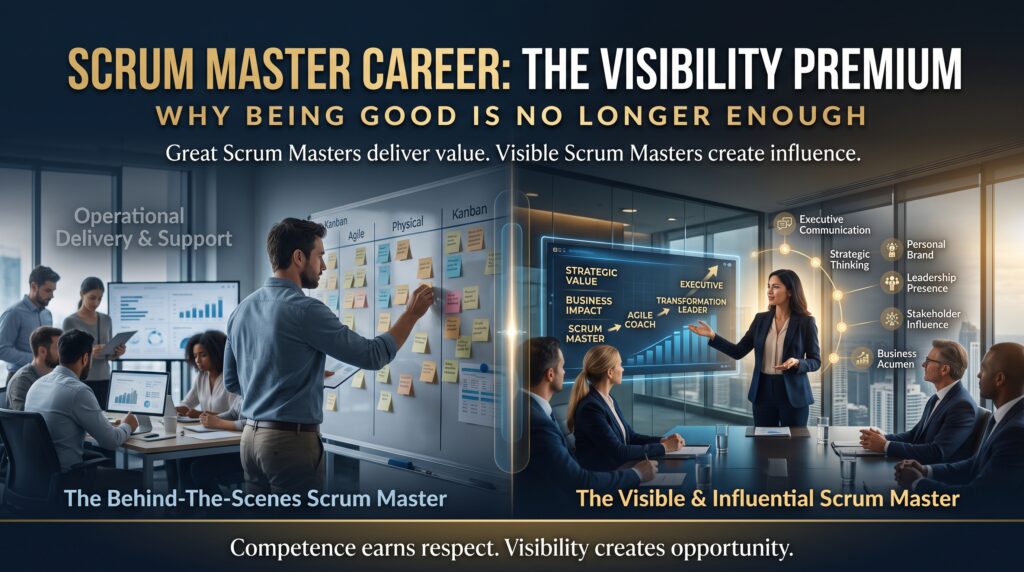
A Scrum Master career rewards good work, but it rewards visible good work far more.
Picture two Scrum Masters with the same skills. Both run tidy ceremonies, both help their teams ship reliably and both are well liked. One quietly lets the team take the credit and moves on to the next sprint. The other regularly shows leadership what changed, why it mattered and what the team learned. A year later, only one of them is asked to coach other teams. The difference wasn’t talent. It was visibility.
That extra opportunity, trust and pay that flows to people whose value is easy to see is what we’ll call the visibility premium. This guide explains why it exists, why Scrum Masters are especially likely to miss out, and how to build visibility in your Scrum Master career honestly without turning into a self-promoter. It’s written for Scrum Masters, project managers, business analysts and team leads across Australia, from Sydney, Melbourne, Brisbane, Perth, Adelaide or Canberra.
What Is the Visibility Premium in a Scrum Master Career?
The visibility premium is the advantage gained by people whose contribution is clear to the people making decisions. Being good is still essential. It’s just no longer the thing that separates you.
Several things have made visibility matter more. Teams are often hybrid or remote, so quiet competence is easier to miss. Hiring is noisier, with many applicants for each role and recruiters searching profiles by keyword. Leaders are busy and rely on a few trusted signals. In that environment, if your value isn’t legible, others will fill the gap with their own assumptions.
Notice that this isn’t about self-promotion. It’s about legibility: making sure the people who matter can see what you do and what it changes.
Why Scrum Masters Are Especially Prone to Being Invisible
- The job is to make others look good. Servant leadership means the team gets the credit, so the Scrum Master’s impact vanishes into the team’s success.
- The role is often misunderstood. Some people still see Scrum Masters as meeting schedulers or note-takers rather than people who improve how teams work.
- The work is quiet. Removing blockers, coaching and facilitating rarely produce dramatic moments.
- Improvements are gradual. A team that slowly becomes more predictable doesn’t trigger an announcement.
- Success looks like nothing happening. When conflicts are resolved early and delivery stays calm, nobody notices the problems that never arrived.
The result is a strange paradox: the better you do the role, the less visible you can become. A Scrum Master career needs deliberate effort to counter that.
7 Ways to Build Visibility in Your Scrum Master Career

1. Translate team results into business outcomes
“We completed all sprint goals” is a team update. “Our release cycle shortened, so customers get fixes sooner” is a business outcome. Use your own team’s data, such as cycle time, predictability or customer feedback, and tie it to something leaders care about.
2. Share what your retrospectives change
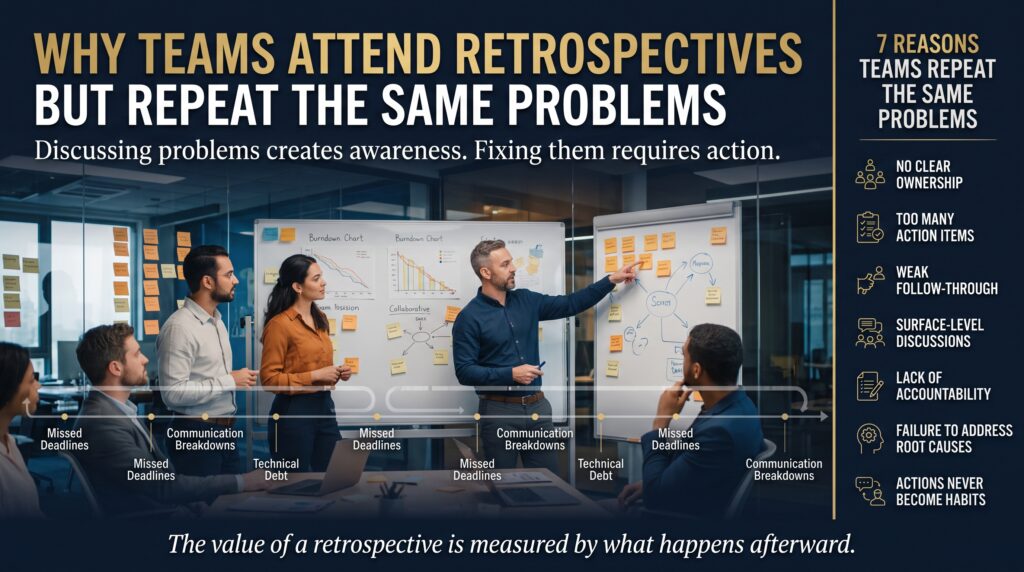
Retrospectives produce real improvements, but they rarely leave the room. Share one or two changes each quarter: what the team tried, what happened and what it learned. It shows how you improve the system, not just run the meeting.
3. Make the team’s work visible
Invite stakeholders to sprint reviews, keep boards clear and publish short demo notes. When people can see the work, they can see the environment that made it possible.
4. Write and speak a little
A short internal lunch-and-learn, a post about a lesson learned or a talk at a local meetup builds your reputation beyond your team. Start small. One useful idea shared well is enough.
5. Earn credentials that signal your level
Certifications give recruiters and managers a quick, recognisable signal. They don’t replace results, but they make your knowledge easier to read at a glance. More on this below.
6. Build relationships beyond your team
Talk regularly with product owners, delivery leads and senior stakeholders. Join or start a community of practice with other Scrum Masters. People promote those they know.
7. Keep a wins file
Every month, write down one outcome, one improvement and one piece of feedback for your Scrum Master career story. When review season arrives, you’ll have evidence instead of vague memories.
Visibility Without Ego: Servant Leadership Still Applies
It’s fair to worry that visibility in a Scrum Master career clashes with servant leadership. It doesn’t, as long as you’re clear about what you’re making visible.
Make the team’s work and results visible, not your halo. Name contributors. Credit ideas to the people who had them. Describe what you did in terms of the system you improved, such as “we cut hand-offs between design and testing”, rather than claiming the outcome as your own.
The goal is accuracy. If your contribution is real, describing it clearly is simply honest.
How Certification Strengthens Your Scrum Master Career Visibility
A recognised qualification is one of the easiest ways to make your skills legible. It tells a recruiter or manager what you’ve studied and to what standard, even before they’ve met you.
- Start with the basics: the Agile Scrum Foundation (BCS/EXIN) course covers Scrum principles, roles and events.
- Prove you can apply it: the Agile Scrum Practitioner (BCS/EXIN) course focuses on using Scrum in real situations.
- Go further: the iSQI Scrum Master Pro certification suits those who want a professional-level credential.
Certification works best for a Scrum Master career alongside evidence of results. Think of it as the headline and your wins file as the story. For the framework itself, the official Scrum Guide is the best free reference, and Scrum.org and the Agile Alliance offer community resources. You can also read about the certification bodies at BCS and EXIN.
A 90-Day Visibility Plan for Your Scrum Master Career
- Weeks 1–2: Gather your data. Pull your team’s recent delivery measures and note two improvements you helped create.
- Weeks 3–4: Write your impact summary. One page covering what changed, why it mattered and what the team learned.
- Weeks 5–6: Share it. Present it to your manager and a senior stakeholder, and offer a short session for other teams.
- Weeks 7–8: Build connections. Schedule coffees with a product owner, a delivery lead and a Scrum Master from another team.
- Weeks 9–10: Close a credential gap. Choose a course that fits your level and book it.
- Weeks 11–12: Update your profile. Refresh your résumé and LinkedIn with outcomes, not just ceremonies, and start your wins file.
Scrum Master Training Across Australian Cities
You can build your Scrum Master career in person or live online, and group training is available for teams. Local pages cover Sydney, Melbourne, Brisbane, Perth, Adelaide or Canberra. The locations page lists every option, and the courses page shows the full range. For a broader view of Agile training options, see this Agile training overview.
Outside of courses, the Australian Computer Society and the Australian Institute of Project Management offer networking and events, which are useful for building the relationships described above.
Scrum Master Career FAQs
What does a Scrum Master career path look like?
Many Scrum Masters grow into senior Scrum Master, Agile coach, delivery lead or program roles, though paths vary by organisation. Visibility, results and recognised skills help you move.
Do I need certification to be a Scrum Master?
Not always, but many employers look for it, and it makes your knowledge easier to recognise. Check the FAQs page for course formats and entry requirements.
Is building visibility just self-promotion?
No. It’s about making real contributions understandable to decision-makers. Crediting the team and describing outcomes accurately keeps it honest.
Can a project manager move into a Scrum Master role?
Yes. Planning, stakeholder and delivery experience transfer well. Training in Scrum principles and facilitation fills the gaps.
Can I study while working full-time?
Yes. Full-time, weeknight and weekend options are available, along with live online delivery.
Final Thoughts: Be Good, and Be Easy to See
Being good is the foundation of every Scrum Master career. But in a crowded, remote and time-poor workplace, it’s no longer enough on its own. Make your value legible and the opportunities tend to follow.
Pick one idea from this article and try it this week. If you’d like help choosing a course, contact our team or call 1300 649 299. You can also read more about us or browse the blog for more career guidance.