

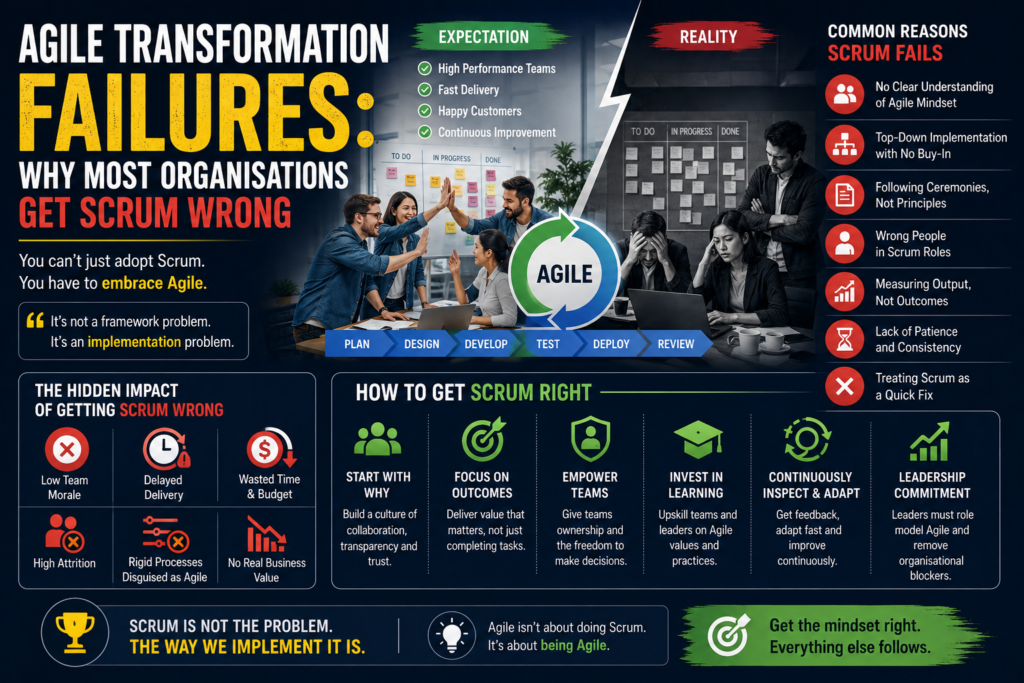

Agile Transformation has become one of the most searched, most funded, and most misunderstood initiatives in modern business. Boards approve the budget, HR renames job titles to “Scrum Master” and “Product Owner,” and teams start holding daily stand-ups — yet, a year later, delivery is still slow, morale is lower, and leadership quietly asks why the promised speed and predictability never showed up. This is not a rare story. It is the default outcome when Scrum is installed as a process instead of adopted as a way of working.
In this article we break down exactly why Agile Transformation efforts fail, the specific ways organisations get Scrum wrong, and the practical, training-backed steps that separate the teams who succeed from the ones who quietly abandon Agile within eighteen months.
What Is Agile Transformation (and Why It Keeps Failing)
An Agile Transformation is meant to be a shift in how an organisation plans, builds, and delivers value shorter feedback loops, empowered teams, and continuous improvement instead of rigid, upfront planning. Scrum is simply the most common framework used to structure that shift. The problem is that most organisations copy Scrum’s ceremonies sprint planning, daily stand-ups, retrospectives — without changing the underlying culture, funding model, or leadership behaviour that Scrum actually depends on. The framework becomes theatre: the meetings happen, but the mindset never arrives.
Industry research backs this up. Multiple large-scale surveys, including the State of Agile Report and analysis from McKinsey on organisational agility, consistently point to the same root causes: inconsistent processes, resistance to cultural change, and inadequate leadership involvement not the Scrum framework itself.
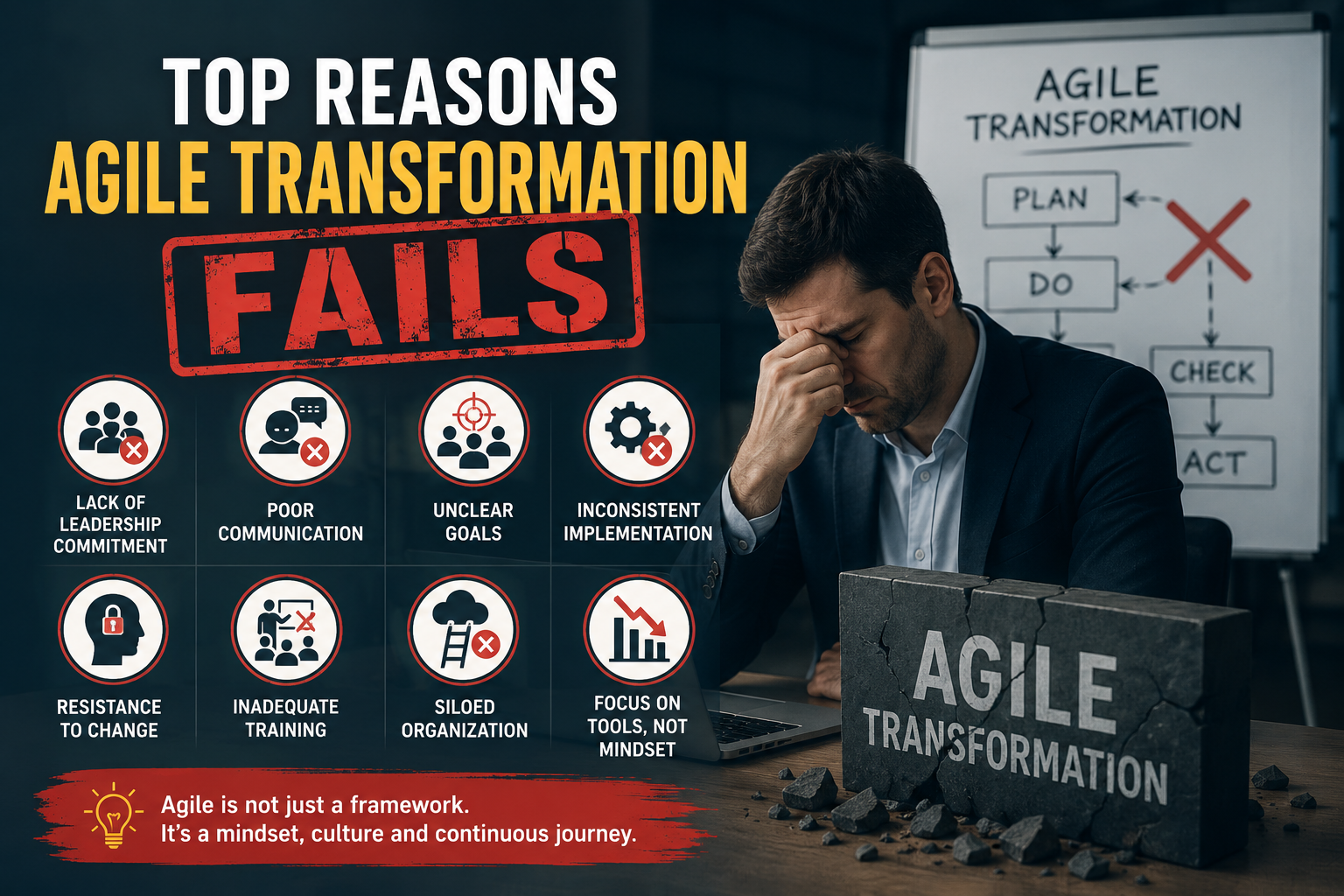
Top Reasons Agile Transformation Fails
Here are the patterns we see most often when an Agile Transformation stalls or reverses.
1. Treating Scrum as a Checklist, Not a Mindset
The single biggest reason organisations get Scrum wrong is “cargo cult Agile” copying the visible artefacts (boards, stand-ups, story points) while ignoring the values underneath: transparency, inspection, and adaptation. A daily stand-up run as a status report to a manager is not Scrum; it is a meeting with a new name. Without the mindset shift, an Agile Transformation simply relabels old habits.
2. No Real Executive Buy-In
Agile transformation cannot succeed bottom-up alone. When leadership still funds projects annually, demands fixed-scope roadmaps, and rewards teams for hitting dates rather than delivering value, Scrum teams are set up to fail before sprint one. Sustainable change requires leaders who understand Scrum well enough to change how they plan, budget, and measure success.
3. Skipping Proper Scrum Master Training
Many organisations promote a project manager or team lead into the Scrum Master role with no formal training, assuming the job is simply “organising meetings.” A trained, certified Scrum Master does far more: coaching the team, removing organisational impediments, protecting the sprint from scope creep, and facilitating genuine self-organisation. Structured, accredited Scrum Master certification closes this exact gap and is consistently the fastest way to correct a failing Agile transformation.
4. Confusing Agile with Scrum (and Scrum with Waterfall-in-Disguise)
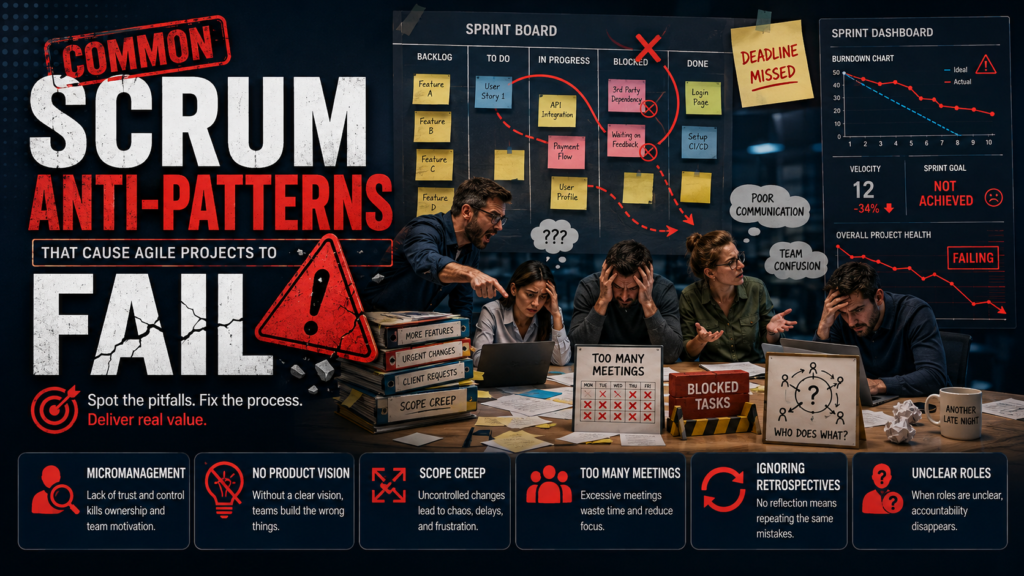
Agile is a set of values and principles; Scrum is one framework for applying them. Many teams run two-week “sprints” that are really just small waterfall projects with a demo at the end detailed upfront specs, no real inspect-and-adapt cycle, and a Product Owner who cannot actually reprioritise the backlog. This hybrid, half-Agile approach is one of the most common Agile transformation failures because it keeps all of the overhead of Scrum with none of the flexibility.
5. Poor Product Backlog Management
A vague, unordered, or constantly-changing backlog is a leading indicator that Scrum has been adopted wrong. Without a skilled Product Owner who ruthlessly prioritises by value, the Scrum Team ends up reacting to whichever stakeholder shouted loudest that week the opposite of the predictability Agile transformation is supposed to deliver.
6. Lack of Cross-Functional, Stable Teams
Scrum assumes a stable team with every skill needed to deliver a done increment. When organisations keep functional silos (separate QA, DevOps, or design teams shared across five projects), sprints are constantly blocked on external dependencies. This structural mismatch not the team’s effort is often the real reason velocity never improves.
The Real Cost of Getting Scrum Wrong
A failed Agile Transformation is rarely cheap. Beyond the direct cost of coaching and tooling, organisations absorb hidden costs: burnt-out teams who now associate “Agile” with more meetings and less autonomy, leadership scepticism that blocks future improvement efforts, and delivery delays caused by half-adopted process. According to Harvard Business Review’s analysis of Agile adoption, organisations that misapply Agile frameworks often see slower delivery than before adoption because they now carry Agile’s ceremony overhead without its speed benefits.
How to Fix a Failing Agile Transformation
- Get leadership certified alongside the team, not just the Scrum Master — shared language prevents shared confusion.
- Invest in proper, accredited Scrum Master training instead of informal, on-the-job learning.
- Fund products and outcomes, not fixed-scope projects, so teams can genuinely adapt the backlog.
- Build stable, cross-functional teams instead of shared specialist pools.
- Run honest retrospectives with real authority to change how the team works.
Every one of these fixes comes back to the same starting point: people in the organisation not just the Scrum Master actually understanding how Scrum is meant to work. That is exactly what structured certification training is designed to solve.
Get Certified: Scrum Master Courses Across Australia
If your organisation is somewhere in the pattern above, the fastest fix is proper training. Scrum Master Certification Australia runs accredited, instructor-led Scrum Master courses for individuals and teams in:
- Scrum Master Certification in Melbourne
- Scrum Master Certification in Sydney
- Scrum Master Certification in Brisbane
- Scrum Master Certification in Perth
- Scrum Master Certification in Adelaide
Conclusion
Most Agile Transformation efforts do not fail because Scrum doesn’t work they fail because Scrum was never properly implemented in the first place. Fixing it starts with honest diagnosis, real leadership commitment, and certified, practical training for the people driving the change.
Ready to stop getting Scrum wrong? Explore accredited Scrum Master certification courses and give your Agile transformation the foundation it was missing.