



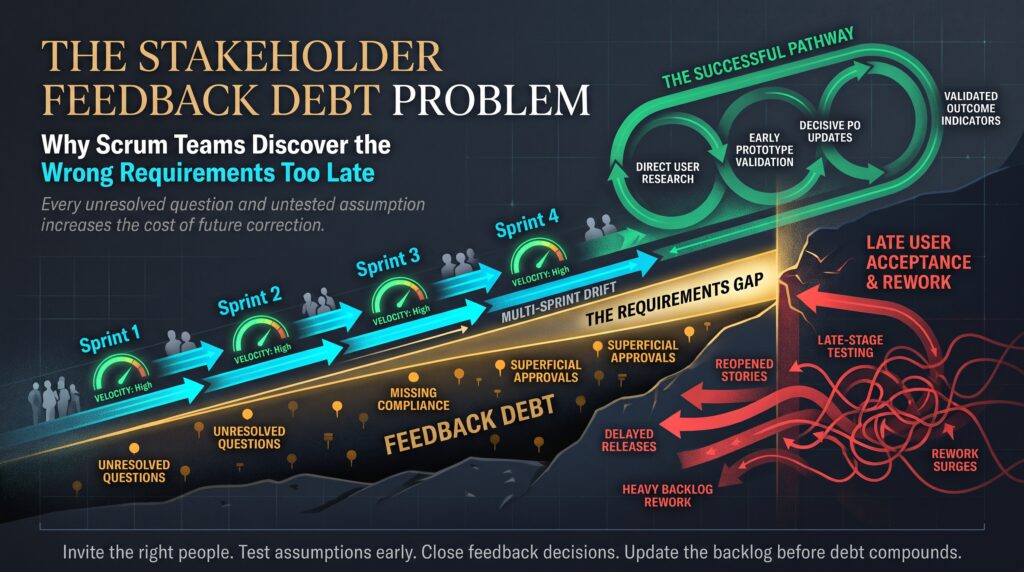
The definition of done is supposed to be the one line a Scrum team never crosses. In practice, it’s often the first thing to bend. It’s Thursday afternoon, the Sprint ends tomorrow, three items are “almost there”, and someone says, “Can we skip the code review and just fix it next sprint?” Nobody objects. The board turns green, the Sprint Review goes smoothly and quality quietly drops a notch. Do that for a few months and you have what we’ll call definition of done erosion.
If that sounds uncomfortably familiar, you’re not alone, and it doesn’t mean your team is careless. Across Sydney, Melbourne, Brisbane, Perth, Adelaide and Canberra, Scrum Masters see the same pattern: pressure to finish the sprint beats the discipline of finishing properly. The damage doesn’t show up immediately, which is exactly why it’s so easy to repeat.
This guide explains why a team’s definition of done erodes, what it costs, how to spot the early warning signs and eight practical ways to protect it. You’ll also see which courses at Scrum Master Certification help Scrum Masters and teams hold the line without turning every sprint into a fight.
What Is Definition of Done Erosion in Scrum?
The Scrum Guide describes the definition of done as a formal description of the state of the Increment when it meets the quality measures required for the product. When a Product Backlog item meets it, an Increment is born. If an item doesn’t meet it, it can’t be released, and it shouldn’t even be presented as finished at the Sprint Review.
In short: definition of done erosion is the gradual weakening of that standard. Steps get skipped, tests get postponed and “done” starts to mean “works on my machine” or “demoable”. The written definition may still be on the wall, but the team’s actual behaviour no longer matches it.
Erosion is rarely a single decision. It’s a series of small, reasonable-sounding exceptions that become normal. Because each one looks minor, the team seldom realises how far the real standard has drifted from the agreed one.
Why Scrum Teams Quietly Lower Quality to Finish the Sprint
Almost every case of definition of done erosion traces back to a few common pressures.
1. Sprint deadlines feel fixed, quality feels negotiable
The sprint has a hard end date, so it’s tempting to treat scope and quality as the flexible parts. In Scrum, though, the time-box is fixed and scope is meant to be renegotiated, not quality. When teams cut quality instead of scope, they lose the honest conversation with the Product Owner about what can actually be delivered.
2. Overcommitment at Sprint Planning
Teams that pull in too much have only two ways out: finish less or finish worse. Under pressure, finishing worse feels less visible. Overcommitment is one of the fastest routes to a weaker definition of done.
3. Stakeholders reward visible progress
If leaders celebrate the number of items shipped and never ask about test coverage, security checks or documentation, teams learn what really counts. People adapt to what gets noticed.
4. The definition of done is vague or outdated
A line such as “code complete and tested” leaves room for interpretation. Without specific, checkable criteria, it’s easy to argue that a half-tested item counts. A vague definition of done erodes faster than a precise one.
5. The team wrote it once and never revisited it
Products, tooling and risks change. If the definition of done wasn’t reviewed in the Sprint Retrospective, it may no longer match reality, and people begin to ignore it because it feels irrelevant.
6. Technical debt is seen as someone else’s problem
“We’ll fix it later” assumes that later will arrive with spare capacity. It rarely does. Teams that don’t track technical debt openly tend to let it accumulate until delivery slows noticeably.
7. Nobody feels safe saying no
Developers may know an item isn’t done but hesitate to say so in front of a Product Owner or manager. When raising a quality concern feels risky, the definition of done quietly loses its authority.
Healthy Definition of Done vs an Eroded One
Use this comparison as a quick self-check against your own team’s habits.
| Factor | Healthy definition of done | Eroded definition of done |
| Clarity | Specific, checkable criteria everyone can recite | Vague phrases open to interpretation |
| Testing | Automated and manual tests completed inside the Sprint | Testing pushed to a “hardening” phase or next sprint |
| Reviews | Peer review completed before an item is called done | Reviews skipped when time is short |
| Sprint pressure | Scope is renegotiated with the Product Owner | Quality is quietly reduced to hit the date |
| Sprint Review | Only items that meet the standard are shown as done | Partly finished items shown as complete |
| Retrospectives | Standard reviewed and improved regularly | Standard never discussed |
| Technical debt | Visible, tracked and planned for | Hidden and growing |
The Real Cost of Eroding the Definition of Done
Skipping a step saves minutes today and costs hours later. Bugs surface after release, support tickets increase, and developers spend more time fixing old work than building new features. Velocity may look steady for a while because unfinished work is counted as finished, then it drops sharply once the debt comes due.
- Hidden rework: defects discovered late are far more expensive to fix than those caught inside the Sprint.
- Unreliable forecasts: if “done” isn’t really done, Sprint and release forecasts are fiction.
- Lost trust: stakeholders who find defects after sign-off stop believing the board.
- Lower morale: developers who are proud of their craft feel uncomfortable shipping work they know is weak.
- Security and compliance risk: skipped checks can expose the organisation, especially in regulated sectors.
Signs Your Team’s Definition of Done Is Eroding
Watch for these early signals:
- Items are called done “except for testing” or “pending review”.
- A hardening or stabilisation sprint appears on the roadmap.
- The same bugs keep returning after items were marked done.
- Few team members can state the current definition of done from memory.
- Exceptions are made on the last day of every Sprint.
- Sprint Reviews show features that stakeholders later find are not production-ready.
- Developers say “we’ll tidy it up next sprint” more than once in a month.
Spotting two or three of these doesn’t mean failure. It means the team has a useful chance to reset its standard before the cost grows.
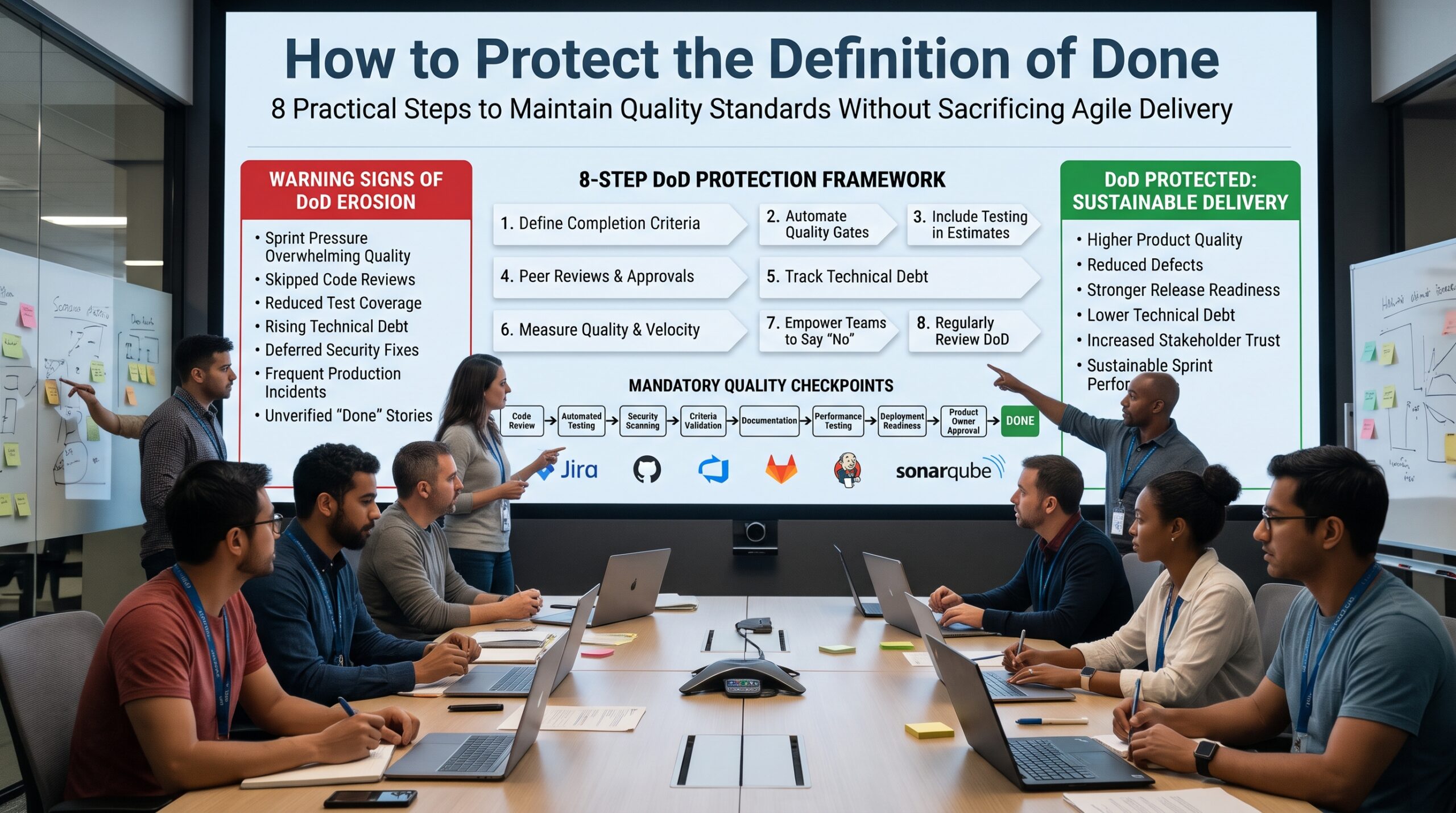
How to Protect the Definition of Done: 8 Practical Steps
Step 1: Rewrite it so it can be checked
Turn vague statements into criteria you can answer with yes or no: peer review completed, automated tests passing, acceptance criteria verified, documentation updated, no known critical defects. If two people can read the same line and disagree, it needs rewording.
| Area | Example criterion | How to check it |
| Code quality | Peer review completed and comments resolved | Pull request status |
| Testing | Automated tests written and passing | Build pipeline result |
| Acceptance | Acceptance criteria demonstrated to the Product Owner | Product Owner confirmation |
| Security | No new high-severity findings from agreed checks | Scan report |
| Documentation | User or support notes updated where needed | Checklist in the ticket |
| Release readiness | Deployable to the agreed environment | Deployment record |
This table is an example. Your own definition of done should reflect your product, your risks and any organisational standards your team must follow.
Step 2: Make it visible
Put the definition of done on the board, in the ticket template and in the Sprint Planning agenda. A standard people can’t see is a standard people forget.
Step 3: Plan capacity honestly
Use recent completed work, not hopes, to decide how much to pull into the Sprint. Include time for testing, review and rework in the estimate. Realistic planning removes the main reason to cut corners.
Step 4: Slice work smaller
Small items are easier to finish properly. If an item can’t realistically be done inside the Sprint, split it. Teams that slice well rarely face the last-day panic that erodes the definition of done.
Step 5: Renegotiate scope, not quality
When the Sprint is at risk, the Product Owner and Developers should talk about what to drop or simplify. A smaller, properly finished Increment is more valuable than a larger, shaky one. Make this the team’s default response.
Step 6: Make technical debt visible
If a shortcut is unavoidable, log it as a backlog item with a clear description and priority. Visibility turns hidden debt into a conscious trade-off that the Product Owner and stakeholders can weigh.
Step 7: Review the definition of done in every few retrospectives
Ask whether the standard is still realistic, whether people are following it and which parts keep being skipped. The Sprint Retrospective is the natural place to tighten, simplify or automate criteria so they’re easier to meet.
Step 8: Automate what you can
Automated builds, tests and security checks make quality the path of least resistance. When the pipeline does the checking, nobody has to argue about whether a step was skipped.
The Scrum Master’s Role in Protecting the Definition of Done
Scrum Masters are accountable for the effectiveness of the Scrum Team, which includes helping the team understand why the standard matters. A good Scrum Master doesn’t act as the quality police. Instead, they coach the team to hold itself accountable, help the Product Owner understand the cost of cutting quality, facilitate a better definition of done conversation and raise organisational pressures that keep pushing teams to compromise.
These are coaching and facilitation skills that can be learned. Scrum Masters who understand the intent behind each Scrum artifact and commitment are far better placed to protect quality without damaging relationships.
Which Scrum Courses Help Teams Strengthen the Definition of Done?
Training doesn’t replace discipline, but it gives teams a shared understanding and practical tools. The table below maps common goals to courses on scrummastercertification.au.
| Goal | Course | How it helps with the definition of done |
| Start with a recognised Scrum credential | Scrum Master Certification | Builds solid understanding of artifacts, commitments and servant leadership |
| Learn facilitation through a well-known path | Certified ScrumMaster (CSM) | Develops the coaching skills needed to hold quality conversations |
| Strengthen your grasp of the Scrum Guide | Professional Scrum Master (PSM) | Clarifies the purpose of the definition of done and the Increment |
| Work across multiple teams | SAFe Scrum Master | Helps align quality standards across teams and programmes |
| Give the whole team a shared language | Agile Scrum Foundation (BCS/EXIN) | Aligns developers, Product Owners and stakeholders on Scrum basics |
| Apply Scrum in realistic scenarios | Agile Scrum Practitioner (BCS/EXIN) | Practises scope negotiation and quality decisions under pressure |
| Build coaching and leadership habits | iSQI Scrum Master Pro Certification | Strengthens influencing skills for protecting standards with stakeholders |
Not sure which suits your role? Start with the main Scrum Master Certification page or contact our team for guidance.
Scrum Master Certification Across Sydney, Melbourne, Brisbane, Perth, Adelaide and Canberra
Teams in every Australian capital feel sprint pressure, though the sources differ by industry.
- Sydney: Banks and fintechs face tight release windows alongside strict compliance. See Scrum Master training in Sydney.
- Melbourne: SaaS and telco teams often chase fast delivery at the cost of testing. Explore Scrum Master training in Melbourne.
- Brisbane: Growing digital programs need quality habits that scale. Visit Scrum Master training in Brisbane.
- Perth: Resources and energy teams often work to fixed project dates. Check Scrum Master training in Perth.
- Adelaide: Defence, health and public-sector delivery teams carry high assurance expectations. See Scrum Master training in Adelaide.
- Canberra: Federal agencies and contractors need auditable quality standards. Browse Scrum Master training in Canberra.
A 30-Day Plan to Rebuild the Definition of Done
- Week 1: Audit. Compare your written definition of done with what the team actually did in the last three Sprints.
- Week 2: Rewrite. Hold a thirty-minute session to make every criterion specific and checkable, and agree what’s automated.
- Week 3: Apply. Use it in Sprint Planning and refuse to mark items done until every criterion is met.
- Week 4: Review. Use the Sprint Retrospective to compare outcomes with Week 1, and log any technical debt openly.
After a month you’ll know how well your definition of done matches reality and where the real pressure points are.
For Leaders: How Organisations Cause Definition of Done Erosion
Teams rarely erode their own standards without prompting. Fixed-date, fixed-scope commitments, unrealistic roadmaps and reward systems that celebrate output over outcomes all push in the same direction. Leaders can help by protecting the standard publicly, accepting smaller scope instead of weaker quality and asking questions about quality alongside delivery dates. The Agile Manifesto’s principles include continuous attention to technical excellence, which is a helpful reminder. For team or in-house training, get in touch.
Frequently Asked Questions About the Definition of Done
What is the definition of done in Scrum?
It’s a formal, shared description of the quality an Increment must meet before it counts as done. Developers use it to decide whether work is finished.
Why do Scrum teams lower quality at the end of a Sprint?
Usually because of overcommitment, deadline pressure, vague criteria and a culture that rewards visible output. Cutting quality feels less costly than admitting scope has to change.
Who owns the definition of done?
The Scrum Team creates it, and if the organisation has a standard, teams must follow it as a minimum. Developers are accountable for the quality of the Increment.
How often should we review the definition of done?
Revisit it in Sprint Retrospectives and whenever the product, tooling or risks change. Many teams review it every few Sprints.
What is the difference between acceptance criteria and the definition of done?
Acceptance criteria describe what a specific backlog item must do. The definition of done describes the quality standard that applies to every item.
Which certification helps most with protecting quality in Scrum?
CSM, PSM and Agile Scrum Practitioner all cover Scrum commitments and facilitation. Compare them on the Scrum Master Certification page to match your role.
Final Thoughts: Finish Properly or Finish Less
Protecting the definition of done isn’t about perfectionism. It’s about telling the truth about what’s finished. When pressure rises, the healthiest response is to deliver less, not to deliver worse. Try one change in your next Sprint, such as rewriting vague criteria, and see how it affects rework.
Ready to build the skills that keep Scrum teams honest and effective? Explore Scrum Master Certification, compare the CSM, PSM and SAFe Scrum Master options, or talk to us to find the right course.