


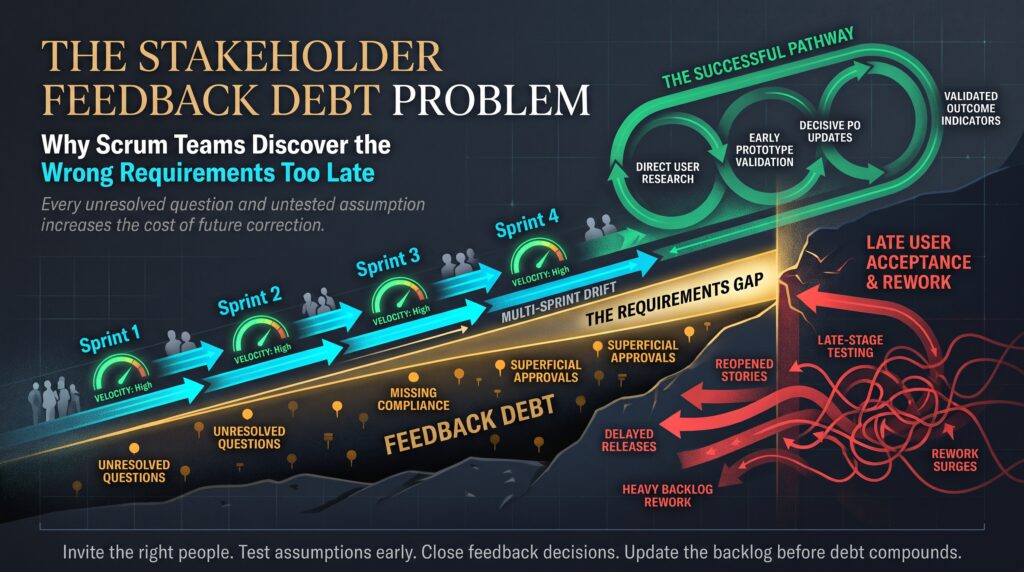
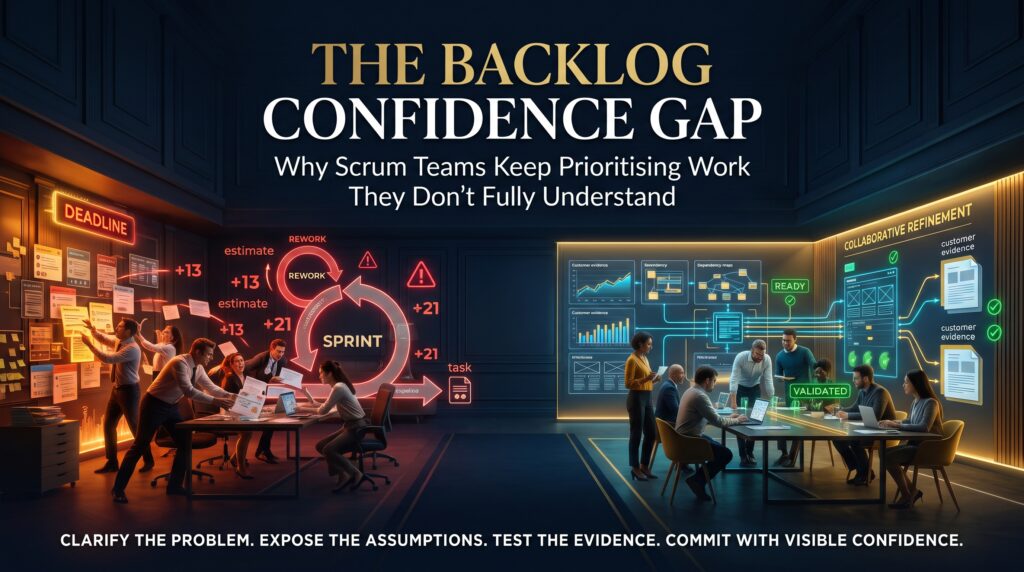
The product owner bottleneck is one of the most common and least discussed reasons Scrum teams miss their sprint goals. A developer asks a simple question on Monday: “Should this field be mandatory?” By Wednesday there’s still no answer. The work stalls, someone makes a guess, and the guess turns out to be wrong in the sprint review.
The team isn’t slow and the product owner isn’t lazy. Decisions are simply queueing up behind one overloaded person. In this guide we explain the product owner decision bottleneck: why it happens, what it costs, how to spot it, and how Scrum teams in Sydney, Melbourne, Brisbane, Perth, Adelaide and Canberra can fix it without breaking the framework.
What Is the Product Owner Bottleneck?
A product owner bottleneck occurs when the Product Owner’s availability, authority or clarity becomes the limiting factor in how fast a Scrum team can deliver. In a product owner bottleneck, work doesn’t stop because developers can’t build it. It stops because nobody can quickly say what “done” should look like, which option to choose or whether a trade-off is acceptable.
Think of a busy kitchen where every dish needs the head chef to taste it before it goes out. The cooks are fast and the ingredients are ready, but plates pile up at the pass. In Scrum, the product owner can become that pass.
According to the Scrum Guide, the Product Owner is accountable for maximising the value of the product and for effective Product Backlog management. That’s a big accountability, and it only works when the role has the time, mandate and information to make decisions at the speed the team needs.
Why Scrum Teams Wait Days for Simple Answers
1. The Product Owner Is Stretched Across Too Many Things
Many organisations ask one person to own several products, attend endless stakeholder meetings and still be “always available” to the team. When the role is part-time on paper but full-time in reality, questions wait in a queue.
2. The Role Has Responsibility but Not Authority
Some product owners are really messengers. They must take every meaningful decision to a manager, a steering committee or a client before replying. A five-minute question becomes a five-day approval chain. The Scrum Guide is clear that the whole organisation needs to respect the Product Owner’s decisions, but in practice that respect is often missing.
3. Backlog Items Arrive Unclear
If stories are vague, every sprint creates a stream of clarifying questions. The product owner bottleneck gets worse because the same person must answer them one by one, often without the detail the team needs.
4. There’s No Agreed Rhythm for Decisions
Without a regular slot for questions, developers either interrupt at random or wait politely. Both feed the product owner bottleneck. Teams that agree a daily question window or use the daily Scrum to flag open decisions tend to move faster.
5. Knowledge Lives in One Head
Product context, customer insight and business rules sometimes sit only with the product owner. Nobody else can safely answer, so everything routes through one person. This is a close cousin of key person dependency, and it makes a product owner bottleneck almost inevitable.
What the Product Owner Bottleneck Really Costs
Here’s a simple, hypothetical example. A Scrum team of seven loses about one hour per person each day to waiting, switching tasks or working on assumptions. That’s seven hours a day, or 70 hours across a 10-day sprint. At $85 an hour, the product owner bottleneck costs roughly $6,000 per sprint, before counting rework when guesses turn out wrong.
The bigger cost is not financial. Waiting erodes morale, hides risk until late in the sprint and pushes teams towards carrying unfinished work into the next sprint. Over time, a persistent product owner bottleneck leads stakeholders to conclude that Scrum is slow, when the real problem is how decisions are being made.
Warning Signs of a Product Owner Bottleneck
- Developers regularly start work on stories they don’t fully understand.
- Questions in chat or tickets stay unanswered for more than a day.
- Stories are commonly finished on the last day of the sprint, or not at all.
- The Product Owner misses or rushes sprint planning and refinement.
- Decisions are reversed in the sprint review.
- The team says “we’re waiting on the PO” in daily stand-ups.
- The Product Owner has to “check with someone” before agreeing to small changes.
If four or more of these sound familiar, the product owner bottleneck is probably limiting your throughput more than your technical skills are.
Common Product Owner Bottleneck Patterns and Fixes
| Pattern | What you’ll see | Practical fix |
| Overloaded Product Owner | Slow replies, missed refinement sessions | Reduce their product scope and protect team time in their calendar |
| Messenger, not decision-maker | Every choice goes to a committee | Agree decision rights in writing and publish them |
| Unclear backlog items | Constant clarifying questions | Hold regular refinement and agree clear acceptance criteria |
| No decision rhythm | Random interruptions or silent waiting | Set a daily question window and a visible decision log |
| Single source of knowledge | Only one person can answer domain questions | Share context via documentation, demos and customer sessions |
| Stakeholder overload | Conflicting requests reach the team directly | Route all input through one ordered Product Backlog |
How to Fix the Product Owner Bottleneck: 8 Practical Steps

- Measure the wait. Track how long questions sit unanswered for two sprints. A simple tally of “hours blocked” is often enough to start an honest conversation.
- Clarify decision rights. Write down which decisions the Product Owner makes alone, which need consultation and which belong to the Developers. Share it with stakeholders.
- Protect availability. Agree specific times each day when the Product Owner is reachable. Even 30 predictable minutes beats being “mostly available.”
- Improve refinement. Spend regular time clarifying upcoming stories with the team so most questions are answered before the sprint starts. Many teams find a lightweight definition of ready helpful, as long as it’s treated as a guide rather than a gate.
- Create a visible decision log. Record choices, the reason and the date in a shared space. This cuts repeat questions and lets the team act on past decisions.
- Share domain knowledge. Invite developers to customer calls and demos so they can make good small decisions on their own. Self-managing teams need context, not just instructions.
- Limit work in progress. Fewer open stories mean fewer simultaneous questions. This also exposes blocked work sooner and shrinks the product owner bottleneck.
- Escalate through the Scrum Master. Use retrospectives to raise the pattern as a system problem and ask leadership for the mandate or capacity the role needs.
The Scrum Master’s Role in Removing the Bottleneck
The Scrum Master isn’t there to answer product questions, but they are accountable for helping the team be effective. That includes making impediments visible, coaching the Product Owner and stakeholders on how the role works, and helping the organisation understand why decision speed matters. A good Scrum Master tackles the product owner bottleneck by bringing data to the conversation: how long decisions take, what they cost and which fixes actually worked.
This is also where formal training pays off. Practitioners who understand Scrum roles, events and artefacts in depth can challenge unhelpful habits confidently and constructively. The Agile Manifesto and guidance from Scrum.org are useful reference points for these conversations.
Scrum Master Certification Courses That Help You Fix Decision Bottlenecks
If you want practical tools for handling roles, backlogs and stakeholder expectations, these courses are a good place to start:
- Agile Scrum Foundation (BCS/EXIN) for a clear grounding in Scrum roles, events and artefacts, including how the Product Owner role is meant to work.
- Agile Scrum Practitioner (BCS/EXIN) for applying Scrum in real situations, including stakeholder management and handling impediments.
- iSQI Scrum Master Pro Certification for deeper facilitation, coaching and servant-leadership skills.
Compare every pathway on our courses page, or learn more about us.
Scrum Master Certification Training Across Australia
Learn with practitioners who’ve seen these patterns in real teams. Choose a city or study online:
- Scrum Master certification in Melbourne for technology, finance and health teams.
- Scrum Master certification in Sydney for banking, government and digital product teams.
- Scrum Master certification in Brisbane for engineering, infrastructure and services organisations.
- Scrum Master certification in Perth for resources, energy and technology teams.
- Scrum Master certification in Adelaide for growing local businesses and defence-related teams.
- Scrum Master certification in Canberra for public-sector delivery and professional services teams.
See all options on our locations page.
Frequently Asked Questions About the Product Owner Bottleneck
What is a product owner bottleneck?
It’s when the Product Owner’s limited time, authority or clarity slows down the Scrum team’s ability to make progress. Developers end up waiting for decisions that should take minutes.
How can a Scrum team stop waiting for the product owner?
Agree decision rights, set predictable times for questions, improve backlog refinement and share more product context with the team. Many routine questions can then be answered without waiting.
Can the Scrum Master make decisions for the Product Owner?
No. The Scrum Master helps the team and organisation work effectively, but product decisions belong to the Product Owner. The Scrum Master can coach, facilitate and make delays visible.
Is a part-time product owner a problem?
Not automatically, but it becomes one when availability doesn’t match the team’s needs. If the team regularly waits more than a day for answers, the role probably needs more time, support or a narrower scope.
Does Scrum Master training help with this problem?
Yes. Training builds a shared understanding of roles and gives Scrum Masters practical techniques for coaching and facilitation. Our FAQs page explains how courses, schedules and certification options work.
Final Thoughts: Faster Decisions, Better Sprints
Scrum depends on fast feedback, and fast feedback depends on timely decisions. A product owner bottleneck is rarely a personal failing. It’s a design problem that can be fixed with clearer authority, better refinement, shared context and a team that knows how to raise impediments early.
Want to help your team move faster? Speak to a course advisor, call 1300 649 299, or read more Agile guides on the Scrum Master Certification blog.