
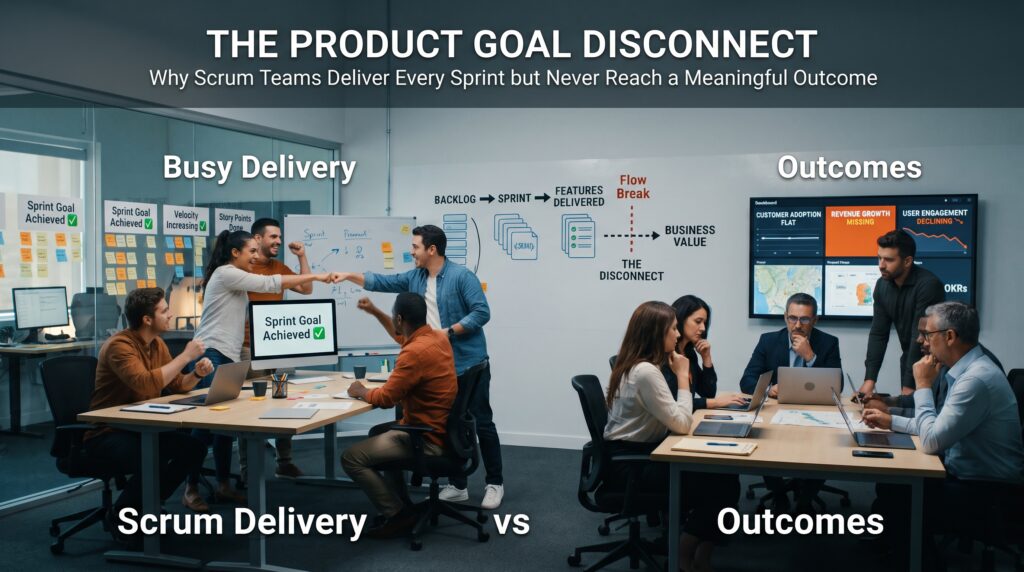



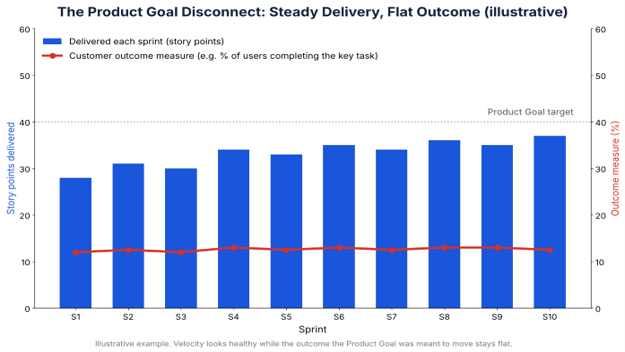
The product goal disconnect is what happens when a Scrum team ships increments on schedule, sprint after sprint, yet the product never moves closer to the outcome that justified building it. The board is full of done work. The sprint reviews are friendly. Velocity looks healthy. And six months later, customers behave exactly as they did before.
If you work with Scrum teams in Melbourne, Sydney, Brisbane, Perth, Adelaide or Canberra, you have probably seen it. This guide explains why the product goal disconnect happens, how to recognise it, and the practical Scrum techniques that reconnect everyday delivery with a goal that actually matters.
What Is the Product Goal Disconnect in Scrum?
The product goal disconnect is the gap between the work a Scrum team completes and the long-term objective the product is supposed to achieve. In Scrum terms, the Product Goal is the long-term objective of the Scrum team, described in the Scrum Guide as part of the Product Backlog. The team should fulfil or abandon one Product Goal before moving on to the next.
When that goal is missing, vague or ignored, a team can follow every Scrum event perfectly and still drift. Sprints deliver output: features, fixes, story points. Nobody checks whether those outputs changed anything for users or the business. That is the essence of the product goal disconnect: activity without direction.
Why the Product Goal Disconnect Happens
The product goal disconnect rarely comes from a lack of effort. It usually grows from a handful of structural habits:
- No Product Goal exists. The backlog is a list of requests, not a path to an outcome. Teams ask “what is next?” instead of “what are we trying to achieve?”
- The goal describes output, not outcome. “Launch the new customer portal” is a deliverable. “Reduce support calls about billing” is an outcome.
- Sprint Goals are copied from the backlog. A Sprint Goal that simply lists the sprint’s tickets does not connect to the Product Goal.
- The Product Owner is overloaded. When the Product Owner spends most of the time relaying stakeholder demands, nobody is shaping value.
- Velocity is treated as success. Story points measure effort and throughput, not customer impact. Once velocity becomes a target, people optimise the number.
- Sprint Reviews are demos. Stakeholders watch features appear, nod and leave, so the review never inspects whether the outcome improved.
- Roadmaps are promises, not hypotheses. Fixed feature lists crowd out learning from real usage.
- Teams operate as a feature factory. Success means shipping, so nobody removes work that no longer serves the goal.
Output vs Outcome: What Scrum Teams Often Measure
A clear way to spot the product goal disconnect is to compare what your team reports with what actually matters:
| What teams often report | What it actually tells you | What outcome-focused teams track |
| Velocity of 35 points per Sprint | How much effort the team completed. | Whether customers or the business improved because of that work. |
| Number of features released | Output volume. | Usage and adoption of the released features. |
| Sprint burndown on schedule | The Sprint plan was followed. | Whether the Sprint Goal was achieved and why it mattered. |
| Backlog items completed | Throughput. | Progress towards the Product Goal’s measurable target. |
| Stakeholder demo attendance | People were present. | Decisions and backlog changes that came from the review. |
| Release dates met | Predictability. | Time to learn from real users after release. |
Warning Signs of the Product Goal Disconnect
- Team members cannot state the current Product Goal in one sentence.
- Sprint Goals read like a list of tickets.
- The Product Backlog keeps growing and nothing is ever removed.
- Sprint Reviews focus on demonstrating features, not on inspecting results.
- Stakeholders ask “when will it be done?” far more than “did it work?”
- Customer or business metrics have not moved for several sprints despite steady delivery.
- The team is proud of velocity but cannot explain what changed for users.
- Features are released and never reviewed again.
How Scrum Is Meant to Connect Sprints to a Product Goal
Scrum already contains the answer. The Scrum Guide describes three commitments that link work to purpose: the Product Backlog has the Product Goal, the Sprint Backlog has the Sprint Goal, and the Increment has the Definition of Done. Each Sprint should move the product closer to the Product Goal, and the Sprint Goal explains why this Sprint is valuable.
The Product Owner is accountable for maximising the value of the product and for managing the Product Backlog. The Scrum Master is accountable for the effectiveness of the Scrum Team, which includes helping everyone understand why the Product Goal matters. The Developers create the valuable, usable Increment each Sprint. When any of these links weakens, the product goal disconnect appears.
How to Fix the Product Goal Disconnect
1. Write a Product Goal that describes an outcome
Replace deliverable-style goals with one that describes a future state of the product, a measurable change for users or the business, and a clear time horizon. A good test is whether you could achieve the goal without shipping a specific feature. If so, the goal is about outcome.
2. Keep one Product Goal visible at a time
Put the Product Goal at the top of the Product Backlog, on the team board and at the start of every Sprint Planning session. Teams that chase several goals at once rarely achieve any of them. Finish or abandon one before starting the next.
3. Make every Sprint Goal serve the Product Goal
During Sprint Planning ask a simple question: how does this Sprint Goal move us towards the Product Goal? If nobody can answer, rethink the Sprint Goal before selecting backlog items.
4. Turn Sprint Reviews into outcome conversations
Show the Increment, but spend most of the time on evidence: what did users do, what did we learn, and what should change in the Product Backlog? Invite stakeholders to inspect results and adapt priorities, not just to watch a demonstration.
5. Measure outcomes, not just output
Choose a small number of outcome measures linked to the goal, such as task completion rate, support contacts, conversion or retention. The Scrum.org Evidence-Based Management approach suggests looking at current value, unrealised value, time to market and the ability to innovate, which helps teams balance delivery with real results.
6. Order the Product Backlog by contribution to the goal
Rank items by how strongly they support the Product Goal. Be willing to delete items that no longer help. A shorter, sharper backlog is a sign of a healthy team, not a lazy one.
7. Empower the Product Owner
A Product Owner needs authority to make decisions about the backlog and direct access to users and data. If stakeholders can bypass the Product Owner and add work, the goal will be buried under requests.
8. Use retrospectives to inspect the goal itself
Retrospectives should not only discuss how the team works together. Ask whether the Product Goal is still right, whether the team is learning from usage, and what experiments could test their assumptions.
9. Stop treating velocity as a success measure
Velocity is useful for forecasting capacity. It is a poor indicator of value. Let it inform planning, and let outcome measures judge success. The Agile Manifesto itself names working software as the primary measure of progress, but the underlying principle is delivering something of real value to customers.
The Product Goal Disconnect Across Australian Cities
The product goal disconnect shows up wherever Scrum is used, but the pressures differ. These are tendencies, not rules:
- Melbourne and Sydney: fast-scaling technology, fintech and digital product teams are often rewarded for shipping speed, which makes output metrics tempting.
- Brisbane and Perth: enterprise, resources and infrastructure organisations adopting Scrum often layer it over traditional governance, so Product Goals get replaced by fixed project scopes.
- Adelaide and Canberra: government and defence-related delivery teams work with heavy stakeholder structures, where the Product Owner role can be diluted by committees.
Wherever you are based, our locations page lists classroom, live online and in-house training options. We also support learners in Hobart and across Australia online.
Scrum Training That Helps Close the Product Goal Disconnect
Understanding Scrum on paper is different from applying it under pressure. These course pathways help Scrum Masters, Product Owners, project managers and team leads connect the framework to real outcomes:
- Agile Scrum Foundation (BCS/EXIN): the roles, events and artefacts of Scrum, including how goals guide each Sprint.
- Agile Scrum Practitioner (BCS/EXIN): applying Scrum in practice, including planning, scaling and measuring delivery.
- iSQI Scrum Master Pro Certification: deeper facilitation and leadership skills for Scrum Masters guiding teams towards outcomes.
See every option on our courses page, or read how other professionals approach Scrum on the blog. Professional bodies such as the Scrum Alliance also publish helpful community resources.
Metrics That Reveal the Product Goal Disconnect
- Outcome measures linked to the Product Goal, reviewed every Sprint.
- Percentage of Sprint Goals that clearly support the Product Goal.
- Share of delivered features that are actually used.
- Time from idea to learning, not only time to release.
- Stakeholder participation in Sprint Reviews and their feedback quality.
- Backlog items removed because they no longer serve the goal.
Product Goal Disconnect Checklist
- Write the Product Goal as an outcome and place it at the top of the Product Backlog.
- Limit the team to one Product Goal at a time.
- Ask how each Sprint Goal supports the Product Goal during Sprint Planning.
- Use Sprint Reviews to inspect evidence, not only demonstrate features.
- Track two or three outcome measures alongside velocity.
- Remove backlog items that no longer contribute.
- Protect the Product Owner’s authority over priorities.
- Review the goal itself in retrospectives.
Product Goal Disconnect FAQs
What is the product goal disconnect?
The product goal disconnect is the gap between steady Sprint delivery and the long-term outcome a product is meant to achieve. Teams complete work, but the work does not clearly move customer or business results.
What is a Product Goal in Scrum?
A Product Goal is the long-term objective of the Scrum Team. It sits in the Product Backlog and gives direction to every Sprint Goal and every backlog decision.
What is the difference between a Product Goal and a Sprint Goal?
A Product Goal is the long-term objective for the product. A Sprint Goal is the single objective for one Sprint that should move the team towards the Product Goal.
Can Scrum training prevent the product goal disconnect?
Yes. Good training shows how Scrum roles, events and commitments are designed to connect daily work with a clear goal, and gives practical techniques for outcome-focused planning and reviews.
Deliver Outcomes, Not Just Sprints
The product goal disconnect is not a sign that Scrum has failed. It is a sign that the team has stopped using the part of Scrum that points the work somewhere. Reconnect the Product Goal, the Sprint Goal and honest evidence about results, and each Sprint becomes a real step forward.
If you want to build these skills, start with our Agile Scrum Foundation course, explore the Scrum Master certification courses, read the FAQs, learn about us, or contact a course advisor. You can also call 1300 649 299.