
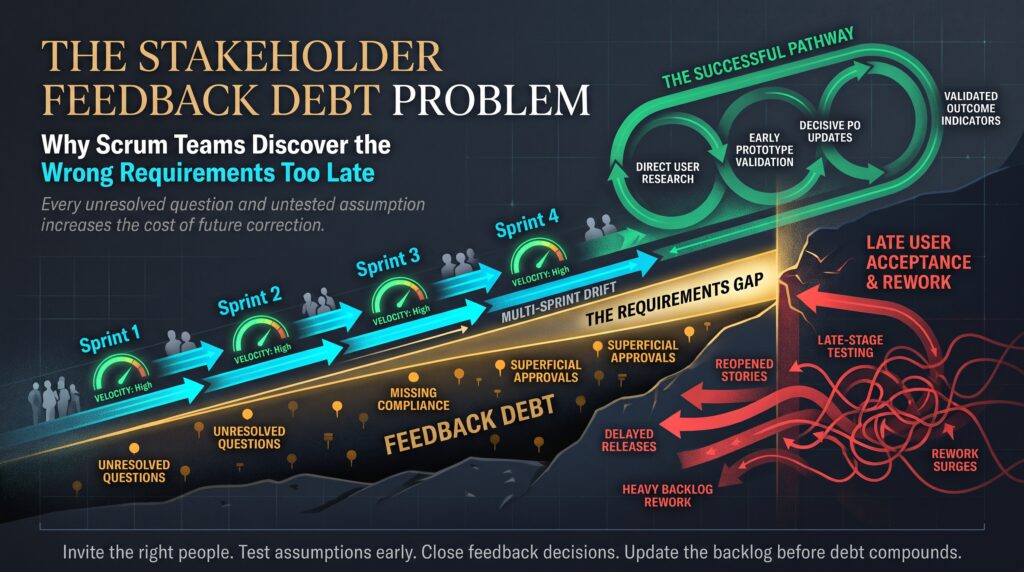
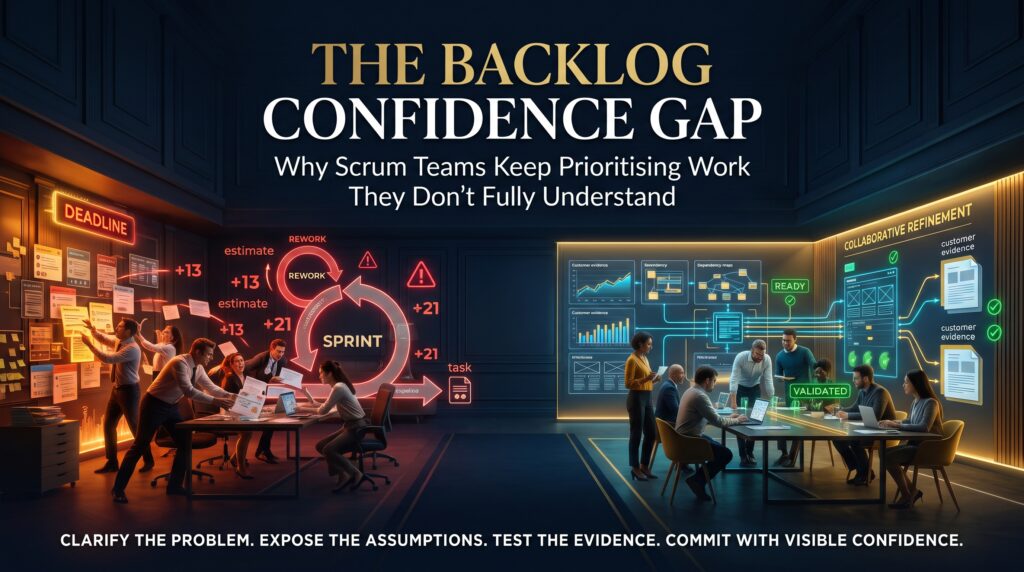
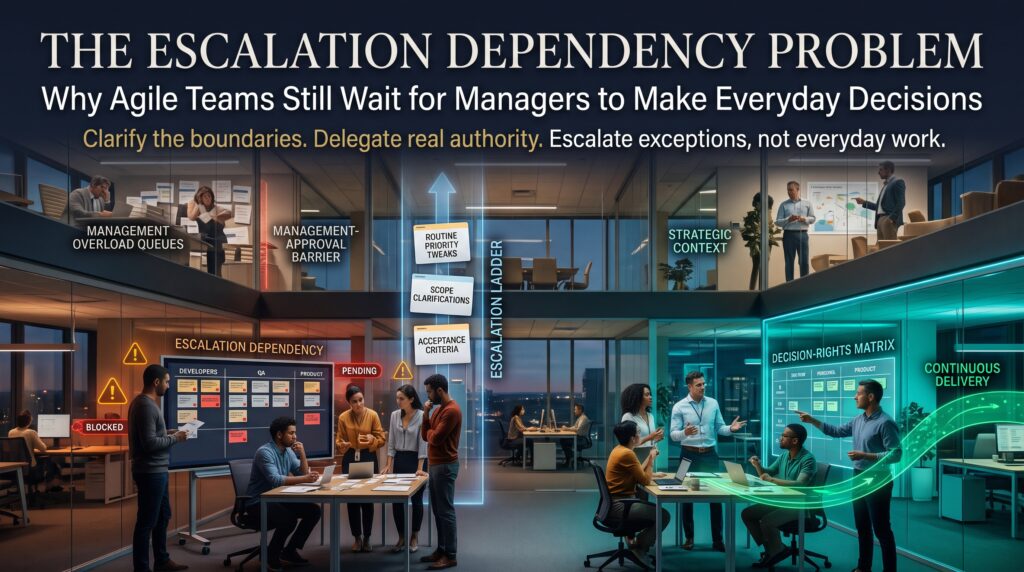
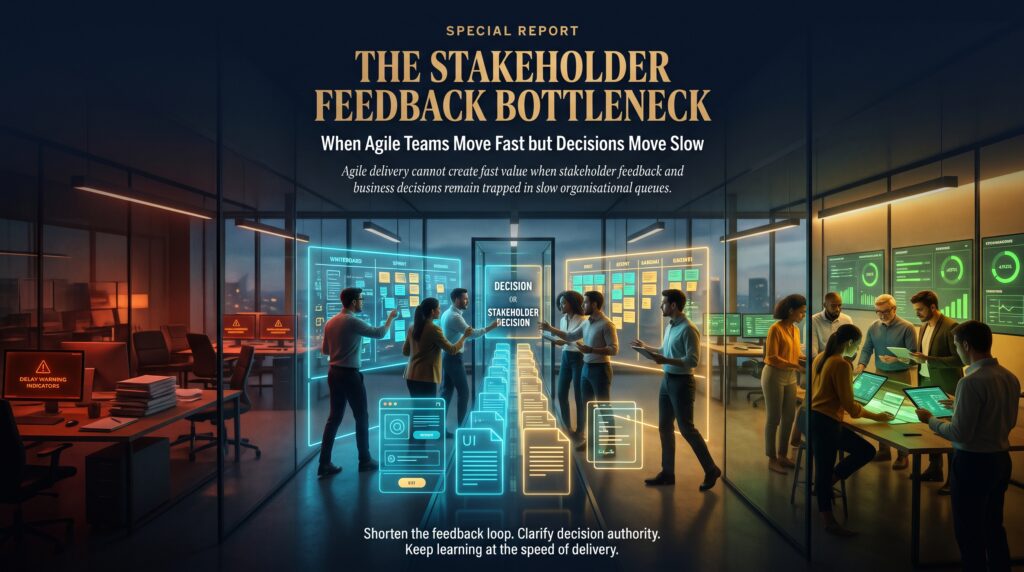
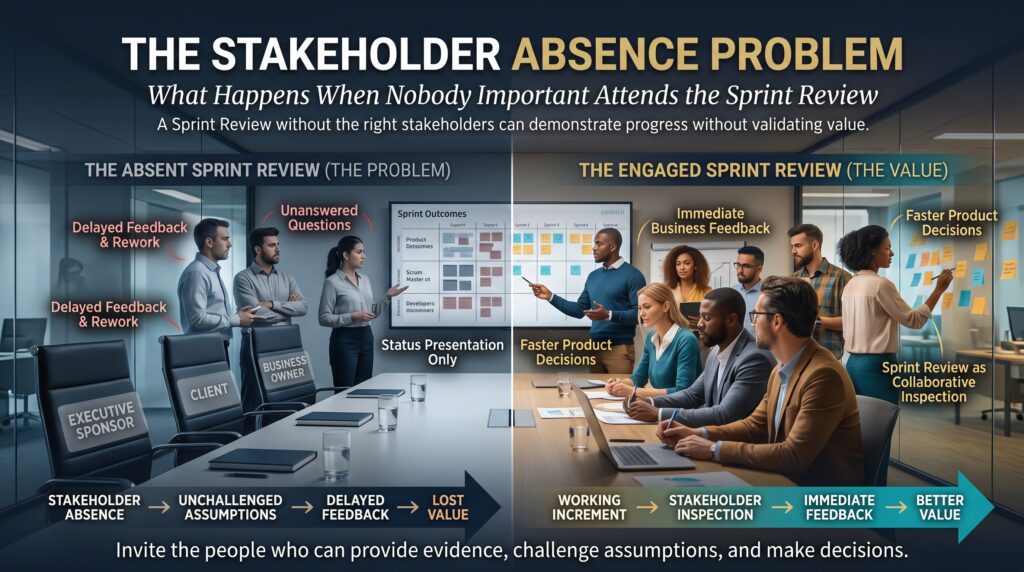
Sprint review attendance is one of the quietest early-warning signals in Agile delivery. When the right stakeholders stop turning up, nothing dramatic happens that day. The team still demos the work, someone still nods, and the meeting still ends on time. The damage shows up weeks later, as rework, missed expectations and a product that slowly drifts away from what the business actually needs.
This guide explains what happens when nobody important attends the sprint review, why sprint review attendance drops, how to measure the problem, and what Scrum Masters, Product Owners and teams in Sydney, Melbourne, Brisbane, Perth, Adelaide and Canberra can do to bring them back.
What Is the Sprint Review and Who Should Attend?
The Scrum Guide describes the sprint review as an event where the Scrum Team presents the results of its work to key stakeholders and discusses progress toward the Product Goal. It’s a working session, not a presentation. Participants inspect what was delivered, talk about what changed in the environment, and collaborate on what to do next. The Product Backlog may well be adjusted as a result. You can read the exact wording in the official Scrum Guide.
That last point is the whole reason sprint review attendance matters. The event is where empiricism, the Scrum idea of making decisions based on what you observe, meets real stakeholder input. If the people who hold the context, budget or decision rights aren’t in the room, the team is inspecting its work in a vacuum.
A sprint review also isn’t a status meeting or a sign-off ceremony. Treating it as either tends to push stakeholders away, which we’ll come back to shortly.
The Stakeholder Absence Problem: What It Looks Like
Poor sprint review attendance rarely appears as an empty room. It tends to show up in quieter forms:

| Attendance pattern | What the team sees | Hidden risk |
| Nobody senior attends | Only team members and the Product Owner join | Decisions are made without input from those who own the outcome |
| Delegates without authority | A junior representative takes notes | Feedback can’t be turned into decisions, so it stalls |
| Present but silent | Cameras off, no questions, no reactions | Silence gets mistaken for approval |
| Late arrivals and early exits | Key people join for ten minutes of a longer event | Context is missed and feedback is shallow |
| Regular cancellations | “Something urgent came up” every sprint | The review slowly becomes optional, then irrelevant |
Each pattern erodes the same thing: the shared understanding that the team is building the right product, not just building the product right.
What Happens When Nobody Important Attends the Sprint Review
The feedback loop breaks
Agile depends on short cycles of build, show and adjust. Remove the show-and-adjust step and you’re left with building in the dark. Problems that a five-minute comment would have caught in week two surface in week ten.
The Product Owner ends up deciding alone
When stakeholders are absent, the Product Owner carries every prioritisation call without fresh input. That’s a heavy load, and it concentrates risk on one person’s assumptions.
The backlog drifts away from real value
Priorities shift in a business all the time. Without regular contact, the Product Backlog reflects last quarter’s thinking instead of this month’s reality.
Late surprises and expensive rework
A compliance lead who first sees a feature at release time may spot a problem that needed a design change. By then, fixing it costs far more than it would have at the sprint review.
Team motivation quietly drops
People want their work to matter. When nobody senior shows up to look at it, teams start to wonder whether anyone cares. Over time, quality of demos declines, and attendance declines further. It becomes a self-reinforcing loop.
Trust between the team and the business erodes
Stakeholders who skip reviews often feel surprised and frustrated later. Teams feel unsupported. Each side blames the other, when the real cause was a missing conversation.
Why Stakeholders Stop Showing Up: Causes of Low Sprint Review Attendance
Before fixing sprint review attendance, it helps to understand why people disengage. In most organisations, it’s not disrespect. It’s one or more of these:
- Calendar overload: Senior people are double-booked and treat a recurring review as the easiest item to drop.
- Unclear value: Past reviews were too technical, too long or full of detail that didn’t concern them.
- Wrong format: A slide-heavy presentation invites passive listening, so people decide they can read the summary instead.
- Poor timing: The review lands at an awkward hour or clashes with other governance meetings.
- Assumed coverage: Stakeholders believe the Product Owner represents them well enough.
- No visible impact: Feedback was given before and nothing seemed to change.
- Weak sponsorship: Leadership never made it clear that attending is part of how the work gets governed.
An Illustrative Example of Low Sprint Review Attendance
Picture a hypothetical Sydney team building a customer onboarding portal for a financial services company. For the first three sprints, the head of compliance and the operations manager attend every review. By sprint six, attendance has dropped to the Product Owner’s manager and one business analyst, because the reviews have become long technical walkthroughs.
In sprint nine, the team demonstrates a document upload feature. Nobody present realises it doesn’t meet a recent compliance requirement. The gap is found two sprints later during release preparation, and the fix means reworking part of the data model. The missing conversation cost the team several weeks. That is the real price of poor sprint review attendance.
How to Measure Sprint Review Attendance Problems
You don’t need heavy reporting. A few simple indicators, tracked sprint by sprint, will show whether sprint review attendance and engagement are healthy.
| Indicator | What it tells you | Healthy direction |
| Decision-maker attendance | Whether people with authority are present | Consistently present |
| Feedback items captured per review | How much real input the team receives | Steady or rising |
| Backlog changes after the review | Whether feedback influences priorities | Regular, visible changes |
| Late-stage rework | Cost of problems found after release preparation | Falling |
| Days between build and stakeholder sight | How long work stays unseen | Short, within one sprint |
| Stakeholder pulse score | How valuable stakeholders find the review | Rising |
How to Improve Sprint Review Attendance Step by Step
1. Identify the stakeholders who truly matter
Not everyone with an opinion needs to attend. Map who owns the budget, who holds decision rights, who uses the product and who carries risk. Prioritise those people first.
2. Make the review about their decisions
Open with the Product Goal and what changed since last time. Then pose specific questions: “Do we release this to pilot users?” or “Which of these two options better fits your process?” People attend meetings where their input counts, and better content lifts sprint review attendance more than any reminder email.
3. Show working product, not slides
Demonstrate real, usable increments. Better still, let stakeholders click through it themselves. Hands-on contact produces sharper feedback than any presentation.
4. Fix the time and protect it
Choose a consistent slot that suits decision-makers, send invitations well ahead and keep the event within its time-box. Predictability builds habit.
5. Ask for input before the event
Send a short note a day or two earlier saying what will be shown and what you need from them. A specific request is harder to ignore than a generic invitation.
6. Offer an asynchronous fallback, not a replacement
A short recorded demo and a simple feedback form can keep an absent stakeholder in the loop. Treat it as a safety net, though. Live conversation is where most of the value lives.
7. Close the loop visibly
At the start of each review, show what changed because of the last one: “You asked for X, here’s what we did.” Nothing motivates attendance like proof that feedback matters.
8. Bring in sponsorship
If sprint review attendance stays low, ask an executive sponsor to reinforce that the sprint review is an expected part of governing the product. Their endorsement carries more weight than a team invitation.
9. Raise it as an impediment
Persistently low sprint review attendance is an impediment to the team’s work. Surface it in the sprint retrospective and escalate it like any other blocker.
The Scrum Master and Product Owner’s Role in Sprint Review Attendance
Stakeholder engagement is shared work. The Product Owner owns the relationship and the value conversation, while the Scrum Master coaches the wider organisation on why the event matters and how to make it effective. Neither can fix the problem alone, which is why this topic features so strongly in practical Scrum training.
Improving Sprint Review Attendance in Remote and Hybrid Teams
- Keep the event shorter and more interactive, using polls, live questions or shared boards.
- Share the Jira or backlog view during the session so stakeholders see progress toward the goal.
- Ask participants to turn cameras on for the discussion portion where practical.
- Rotate who presents so the demo isn’t always one person’s voice.
- Record the session and share a brief summary of decisions made.
Scrum Training That Builds Stakeholder Engagement Skills
Knowing the theory of the sprint review and actually getting stakeholders into the room are two different skills. Training helps with both, and it gives Scrum Masters a framework for improving sprint review attendance over time. These courses are a practical starting point:
- Agile Scrum Foundation (BCS/EXIN): core Scrum roles, events and artefacts, including the purpose of each event.
- Agile Scrum Practitioner (BCS/EXIN): applying Scrum in real situations and handling common team and stakeholder challenges.
- iSQI Scrum Master Pro Certification: deeper Scrum Master capability, including facilitation and coaching.
Scrum Master Courses Across Australia
Our Scrum Master courses are available through flexible online and classroom options. You can explore local pages for Sydney, Melbourne, Brisbane, Perth, Adelaide and Canberra.
Logitrain also delivers instructor-led IT and Agile training in Sydney, Melbourne, Brisbane, Perth, Adelaide and Canberra, alongside its wider Agile training courses. Unsure which course fits? Speak to a course advisor and we’ll help you choose.
Frequently Asked Questions About Sprint Review Attendance
What is a sprint review?
A sprint review is a Scrum event near the end of the sprint where the Scrum Team and key stakeholders inspect the work completed and discuss progress toward the Product Goal. It’s collaborative, and its outcome can include changes to the Product Backlog.
Who should attend the sprint review?
The whole Scrum Team (Product Owner, Scrum Master and Developers) plus key stakeholders: people who hold decision rights, use the product or carry the risk of the outcome. Quality of attendees matters more than quantity.
What should we do if sprint review attendance is low?
Find out why before reacting. Check whether the format, timing or content is the issue, tighten the agenda around their decisions, and ask a sponsor to reinforce expectations. Use a recorded demo only as a temporary fallback.
Can we cancel the sprint review if nobody important can attend?
It’s best not to. Skipping the event removes a core moment of inspection and adaptation. If attendance is genuinely impossible one sprint, shorten the session, capture input asynchronously and address the underlying problem straight away.
Is a sprint review the same as a demo?
No. A demo is one part of it. The sprint review also covers progress toward the goal, changes in the market or business, and what to do next. Reducing it to a demo is one reason stakeholders disengage.
How long should a sprint review last?
The Scrum Guide sets a maximum of four hours for a one-month sprint, and it’s usually shorter for shorter sprints. Most teams do well with a focused session, because shorter, sharper reviews are easier for senior people to commit to.
Who is responsible for getting stakeholders to attend?
The Product Owner leads the relationship, and the Scrum Master helps the organisation understand and remove barriers. In practice it’s a shared effort, backed by sponsor support.
Final Thoughts: Don’t Let the Room Go Quiet
Low sprint review attendance doesn’t announce itself with an alarm. It creeps in through cancellations, delegates and cameras that stay off. Yet this one event is often the clearest chance a team has to confirm it’s building something people actually want. The Agile Manifesto principles put it plainly: business people and developers should work together throughout the project.
If you’d like to build the facilitation and coaching skills to turn this around, explore our Scrum Master courses or read more on the Scrum Master Certification blog.