
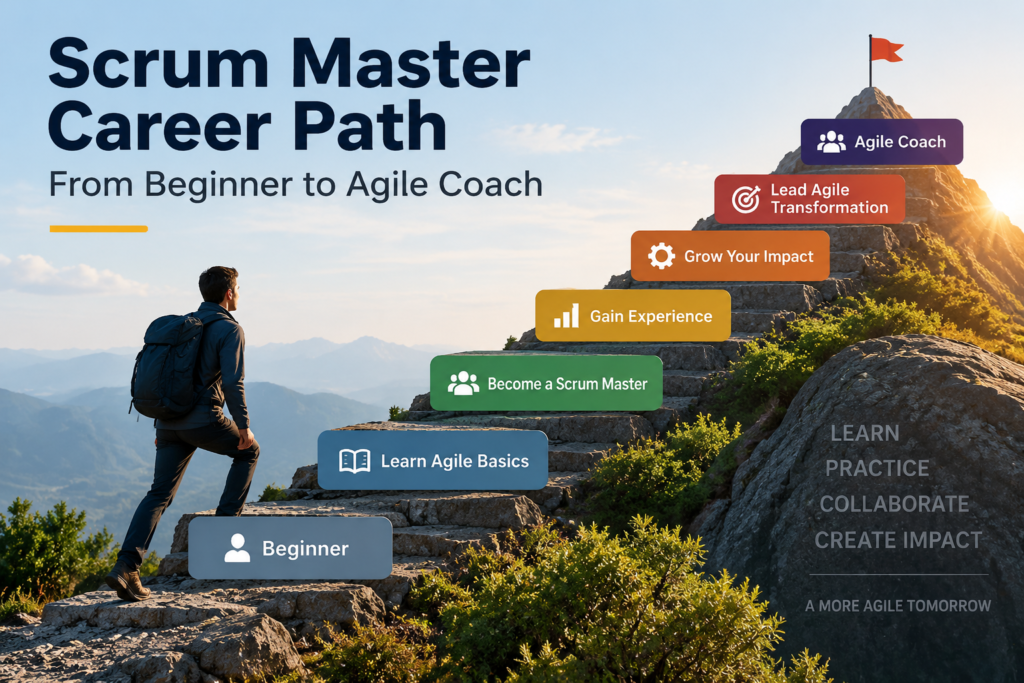
Every Scrum Master career path begins the same way: a curious team member volunteers to run stand-ups, and within a year they are facilitating sprints for an entire delivery team. The good news is that this journey is far more structured today than it was a decade ago. Whether you are a project coordinator in Melbourne, a business analyst in Sydney, or a developer in Brisbane looking to move into Agile leadership, there is now a clear, certification-backed route from your first Scrum ceremony to a senior Agile Coach title.
In this guide we map the entire Scrum Master career path step by step the entry-level skills you need, the certifications employers actually screen for, realistic Australian salary bands, and the pivot points that separate a junior Scrum Master from a strategic Agile Coach.
Stage 1: Starting the Scrum Master Career Path as a Beginner
Most people don’t apply for a “Scrum Master” job straight out of university they grow into it from an adjacent role such as coordinator, tester, business analyst or junior project manager. At this stage, the goal is to build a working vocabulary of Agile ceremonies and prove you can run a sprint without derailing it.
Core skills to build first
- Facilitating daily stand-ups, sprint planning, sprint review and retrospectives
- Reading and maintaining a product backlog in Jira, Azure DevOps or Trello
- Basic servant-leadership and conflict-resolution techniques
- Understanding velocity, burndown charts and definition of done
A structured Scrum Master Certification course is the fastest way to compress years of on-the-job trial and error into a few weeks of guided practice, which is why most recruiters now expect at least one recognised credential before they will shortlist an entry-level Scrum Master.
Stage 2: Getting Certified The Turning Point in Your Scrum Master Career Path
Certification is the single biggest lever you can pull early in your Scrum Master career path. It signals to hiring managers that you understand the Scrum Guide, not just the vocabulary, and it is usually the deciding factor between two otherwise similar resumes.
Popular entry certifications
- Agile Scrum Foundation (BCS/EXIN) — a beginner-friendly starting point covering Agile values and Scrum fundamentals. View the course
- Agile Scrum Practitioner (BCS/EXIN) — builds on the foundation level with applied sprint and backlog scenarios. View the course
- iSQI Scrum Master Pro Certification — a professional-level credential aimed at practising Scrum Masters. View the course
- Globally recognised options such as the Professional Scrum Master (PSM) from Scrum.org and the Certified ScrumMaster (CSM) from Scrum Alliance
These credentials are recognised by employers across Perth, Adelaide, Canberra and every other major Australian city, and most are also accepted by the Australian Computer Society as continuing professional development.
Stage 3: Working as a Full-Time Scrum Master
Once certified, most professionals spend two to four years running Scrum for one or two delivery teams. This is where the practical, day-to-day skills of the Scrum Master career path are sharpened: managing stakeholder expectations, coaching Product Owners on backlog refinement, protecting the team from scope creep, and reporting delivery metrics to leadership.
Typical Australian salary range
- Junior Scrum Master: AU$85,000 – AU$105,000
- Mid-level Scrum Master: AU$105,000 – AU$130,000
- Senior Scrum Master / multi-team: AU$130,000 – AU$150,000
Salaries vary by industry technology, finance and government roles tend to sit at the top of these bands, while not-for-profit and education roles sit closer to the lower end.
Stage 4: Scaling Agile SAFe, Multiple Teams and Program-Level Delivery
The next milestone on the Scrum Master career path is usually a scaled-Agile environment coordinating two or more Scrum teams inside a Scaled Agile Framework (SAFe) Agile Release Train, or stepping into a Release Train Engineer (RTE) role. This stage rewards Scrum Masters who can think beyond a single backlog and start influencing program-level planning, dependency mapping and cross-team retrospectives.
Stage 5: Becoming an Agile Coach The Top of the Scrum Master Career Path
The final destination on most people’s Scrum Master career path is the Agile Coach role. Where a Scrum Master serves one team, an Agile Coach works across an entire department or organisation, mentoring multiple Scrum Masters, redesigning delivery processes, and helping leadership adopt an Agile operating model.
What changes at the Agile Coach level
- You coach Scrum Masters and Product Owners rather than running ceremonies yourself
- You advise executives on organisational change and Agile transformation
- You design training programs and internal Communities of Practice
- Australian Agile Coach salaries typically range from AU$140,000 to AU$180,000+
Employers generally expect five or more years of Scrum Master experience, a track record across multiple teams, and an advanced credential such as a Scrum Alliance Certified Team Coach (CTC) or Certified Enterprise Coach (CEC) before promoting into this title.
Scrum Master Career Path Roadmap at a Glance
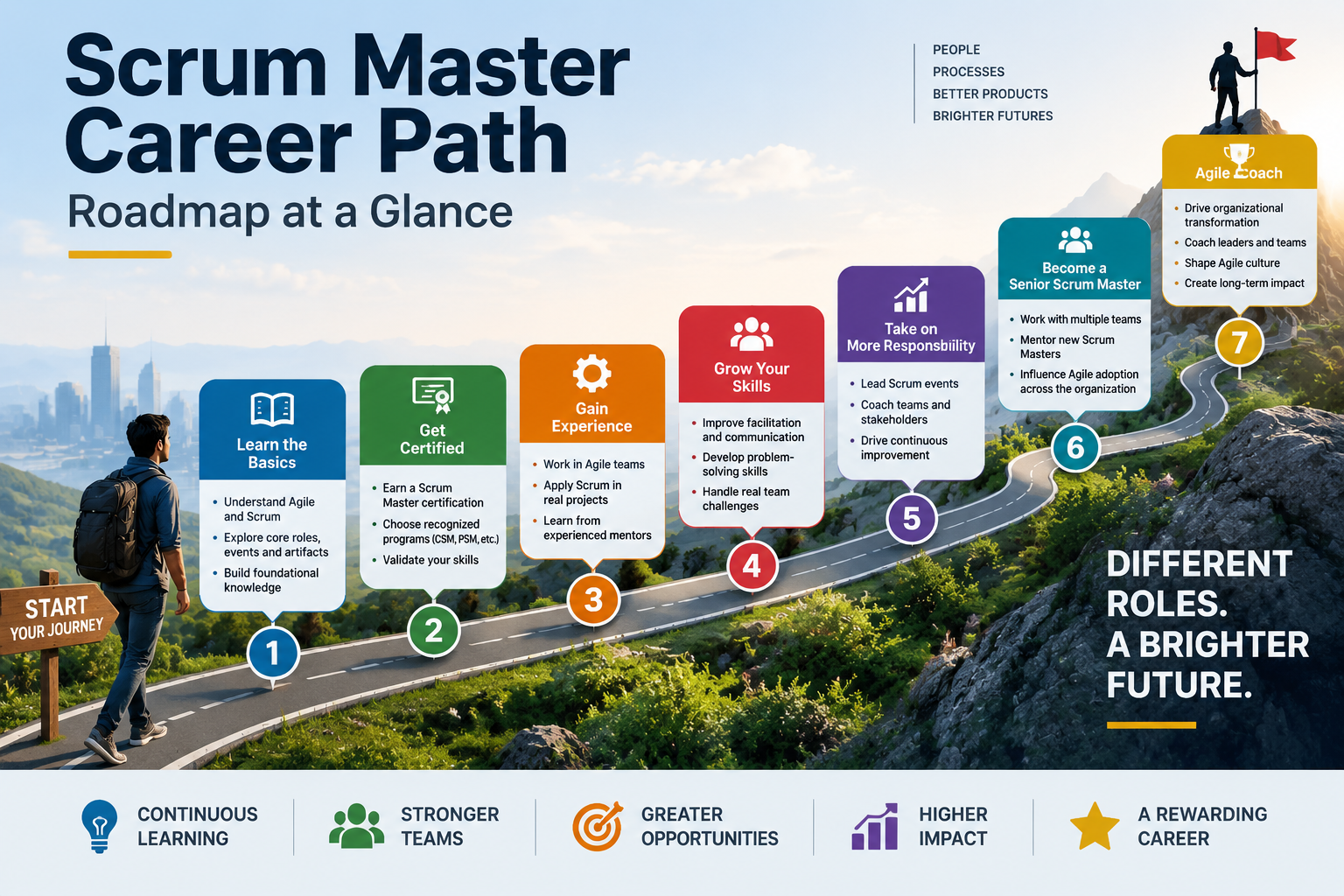
| Stage | Focus | Typical Timeframe |
| Beginner | Learn Agile ceremonies, backlog basics | 0–1 year |
| Certified Scrum Master | PSM / CSM / iSQI certification | 1–2 years |
| Practising Scrum Master | Run 1–2 teams, coach Product Owners | 2–4 years |
| Scaled Scrum Master | SAFe, multi-team, Release Train | 4–6 years |
| Agile Coach | Organisation-wide Agile transformation | 6+ years |
FAQs About the Scrum Master Career Path
Do I need a certification to start a Scrum Master career path?
It isn’t legally required, but almost every employer now shortlists certified candidates first. A recognised credential is the fastest way to prove Scrum knowledge to a hiring manager who doesn’t already know you.
How long does it take to go from beginner to Agile Coach?
Most professionals take six to eight years, moving through certified Scrum Master, practising Scrum Master and scaled-Agile roles before stepping into an Agile Coach position.
Is the Scrum Master career path only for IT professionals?
No. Scrum and Agile principles are now used in marketing, finance, construction, healthcare and government delivery teams, so the career path is open to professionals from almost any background.
Start Your Scrum Master Career Path Today
Ready to take the first step? Explore our Scrum Master Certification courses or contact our team to find the right training pathway for your city, including Melbourne, Sydney, Brisbane, Perth, Adelaide and Canberra.