
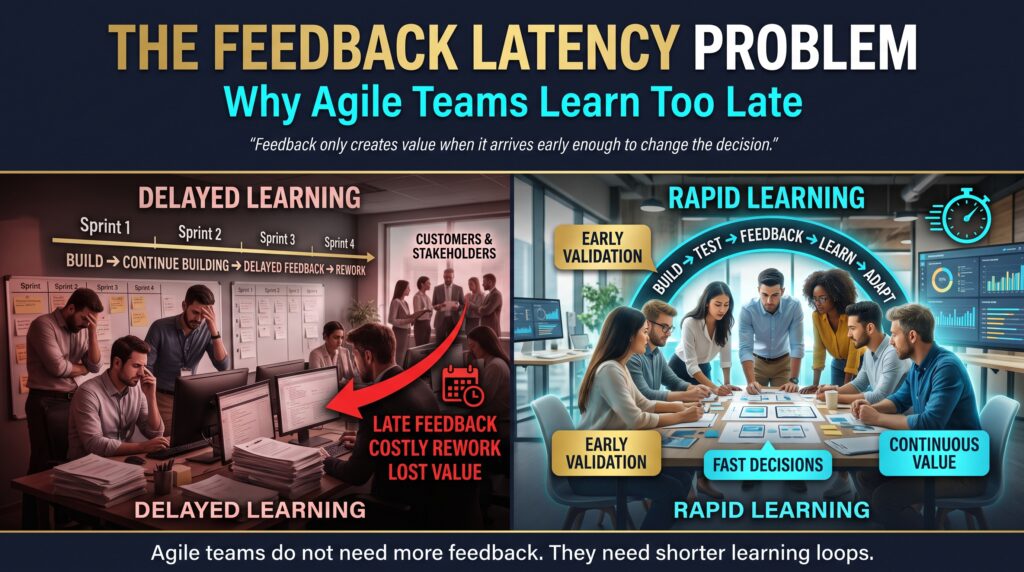


Feedback latency is the time between doing something and finding out whether it was the right thing to do. In an Agile team, that gap decides a surprising amount: how much rework you carry, how often you ship the wrong feature, and how long a small mistake is allowed to grow before anyone notices.
Here is a scene most teams will recognise. A developer finishes a story on Tuesday. The pull request sits in a queue until Thursday. Testing picks it up the following week. The product owner sees it for the first time at the sprint review, ten days after the work was done, and says, “Hmm, that is not quite what I meant.” Nobody did anything wrong. The team simply learned too late, and a sprint’s worth of assumptions are now baked in.
Agile is meant to be a learning machine. The Agile Manifesto asks teams to respond to change, and Scrum is built on inspection and adaptation. But you cannot adapt to something you have not seen yet. This guide explains where feedback latency hides, what it costs, how to measure it and what a Scrum Master can do about it, with training options for teams in Sydney, Melbourne, Brisbane, Perth, Adelaide and Canberra.
What Is Feedback Latency in Agile Teams?
Think of every piece of work as asking a question. Does this code run? Is it what the product owner wanted? Will a real customer care? Feedback latency is how long you wait for each answer. The shorter the wait, the cheaper it is to change direction.
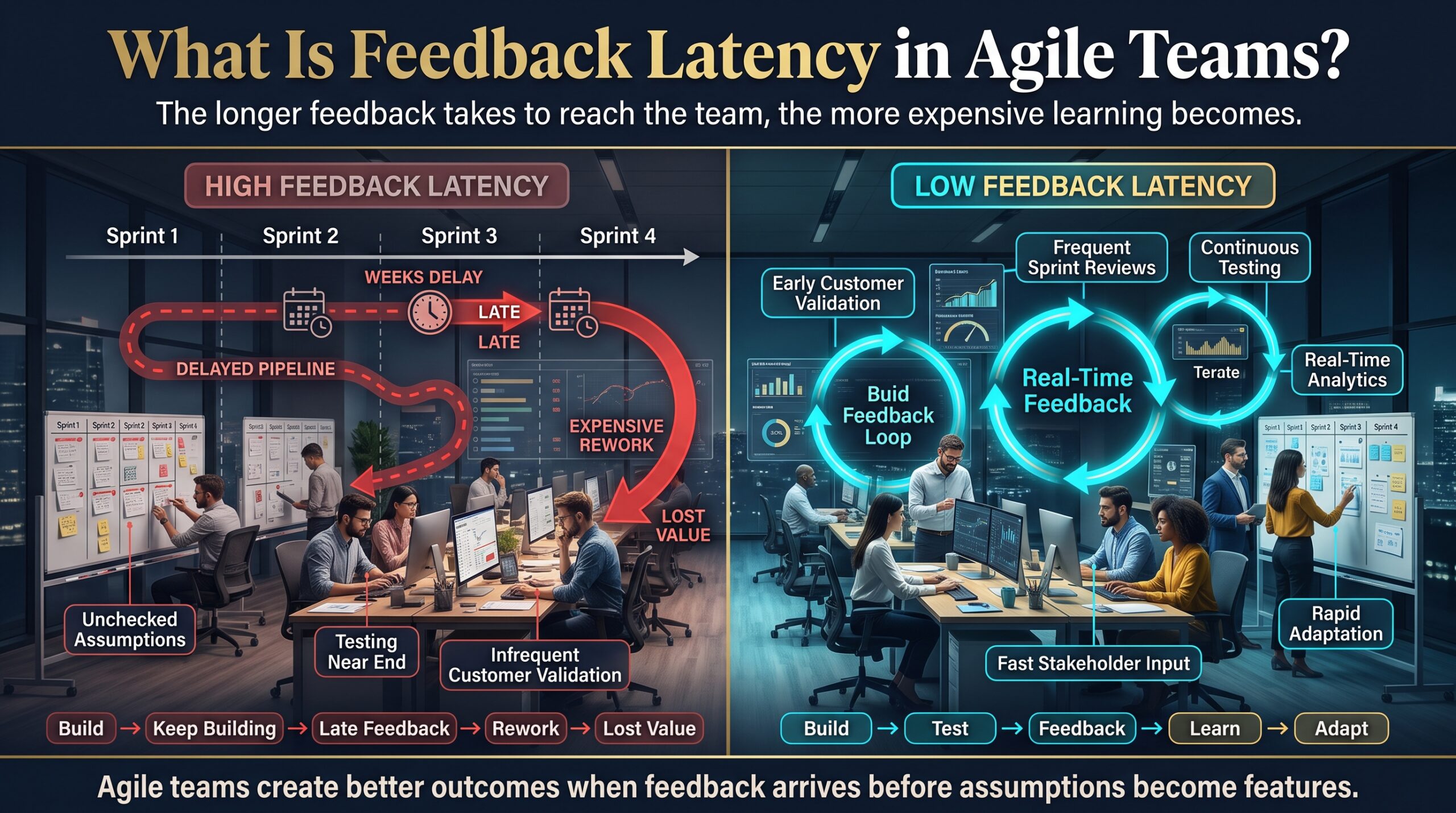
Most teams have several feedback loops running at once, and each one can be fast or slow:
| Feedback loop | Question it answers | Fast version | Slow version |
| Build and test | Did my change break anything? | Minutes after the commit | A test cycle days later |
| Code review | Is this change sound and understood? | Same working day | Pull requests waiting for days |
| Product review | Is this what the product owner meant? | As each story finishes | Only at the sprint review |
| Customer feedback | Does a real user find this valuable? | Soon after a small release | After a big launch, if at all |
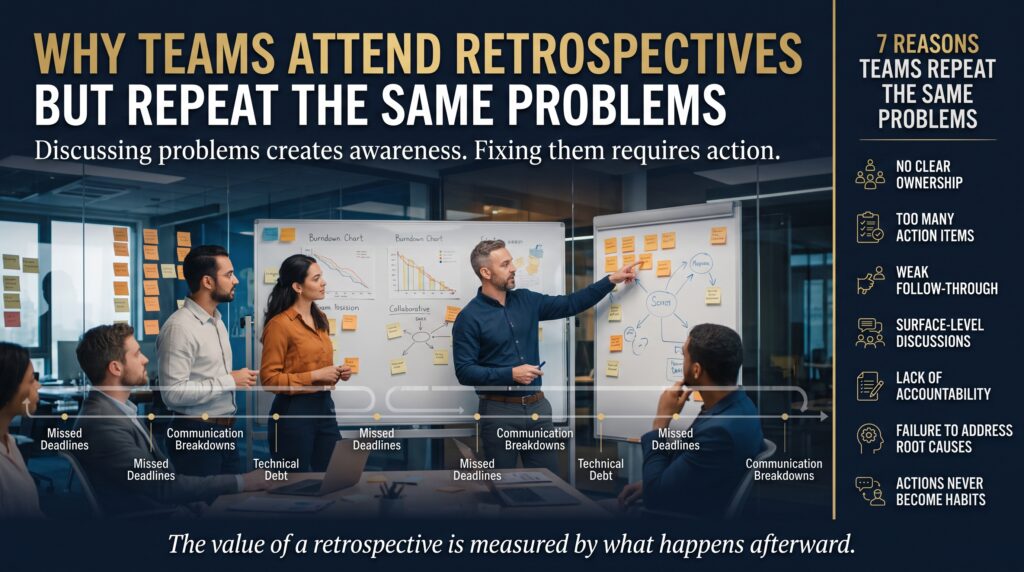
| Team process | Is the way we work helping us? | Every sprint, with follow-through | Retros that repeat the same issues |
A team can look busy and productive while every one of those loops runs slowly. That is what makes feedback latency easy to miss.
Why Agile Teams Learn Too Late
Slow feedback is rarely one big failure. It is a handful of ordinary habits that add up.
- Work arrives in big batches. Large stories, large pull requests and large releases all delay the first moment anyone can react to what was built.
- Real review only happens at ceremonies. If the sprint review is the first time stakeholders see the work, the earliest possible correction is the end of the sprint.
- Testing sits at the end of the sprint. This creates a mini waterfall inside Scrum, where the riskiest discoveries land just before the deadline.
- Queues are invisible. Work waiting between people does not look like a problem on a board. It looks like “In Review” or “Ready for Test”, and it can sit there for days.
- Customers are far away. When the product owner is the only link to users, the team gets opinions instead of evidence.
- Releases are painful. If deploying is stressful, teams do it less often, and every change waits longer to meet real users.
- Velocity gets the attention. Measuring output tells you how fast you are moving, not how fast you are learning.
- Nobody owns the loop. Everyone assumes someone else is watching how long feedback takes.
The Real Cost of Slow Feedback
A bug caught minutes after it is written is cheap to fix because the developer still remembers what they were thinking. The same bug found weeks later costs far more, because the context is gone and other work has been built on top of it. The same logic applies to features, designs and process choices. The cost of feedback latency shows up in familiar ways:
- Rework that surprises the team at the sprint review.
- Features that are delivered on time but miss what users actually needed.
- Risks discovered late, when options are limited and stress is high.
- Sprint goals that slip because problems surfaced in the final days.
- Stakeholders who lose trust because they only see progress in big, late reveals.
- Team frustration, because people feel they keep fixing yesterday’s decisions.
How to Spot Feedback Latency in Your Team
You do not need new software to find it. Start by noticing the symptoms. Do items spend longer waiting than being worked on? Do stakeholders often react with surprise at the sprint review? Do retrospective actions keep reappearing? Are customers first seeing features at launch rather than during development? If you answered yes to any of these, feedback latency is probably costing you.
Then put numbers on it. Most of these measures are already available in tools such as Jira or Azure DevOps, and the DevOps Research and Assessment programme at DORA publishes well-known delivery metrics, including lead time for changes, that you can borrow.
| Measure | What it shows | Where to look |
| Cycle time | How long work takes once it is started | Your sprint or Kanban board |
| Time in each status | Where work sits waiting | Board history or workflow report |
| Time to first review | How long pull requests wait for attention | Your code repository |
| Lead time for changes | How long a change takes to reach production | Deployment pipeline |
| Surprise rate at review | How often stakeholders expected something different | A simple tally kept by the team |
Feedback Latency vs Velocity
Velocity measures how much a team finishes. Feedback latency measures how quickly the team finds out whether what it finished was right. A team with high velocity and slow feedback ships the wrong things very efficiently. A team with moderate velocity and fast feedback tends to ship the right things, then improves quickly. When leaders ask for faster delivery, the better question is often “how can we learn sooner?”
A Practical Plan to Reduce Feedback Latency
You can make real progress without changing your whole process. Try these in order.
- Map your feedback loops. Draw the path from idea to user on a whiteboard and mark every point where someone waits for an answer. The map itself is often an eye-opener.
- Shrink the batch size. Slice stories into thin, vertical pieces that can be finished, reviewed and demonstrated in a day or two.
- Bring review forward. Show finished work to the product owner as each story completes, not only at the sprint review. Ten minutes at the desk beats a surprise in the ceremony.
- Make testing continuous. Automate what you can, test alongside development, and write acceptance criteria into the Definition of Done so quality is checked early.
- Limit work in progress. Fewer items in flight means shorter queues. Kanban-style WIP limits are a simple way to make waiting visible and uncomfortable.
- Put real users in the loop. Run short demos, quick usability sessions or small releases behind a feature toggle, so evidence replaces guesswork.
- Close the retrospective loop. Pick one improvement, name an owner and review it at the start of the next sprint. Retros only shorten feedback if actions actually happen.
What about sprint length? The Scrum Guide caps a sprint at one month, and shorter sprints do create more frequent chances to inspect and adapt. But shortening the sprint alone will not fix feedback latency if work still waits in queues or stakeholders still only appear at the end. Treat sprint length as one lever, not the whole answer.
Where the Scrum Master Fits
The Scrum Master is the natural guardian of the empirical loop. That does not mean running more meetings. It means making delays visible and helping the team remove them. In practice, a strong Scrum Master will:
- Ask “how long did we wait to find that out?” whenever a surprise appears.
- Coach the product owner to give feedback during the sprint rather than saving it up.
- Make queues and waiting time visible on the board and in retrospectives.
- Help the team agree smaller slices of work and stronger Definitions of Done.
- Remove organisational impediments such as slow approvals, shared environments or unclear decision rights.
These are learnable skills, and they sit at the heart of good Scrum practice. They are also exactly what separates a facilitator who runs ceremonies from a leader who improves how the team learns.
Feedback Latency Across Australian Cities
Every city deals with feedback latency, just through a different industry lens.
- Sydney: banks, fintechs and large digital teams release often, so slow review and approval steps are felt quickly.
- Melbourne: telecommunications, health, retail and state government projects mix many stakeholders, which can stretch feedback from users and sponsors.
- Brisbane: infrastructure, resources and growing technology teams often depend on handovers between delivery groups.
- Perth: mining and energy technology teams work where a late discovery can be expensive, so early feedback is highly valuable.
- Adelaide: defence, health and advanced manufacturing projects often carry strict review and sign-off requirements.
- Canberra: government digital delivery often includes compliance and approval steps that can add long waits if they are not planned for.
Wherever you work, you can train live online, and learners in Melbourne, Sydney and Brisbane can also attend in person. Compare all options on our locations page.
Scrum Master Certification Courses That Build Faster Feedback Habits
If you want to move from noticing slow feedback to fixing it, a structured course gives you the shared language and techniques to lead the change:
- Agile Scrum Foundation (BCS/EXIN): a solid starting point covering core Agile and Scrum principles, roles and events.
- Agile Scrum Practitioner (BCS/EXIN): builds on the foundation and focuses on applying Scrum in real delivery situations.
- iSQI Scrum Master Pro Certification: a practical certification aimed at people who want to perform the Scrum Master role well.
Not sure which suits you? Browse all Scrum Master certification courses, check the FAQs, or explore the wider Agile training pathway at Logitrain. You can also call 1300 649 299 and speak to a course advisor.
Frequently Asked Questions About Feedback Latency
What is feedback latency in Agile?
It is the delay between completing work and learning whether it was correct, useful or valuable. Long delays mean mistakes grow before anyone notices them.
How do you reduce feedback latency in Scrum?
Work in smaller slices, review finished stories with the product owner straight away, test continuously, limit work in progress and get real users involved early. Then follow through on retrospective actions.
Does a shorter sprint reduce feedback latency?
It can, because the team inspects and adapts more often. But if work still waits in queues or stakeholders only appear at the review, a shorter sprint will not fix the underlying delay.
Who is responsible for fast feedback in a Scrum team?
The whole team shares it. The Scrum Master helps make delays visible and coaches the team, the product owner provides timely answers, and developers build quality in early.
Which metrics show slow feedback?
Cycle time, time spent in each status, time to first code review and lead time for changes are good starting points. A simple count of review surprises also helps.
Which Scrum course should I take first?
Most beginners start with Agile Scrum Foundation, then move to Agile Scrum Practitioner or the iSQI Scrum Master Pro certification as they gain hands-on experience.
Learn Sooner, Not Just Work Faster
Feedback latency does not disappear because a team is talented or hardworking. It shrinks when someone notices the waiting, names it and helps the team design it out. Start small. Pick one loop, measure how long it takes and try to halve it in the next sprint.
If you want the skills and credentials to lead that kind of change, explore our Scrum Master certification courses and build the habits that help Agile teams learn while it still matters. Call 1300 649 299 or contact our team and we will help you choose the right pathway.