



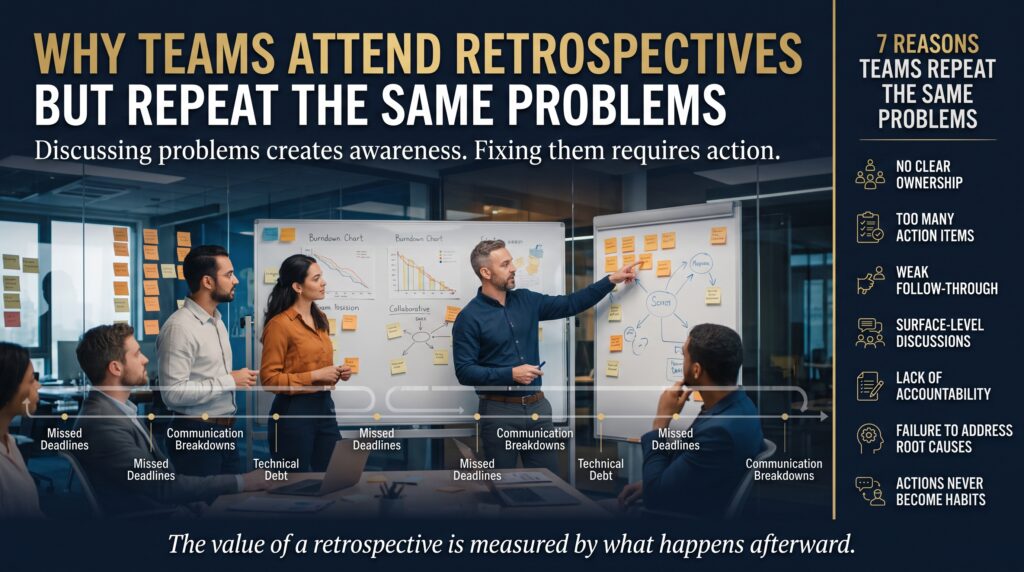
The accountability vacuum is what opens up when a group of capable people all notice the same problem and quietly decide that someone else will deal with it. Nobody is lazy. Nobody is hiding. Yet the broken process stays broken, the risky email stays unanswered, and the decision that matters sits on the table until it turns into a crisis.
You have probably lived it. A bug gets mentioned in three different chat threads and no ticket is ever raised. A stakeholder asks a hard question in a meeting and the room goes quiet. Everyone leaves with the same thought: surely the manager, the team lead or the person sitting closest to the issue will pick it up. This guide explains why the accountability vacuum forms, how to spot it early, and the practical steps that close it, including how Scrum gives teams the structure to stop it for good.
What Is an Accountability Vacuum?
An accountability vacuum is a gap where responsibility should be, but is not. The work, the decision or the risk clearly exists, yet no single person has been named as the one who must act. In place of an owner, the group relies on an assumption: somebody else will handle it.
This is different from poor performance. In a performance problem, a person has a task and fails to deliver it. In an accountability vacuum, nobody was ever clearly handed the task. That distinction matters because coaching an individual will not fix a structural gap. You have to fix the structure.
The pattern turns up in cross-team dependencies, shared inboxes, new projects with vague roles, hybrid meetings and any decision made by committee. Wherever ownership is shared by “everyone”, it is usually held by no one.
Why Everybody Assumes Somebody Else Will Act
Psychologists have studied this behaviour for decades. The bystander effect describes how people are less likely to help in an emergency when other people are present. In the late 1960s, researchers John Darley and Bibb Latané ran experiments showing that the more people believed they were witnesses, the slower any one of them was to respond.
The mechanism underneath is called diffusion of responsibility. When a duty is spread across many people, each person feels only a thin slice of it. Workplaces then add their own ingredients to the mix:

- Unclear roles. If the project charter does not say who decides, nobody does.
- Fear of overstepping. People hold back when they worry about stepping on a colleague’s territory.
- Social proof. When nobody else reacts, we read the silence as proof there is nothing to react to.
- Junior staff assume leaders already know. Leaders assume the team would have raised it.
- Overloaded calendars. When everyone is stretched, “not my job” becomes a survival tactic.
Warning Signs of an Accountability Vacuum in Your Team
The good news is that this problem leaves fingerprints. Watch for these signals:
- Action items in meeting notes with no name and no date attached.
- Sentences that start with “we should” or “someone needs to”.
- The same issue raised week after week without visible progress.
- Work that sits at 90 per cent complete and never quite finishes.
- Surprise escalations followed by the question “why didn’t anybody tell me?”.
- Blame appearing after a failure instead of ownership appearing before it.
Here is a fast test. Pick any open problem on your team and ask, “Who will do the next step, and by when?” If you hear three different answers, or a long pause, you have found a vacuum.
The Real Cost of Unowned Work
Small gaps compound. A missed follow-up becomes a missed deadline, which becomes a strained client relationship. Rework climbs because problems are found late. Quality slips because nobody felt it was their place to flag a defect early.
The human cost is just as serious. High performers get frustrated carrying the load nobody else will pick up, and trust erodes as people start to suspect that raising a concern changes nothing. Over time, an unchecked gap becomes part of the culture, and that is much harder to repair than any single missed task.
How Scrum Closes the Accountability Vacuum
Scrum was built on the idea that clarity beats heroics. The official Scrum Guide defines three accountabilities: the Product Owner, the Scrum Master and the Developers. Notice the word. These are not just job titles, they answer a direct question: who is answerable for this outcome? Teams that want to go deeper can also explore the learning resources at Scrum.org.
One Name Per Outcome
The Product Owner is accountable for maximising the value of the product and for ordering the Product Backlog. The Scrum Master is accountable for the team’s effectiveness and for how well Scrum is understood and applied. The Developers are accountable for creating a usable Increment every Sprint. When a question comes up, there is a clear place to send it.
Make the Work Visible
A transparent Product Backlog, Sprint Backlog and team board show what exists and who is working on it. Work with no name on it stands out immediately, which makes unowned work much harder to hide.
A Definition of Done Nobody Can Ignore
A shared Definition of Done sets the quality bar for every item. Testing, documentation and review stop being “someone else’s job” because they are part of finished work for the whole team.
Daily Scrum and Retrospective
Short, regular check-ins expose stalled items within a day, not a month. Retrospectives then ask the harder question: where did we assume somebody else would act, and what will we change? A trained Scrum Master learns to look for impediments and to keep asking who owns the next step.
7 Steps to Close the Gap Today
- Name a single owner. One person per action. Not a team, not a committee.
- Write the next step and the date. “Sam will send the revised estimate by Thursday” beats “we’ll follow up”.
- Ask by name. Replace “can someone take this?” with “Alex, can you take this?” Direct requests cut through the bystander effect.
- Make it safe to say “I’ve got it” and just as safe to say “I can’t”. Honest hand-offs prevent silent failures.
- Clarify decision rights. A simple RACI chart or decision log shows who decides, who advises and who is informed.
- Review open actions first. Start every recurring meeting with last week’s commitments, not new topics.
- Recognise ownership out loud. Praise the person who picked up the loose thread, publicly and specifically.
Accountability Vacuum Training for Teams Across Australia
If your team keeps falling into the same trap, structured training can reset habits faster than another policy memo. Scrum Master Certification offers courses for professionals in Melbourne, Sydney, Brisbane, Perth, Adelaide and Canberra, plus live online and in-house options. Learners in Hobart, Darwin, the Gold Coast, Newcastle, Geelong, Wollongong, Townsville and Cairns can also train online.
Choose the course that fits your role:
- Agile Scrum Foundation (BCS/EXIN) to build a solid understanding of Scrum roles, events and artefacts.
- Agile Scrum Practitioner (BCS/EXIN) to apply Scrum in real project scenarios.
- iSQI Scrum Master Pro Certification to step confidently into a Scrum Master role.
Not sure where to begin? Read the FAQs, learn more about us, browse more articles on the blog, or contact the team on 1300 649 299 to ask about group and in-house training.
Frequently Asked Questions
What is an accountability vacuum?
An accountability vacuum is a gap in a team or organisation where nobody has been clearly named as responsible for an action, decision or risk, so everyone assumes somebody else will act.
What causes an accountability vacuum at work?
The main causes are unclear roles, diffusion of responsibility, fear of overstepping, social proof and overloaded schedules. Vague meeting actions without owners or dates make it worse.
How do you fix an accountability vacuum?
Name one owner for every action, record the next step and due date, ask for commitments by name, clarify decision rights and review open actions at the start of each meeting.
Is this the same as the bystander effect?
They are closely related. The bystander effect describes individuals failing to help when others are present, while an accountability vacuum describes the structural gap this behaviour creates inside teams and organisations.
Can Scrum training help close an accountability vacuum?
Yes. Scrum defines clear accountabilities, makes work visible, uses a Definition of Done and builds in regular inspection, which together make unowned work easy to spot and fix.
Conclusion: Stop Waiting for Somebody Else
An accountability vacuum does not need bad people to exist. It only needs good people, a shared problem and an unspoken assumption. The fix is refreshingly practical: name an owner, set a date, make the work visible and keep checking in.
If you are ready to build that habit across your team, explore the Scrum Master Certification courses or speak with our team today. Somebody has to take the first step, and it can be you.