


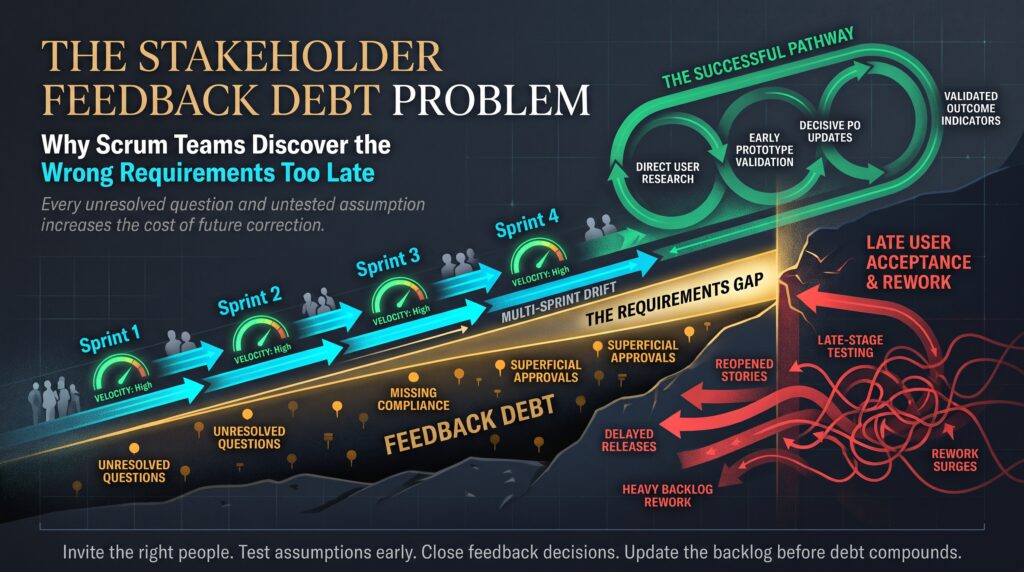
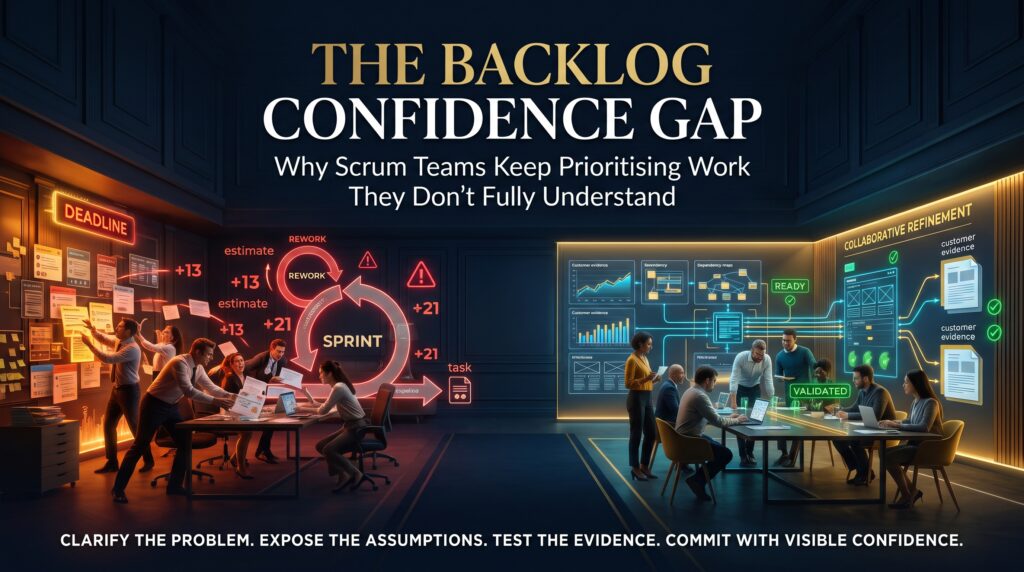
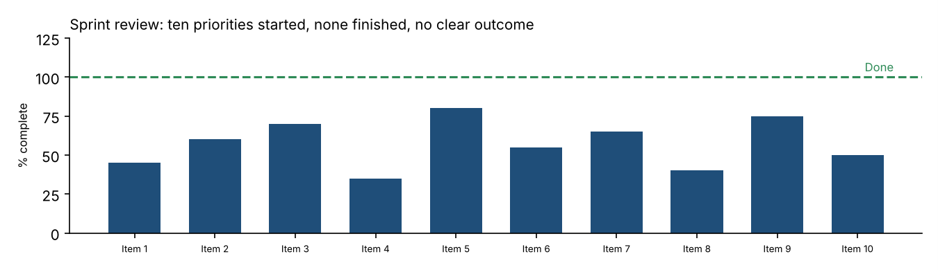
Sprint goal dilution is what happens when a Scrum team fills a sprint with so many priorities that the one thing the sprint was meant to achieve gets lost. At the sprint review, ten items are “in progress”, nothing is truly finished and nobody can say what the team set out to deliver. The board looks busy. The stakeholders look confused. If that sounds like your last sprint, you are dealing with sprint goal dilution.
This guide explains why it happens, what it costs your team and how to fix it with practical habits. It is written for Scrum Masters, product owners, developers and delivery leads across Australia, from Melbourne and Sydney to Brisbane, Perth, Adelaide and Canberra.
What Is a Sprint Goal, and What Does Dilution Mean?
In Scrum), the sprint goal is the single objective for the sprint. It explains why the sprint is valuable to stakeholders and gives the team a reason to work together instead of in separate lanes. The official Scrum Guide makes the sprint goal the commitment attached to the sprint backlog.
Sprint goal dilution happens when that single objective is replaced by a long list. The sprint goal becomes “finish tickets 101 to 110”, or it quietly disappears, or it exists on a slide that nobody remembers. Every extra priority takes a little focus away from the rest until the team is working on everything and completing nothing.
A diluted goal is not the same as a missed goal. A team can miss a clear goal and still learn something. When the goal is blurred, nothing is learned because nobody knows what success looked like.
Why Sprint Goal Dilution Happens
Teams do not plan to lose focus. Sprint goal dilution grows from everyday pressures:
- The backlog is treated like a to-do list. Teams pull as many items as capacity seems to allow, instead of choosing items that serve one outcome.
- Stakeholders each bring a priority. Sales, operations and leadership all want their request in this sprint, and nobody wants to be the one left out.
- The product owner cannot say no. Without a clear product vision and strong boundaries, “just one more item” becomes a habit.
- The goal is written as a list. “Complete stories A, B, C and D” describes work, not an outcome.
- Capacity is overestimated. Teams forget holidays, support work, meetings and unplanned requests.
- Mid-sprint additions. Urgent requests arrive and replace the plan without anyone reviewing the goal.
- Too much work in progress. Everyone starts their own item, so nothing reaches done together.
- Velocity becomes the target. When teams are measured on points delivered, they chase volume instead of value.
- Scrum Masters act as administrators. If no one coaches the team on focus, the events become rituals with no purpose.
Each reason feels small. Together, they make sprint goal dilution the default outcome.
Warning Signs of Sprint Goal Dilution
Look for these signs of sprint goal dilution in your own sprints:
- The team cannot state the sprint goal in one sentence without looking it up.
- Most items finish in the last two days of the sprint, or spill over to the next one.
- The sprint review is a tour of tickets rather than a story about an outcome.
- Carry-over work appears on the board sprint after sprint.
- Stakeholders ask “what did you actually get done?” after the review.
- Developers work on different items in parallel with little collaboration.
- The retrospective keeps repeating “we took on too much”.
Example: Sprint Goal Dilution in a Fintech Team
Imagine a Scrum team at a fintech company in Melbourne. At sprint planning, three stakeholders each present an urgent feature. The product owner agrees to all of them and the team pulls in ten stories. The sprint goal on the board reads: “Deliver the Q4 backlog items.”
By day six, an unplanned production issue takes two developers away. A fourth stakeholder asks for a quick change. At the sprint review, six stories are 70% done, two are not started and two are finished but not tested together. Nothing can be released. The team calls it a “tough sprint”, but the real cause was a goal that was never a goal. (This is an illustrative scenario, not a specific client.)
The Cost of Sprint Goal Dilution
The impact of sprint goal dilution goes well beyond one untidy sprint:
- Longer cycle times. Queueing theory, summed up in Little’s Law, shows that more work in progress means each item takes longer to finish.
- Nothing to release. A sprint full of half-done items delivers no usable increment.
- Lost stakeholder trust. After a few sprints without a visible outcome, people stop believing in the process.
- Rising carry-over and hidden debt. Unfinished work piles up and slows later sprints.
- Weak learning. Without a clear goal, the team cannot tell whether a result was good or bad.
- Ritual-only Scrum. Planning, stand-ups and reviews happen, but they stop producing real decisions.
- Tired teams. People feel busy all the time yet rarely get the satisfaction of finishing something that matters.
How to Fix Sprint Goal Dilution: 7 Steps
1. Write the sprint goal as one clear outcome
Use a single sentence that states the value for users or the business. “Customers can pay their invoice online with a saved card” is better than “complete stories 12, 14 and 15”.
2. Pick the goal first, then the work
At sprint planning, agree the goal before choosing backlog items. Pull only the items that help achieve that goal. Items that do not support it wait for a later sprint.
3. Limit work in progress
Encourage the team to finish items before starting new ones. Swarming on a story, pairing and small work items all help work reach done together.
4. Make the product owner the single voice of priority
Stakeholders should bring requests to the product owner, not to individual developers. The product owner decides what serves the goal and what goes to the backlog.
5. Plan for the unexpected
Leave room for support, bugs and leave. If urgent work arrives mid-sprint, ask whether it threatens the goal. Negotiate scope, not the goal.
6. Use the daily scrum to inspect progress toward the goal
Ask “are we on track to meet the sprint goal?” rather than “what did you do yesterday?”. Adjust the plan each day to protect the outcome.
7. Review and improve goal achievement
At the sprint review, show how the goal was met or missed. In the retrospective, track how often the team meets its goals and what blocked it. This is where sprint goal dilution gets fixed for good.
Weak vs Strong Sprint Goals
| Situation | Weak sprint goal | Strong sprint goal |
| Payments feature | Complete stories 21, 22, 23 and 24 | Customers can pay an invoice online using a saved card |
| Onboarding | Work on onboarding improvements | New users can create an account and reach their dashboard in under 3 minutes |
| Reporting | Deliver Q4 backlog items | Managers can export the monthly sales report without help from IT |
| Technical debt | Fix tech debt | Reduce checkout page load time below 2 seconds on mobile |
| Mixed priorities | A bit of everything for all stakeholders | One shippable improvement; other requests are ordered in the backlog |
Sprint Goal Checklist for Scrum Teams
- Can every team member state the sprint goal in one sentence?
- Does the goal describe an outcome, not a list of tickets?
- Was the goal agreed before backlog items were selected?
- Does every item in the sprint backlog clearly support the goal?
- Is work in progress limited, and do we finish before we start?
- Is there room in the plan for unplanned work?
- Do we check progress toward the goal at every daily scrum?
- Do we record in each retrospective whether the goal was met?
What Do Scrum Resources Say About the Sprint Goal?
The Scrum Guide describes the sprint goal as a commitment that gives the team flexibility on the work while staying fixed on the purpose. Developers can adjust the scope as they learn more, as long as the sprint goal is not endangered. If the goal becomes obsolete, the product owner can cancel the sprint. For practical articles and training standards, visit Scrum.org and the Agile Alliance.
Build Your Skills: Scrum Master Certification in Australia
Protecting the sprint goal is a core Scrum Master skill. Good training teaches you how to facilitate planning, coach product owners and keep teams focused when pressure rises. Explore our full list of Scrum Master certification courses, including the Agile Scrum Foundation (BCS/EXIN) course, the Agile Scrum Practitioner (BCS/EXIN) course and the iSQI Scrum Master Pro certification.
Study online or choose a city near you:
- Scrum Master certification in Melbourne
- Scrum Master certification in Sydney
- Scrum Master certification in Brisbane
- Scrum Master certification in Perth
- Scrum Master certification in Adelaide
- Scrum Master certification in Canberra
Not sure which course fits? Read our FAQs, see all training locations, learn about us or contact our team on 1300 649 299.
Sprint Goal Dilution FAQs
What is sprint goal dilution?
It is when a sprint carries so many competing priorities that the single sprint goal is blurred or lost, so the team ends the sprint without one clear, finished outcome.
What makes a good sprint goal?
A good sprint goal is one sentence, describes value for users or the business, is understood by the whole team and can be checked at the sprint review.
How many priorities should a sprint have?
One primary goal. A sprint can contain several backlog items, but they should all contribute to that single objective.
What should we do when urgent work arrives mid-sprint?
Talk with the product owner and ask whether it threatens the goal. If it does, negotiate the scope or, in extreme cases, consider whether the sprint should be cancelled. Do not quietly add work and hope for the best.
Which course helps Scrum Masters keep teams focused?
The Agile Scrum Foundation and Agile Scrum Practitioner courses cover Scrum events, roles and coaching, and the iSQI Scrum Master Pro certification goes deeper into the Scrum Master role.
Final Thoughts on Sprint Goal Dilution
Sprint goal dilution does not come from lazy teams. It comes from too many priorities and too little focus. Write one clear outcome, choose work that serves it, limit work in progress, protect the team from mid-sprint noise and review goal achievement every sprint. Do that and your teams will finish what matters, and your stakeholders will see it.
Ready to lead sharper sprints? Explore our Scrum Master certification courses or get in touch today. For more practical advice, visit the Scrum Master Certification blog.