

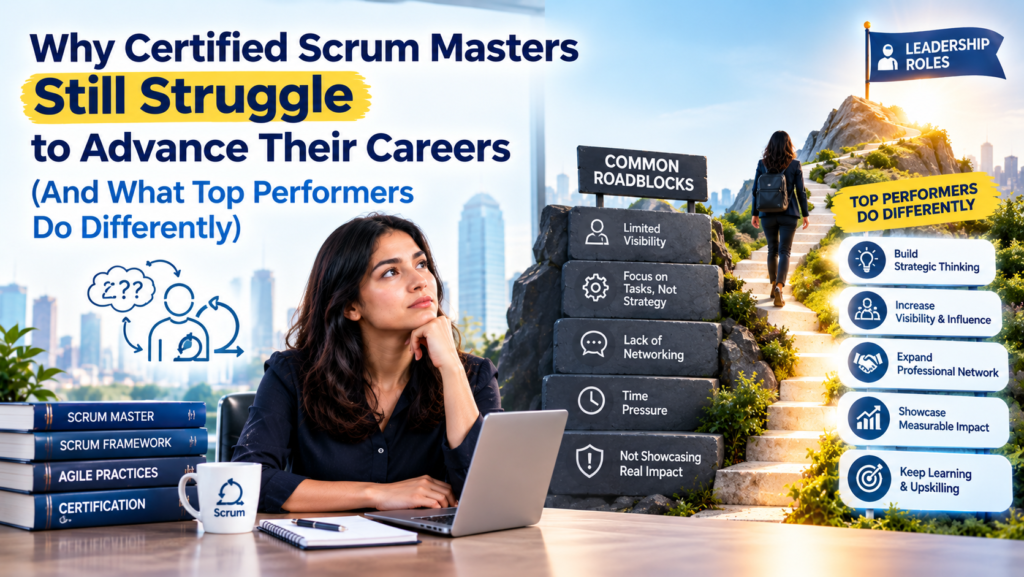
Scrum Master career advancement stalls for far more certified professionals than most people admit. You passed the exam, you run tidy sprints and your team likes working with you. Yet the senior title, the pay rise or the move into coaching keeps going to someone else. If that sounds familiar, the problem is probably not your certificate.
This article explains why a certification alone rarely drives Scrum Master career advancement, what top performers do differently, and how to build a plan you can start this month.
The Certification Trap: Why a Certificate Does Not Guarantee Scrum Master Career Advancement
A Scrum Master certification is a great start. It proves you understand the framework, the roles and the events, and it gets your CV past the first filter. The trouble is that everyone else in the pile has one too. Scrum Alliance’s own guidance on growing agile coaching skills notes that its skills report found organisations receiving somewhere between 70 and 300 applications for a single Scrum Master role.
When the certificate is the baseline rather than the differentiator, Scrum Master career advancement depends on what you can show beyond it. Hiring managers and executives want evidence that you change results, not just that you know the Scrum Guide. That evidence is exactly what most stalled Scrum Masters cannot produce.
Scrum Master Career Advancement: 6 Reasons Certified Professionals Get Stuck
These patterns show up across teams in Sydney, Melbourne and every other Australian city. Read them honestly and pick the two that sting the most.
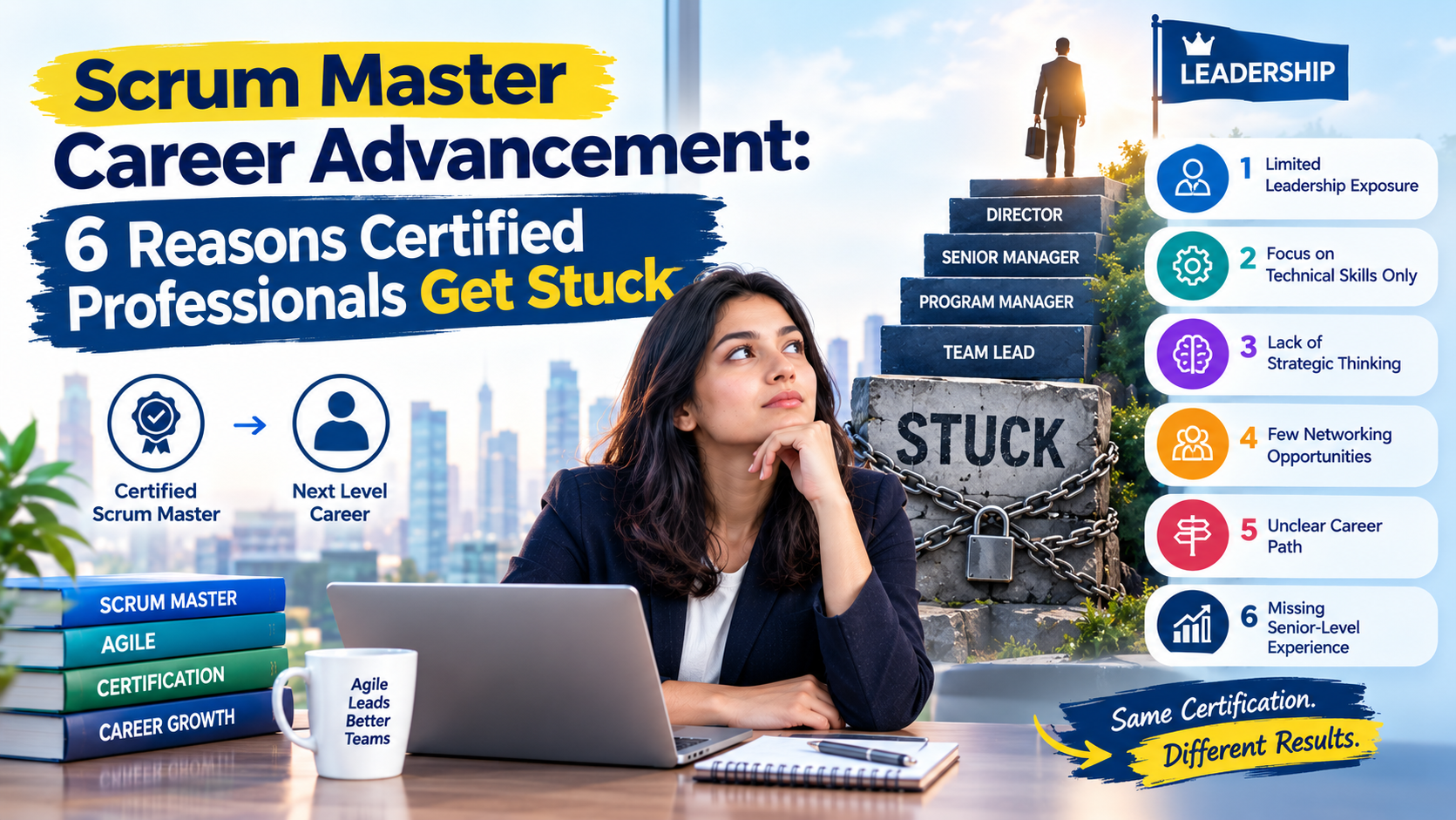
1. You are seen as a ceremony host
If your week is stand-ups, planning, reviews and retrospectives, that is how people will describe your job. Ceremonies matter, but they are the visible surface of the role. Stakeholders promote people who improve outcomes, and nobody can see an outcome in a calendar invite.
2. You cannot speak the language of business results
Velocity and story points mean little to a general manager. Cycle time, customer satisfaction, cost of delay and time to market do. Scrum Masters who translate team metrics into business impact get invited into conversations about funding and priorities. Those who do not stay in the team room.
3. You coach the team but not the organisation
Many of the biggest impediments sit above the team: approval bottlenecks, unclear priorities, rigid budgets and misaligned incentives. A Scrum Master who only fixes team-level problems will hit a ceiling quickly. Real Scrum Master career advancement comes from taking those systemic blockers to leaders with a clear case and a proposed fix.
4. Your learning stopped at the first certificate
Plenty of people take a foundation course, feel finished and never build on it. Employers notice when your skills have not moved for three years. Layering learning, from Agile Scrum Foundation (BCS/EXIN) to Agile Scrum Practitioner (BCS/EXIN), shows you can apply Scrum in real, messy scenarios rather than only describe it.
5. You have no evidence portfolio
Ask yourself: what changed because of you? If you cannot answer with a before-and-after, such as a faster release cycle, fewer escaped defects or higher team engagement, you are asking decision makers to promote you on trust. Trust is helpful, but numbers win.
6. You wait to be promoted instead of shaping the role
Senior Scrum Master, Agile Coach and Delivery Lead roles rarely appear because someone noticed you. They appear because someone with influence argued for them. Without a sponsor, and without a clear proposal for what the bigger role would do, your progress depends on luck.
What Top Performers Do Differently
The Scrum Masters who keep moving up are not necessarily the most certified or the most senior. They simply behave differently in six ways, and each one closes a gap from the list above.
- They measure and share outcomes. Every quarter they publish two or three simple numbers that show how the team is improving, and they tie those numbers to what the business cares about.
- They escalate impediments with solutions. Instead of complaining about blockers, they bring leaders a short summary of the problem, its cost and a recommended action.
- They coach leaders, not only teams. They help managers understand their own role in an agile system, which builds the influence senior roles require.
- They learn in layers. They add a new certification or skill every year or two, chosen to fill a specific gap rather than to collect badges.
- They build a visible track record. They present at internal forums, run brown-bag sessions and write short case notes, so their impact is known beyond their own team.
- They find a sponsor and ask for the role. They tell a senior leader exactly what they want to grow into and ask what evidence would earn it.
| Area | Stalled Scrum Master | Top Performer |
| Main focus | Running ceremonies well | Improving delivery and business outcomes |
| Metrics | Velocity and burndown | Cycle time, quality, customer feedback |
| Impediments | Fixes what the team can reach | Escalates systemic blockers with a proposed fix |
| Coaching | Team only | Team, product owner and leadership |
| Learning | One certificate, then a gap | A deliberate layered plan |
| Visibility | Known inside the team | Known across the department |
| Career approach | Waits to be noticed | Builds a case and asks for the role |
Which Certifications Support Scrum Master Career Advancement?
Certification cannot replace results, but the right credential at the right time supports your case for a bigger role. If you are choosing your next step in Scrum Master career advancement, these Scrum Master courses are a sensible path:
- Agile Scrum Foundation (BCS/EXIN): builds a solid base in Agile and Scrum principles, roles and events.
- Agile Scrum Practitioner (BCS/EXIN): moves from theory to applying Scrum in realistic project scenarios.
- iSQI Scrum Master Pro Certification: an additional recognised credential aimed at professional Scrum Masters who want to strengthen their profile.
You can also explore the wider Agile training pathway at Logitrain, or read more career articles on our Scrum Master blog.
A 90-Day Plan to Restart Your Scrum Master Career Advancement
You do not need a new job to change your trajectory. You need ninety days of deliberate action. Here is a simple plan for Scrum Master career advancement that fits around your current role.
- Days 1 to 30, audit. List what you have changed in the last twelve months and attach a number to each item. Ask your manager and product owner which of the six blockers they see in you.
- Days 31 to 60, stretch. Pick one systemic impediment and take it to a leader with a written proposal. Start sharing a one-page outcomes summary each sprint.
- Days 61 to 90, position. Book a career conversation with a senior sponsor. Present your evidence portfolio, name the role you want and ask what is missing.
Repeat the cycle every quarter. Steady, visible progress beats a single dramatic move every time, and it is the most reliable route to Scrum Master career advancement.
Scrum Master Career Advancement Across Australian Cities
Opportunities vary by city, so it helps to know where agile delivery roles tend to cluster. Use this table to plan your next move and find local training.
| City | Where agile roles cluster | Training options |
| Sydney | Financial services, technology and consulting | Scrum Master training in Sydney |
| Melbourne | Technology, health, education and construction | Scrum Master training in Melbourne |
| Brisbane | Government, infrastructure and technology | Scrum Master training in Brisbane |
| Perth | Resources, energy and engineering technology | Scrum Master training in Perth |
| Canberra | Federal government digital and policy delivery | Scrum Master training in Canberra |
| Adelaide | Defence, state government and health | Scrum Master training in Adelaide |
Based in Hobart, Darwin or a regional centre? Live online and in-house options let you follow the same career plan from anywhere. See all training locations.
Scrum Master Career Advancement FAQs
Why is my Scrum Master career not progressing?
Usually because your value is hard to see. Certification proves knowledge, but promotions go to people who can show business results, influence beyond the team and a clear plan for the next role. Scrum Master career advancement follows evidence, not tenure.
What is the next step after Scrum Master?
Common next steps include Senior or Lead Scrum Master, Agile Coach, Delivery Lead, Release Train roles and Agile Project Manager. The right choice depends on whether you enjoy coaching, delivery leadership or organisational change.
Do I need more certifications to advance?
Not always, but the right one helps. A practitioner-level credential shows you can apply Scrum in complex situations, which supports a Scrum Master career advancement conversation with your manager. Pair it with measurable results.
How long does it take to get promoted as a Scrum Master?
There is no fixed timeline. Many people who build an evidence portfolio and a sponsor relationship see movement within 12 to 24 months, depending on their organisation and the roles available.
Can I study Scrum Master courses online?
Yes. Live online and instructor-led options are available across Australia. Visit our FAQs page or contact our team to find a class that suits your schedule.
Turn Your Certificate Into Real Career Growth
A Scrum Master certificate opens the door, but it does not walk you through it. Scrum Master career advancement comes from measurable outcomes, organisational coaching, layered learning and a sponsor who backs you. Choose one habit from this article and start this week.
When you are ready to add your next credential, explore our Scrum Master certification courses or call 1300 649 299 to speak with our team. Your next role is closer than it looks.