
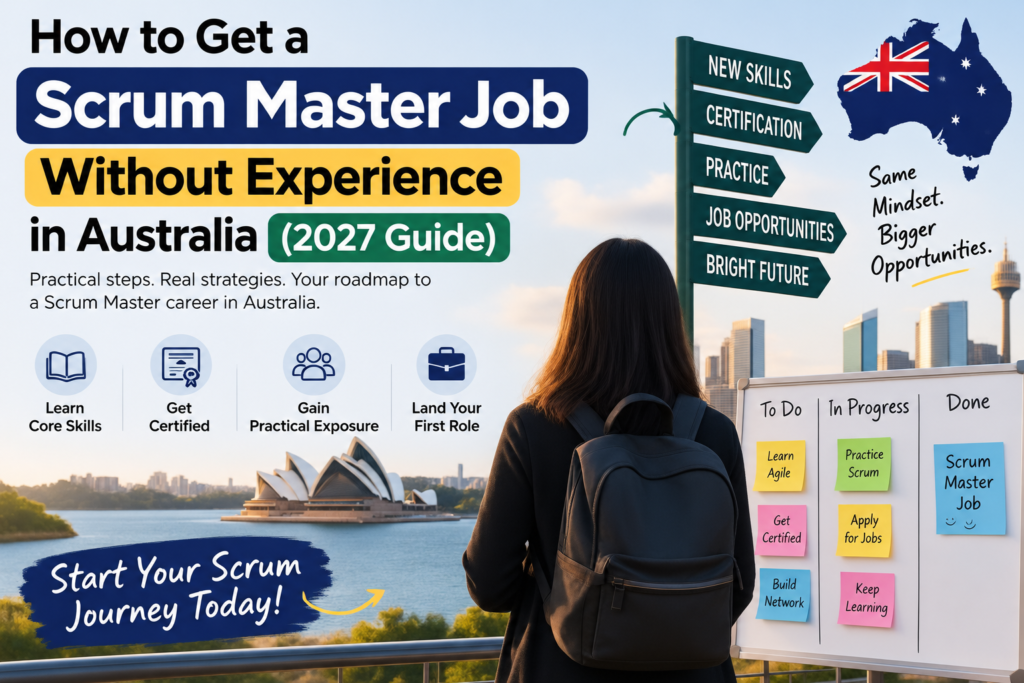
It’s the question every career changer eventually types into Google: how to get a Scrum Master job without experience. The good news is that Scrum Master is one of the few tech-adjacent careers where you genuinely don’t need years in the industry to land your first role but you do need a deliberate plan. Employers can’t hire potential alone; they hire evidence, even from candidates with zero formal job titles yet.
This 2027 guide walks through exactly how to get a Scrum Master job without experience in Australia, step by step, whether you’re job hunting in Melbourne, Sydney, Brisbane, Perth, Adelaide or Canberra.
Why ‘No Experience’ Doesn’t Mean ‘No Chance’
Scrum Master is unusual among Agile roles because it’s a facilitation and coaching role, not a purely technical one. Many hiring managers actively look for strong communicators, natural problem-solvers and people who can keep a team focused traits people bring from teaching, hospitality, customer service, coordination or even retail management, not just IT.
What employers are really screening for isn’t a job history that says ‘Scrum Master’ it’s proof you understand the Scrum framework, can run key ceremonies, and can handle the people side of Agile delivery under pressure.
Step 1: Get a Recognised Scrum Certification
A certification is the fastest way to prove baseline knowledge when you have no on-the-job history to point to. Structured training such as the Agile Scrum Foundation (BCS/EXIN) course, the Agile Scrum Practitioner (BCS/EXIN) course, or the iSQI Scrum Master Pro Certification gives you a recognised credential and a working knowledge of Scrum roles, events, artefacts and Agile principles that recruiters can screen for immediately.
- Choose Foundation level first if you’re completely new to Agile.
- Move to Practitioner or Pro level once you understand the basics, to signal deeper competence.
- Keep the certificate visible at the top of your resume and LinkedIn headline.
Step 2: Build Real Experience Before You Have a Job Title
This is the step most beginners skip and it’s the one that actually gets interviews. You don’t need a paid role to practise being a Scrum Master:
- Volunteer to run Scrum ceremonies for a community group, sporting club or non-profit project.
- Offer to facilitate a small project at your current job, even outside your official role.
- Join or start a study group that simulates sprints, stand-ups and retrospectives.
- Take on an unofficial ‘Scrum Master’ role in a personal or open-source side project.
Document all of it. A candidate who can say “I ran daily stand-ups and a retrospective for a six-week volunteer project” beats a candidate with a certificate and nothing else, every time.
Step 3: Rebuild Your Resume Around Transferable Skills
If your background is in teaching, coordination, customer service, hospitality or project support, don’t hide it reframe it. Classroom management is stakeholder facilitation. Rostering is sprint planning. Handling customer complaints under pressure is exactly the composure a Scrum Master needs during a blocked sprint.
- List your certification and any Agile-related training at the top.
- Reframe past roles around facilitation, coordination, and removing obstacles for a team.
- Add a short ‘Agile Projects’ section for volunteer or self-driven Scrum experience.
- Use language from real job ads sprint planning, backlog refinement, stakeholder communication.
Step 4: Target the Right Entry Points
Very few organisations advertise a role literally called “Junior Scrum Master” so look sideways instead of only searching that exact title:
- Agile Coordinator or Agile Delivery Support roles
- Project Coordinator or Business Analyst roles within Agile teams
- Internal transfers moving from another team into Agile delivery once you’re inside a company
- Contract or short-term Scrum Master roles, which often carry a lower experience bar than permanent positions
Step 5: Prepare for Scenario-Based Interviews
Scrum Master interviews rarely test textbook definitions alone they test how you’d handle real team dynamics: a blocked sprint, a difficult stakeholder, a team member who won’t engage in stand-ups, or scope creep mid-sprint. Practise talking through these scenarios out loud using the framework and vocabulary from your certification training, backed by any volunteer or practice-project examples you’ve built.
How Structured Scrum Master Training Speeds This Up
This is exactly why a properly structured Scrum Master Certification course matters for beginners it doesn’t just prepare you for an exam, it builds the practical, scenario-based understanding of sprint planning, backlog management, team facilitation and continuous improvement that interviewers actually probe for. Courses cover real-world project delivery practices, not just theory, so first-time candidates walk in with something to talk about beyond a certificate.
You can view the full Scrum Master courses list to compare Foundation, Practitioner and Pro-level pathways depending on where you’re starting from.
Training Available in Every Major Australian City
Flexible online and instructor-led training is available for beginners in Melbourne, Sydney, Brisbane, Perth, Adelaide, Canberra, as well as Hobart, Darwin, Gold Coast, Newcastle, Geelong, Wollongong, Townsville, Cairns and online across Australia. See the full locations page for options near you.
What the Job Market Says About Entry-Level Agile Roles
Demand for Agile-skilled professionals remains strong across Australia’s technology, finance, healthcare, government and construction sectors. Workforce and hiring trend data from sources such as Scrum.org and Australian job-market listings on SEEK consistently show demand for certified Scrum Masters outpacing the supply of experienced candidates which is exactly why employers remain open to well-prepared beginners who can demonstrate real understanding of the framework.
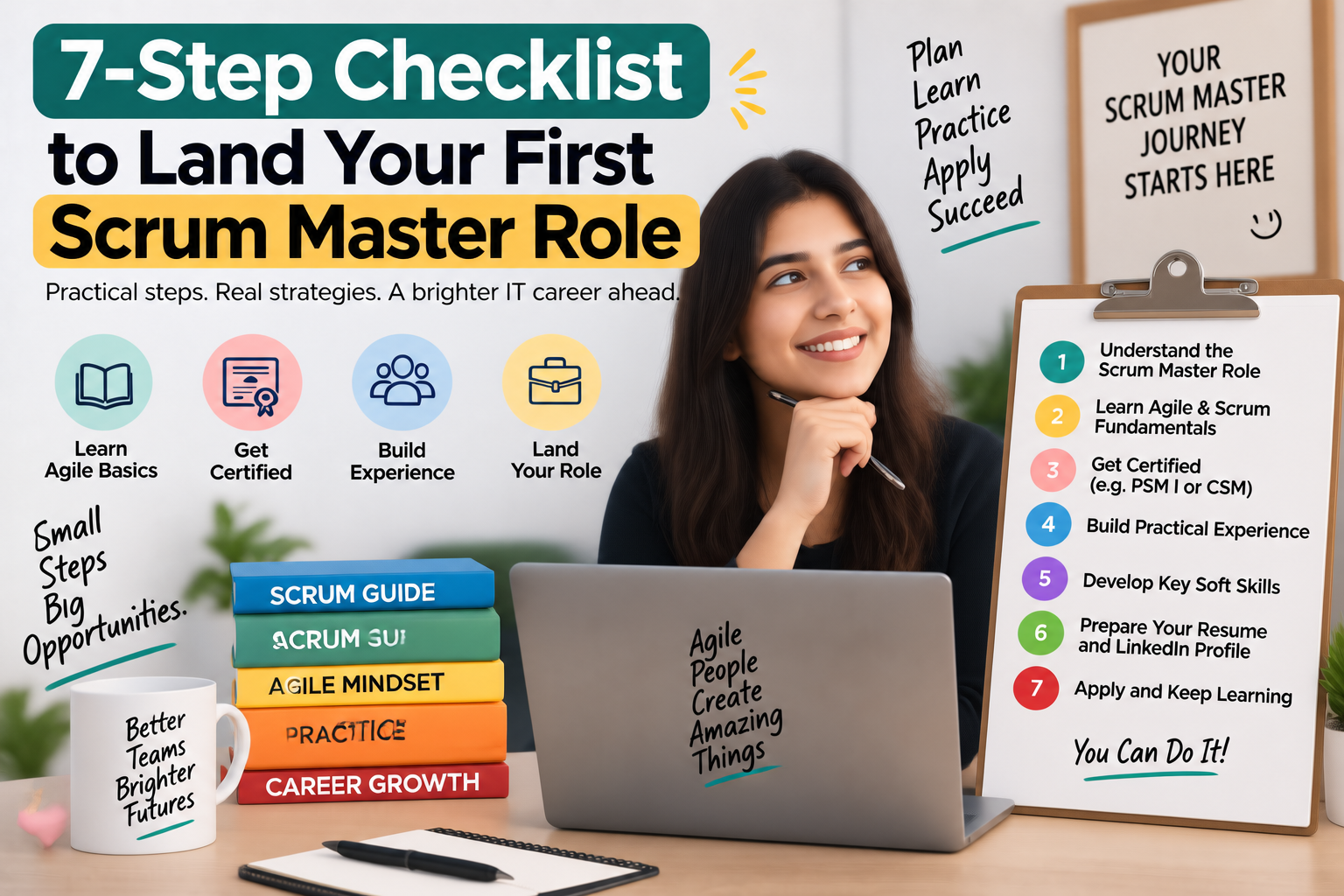
7-Step Checklist to Land Your First Scrum Master Role
- Complete a recognised Scrum Master certification (Foundation or Practitioner).
- Volunteer or self-start a project to practise real Scrum ceremonies.
- Rebuild your resume around facilitation and transferable skills.
- Apply to Agile Coordinator, Delivery Support and Business Analyst roles, not just ‘Scrum Master’ titles.
- Practise scenario-based interview answers out loud.
- Network with local Agile meetups and communities in your city.
- Follow up on every application and keep applying consistently.
Frequently Asked Questions
Can I really become a Scrum Master with no prior experience?
Yes it’s one of the more accessible entry points into Agile careers, provided you pair a recognised certification with demonstrated practice, even from volunteer or self-driven projects.
Do I need an IT background to become a Scrum Master?
No. Many successful Scrum Masters come from teaching, coordination, hospitality and customer service backgrounds the role is about facilitation and team leadership more than technical skill.
Which Scrum Master certification is best for beginners in Australia?
Foundation-level training such as Agile Scrum Foundation (BCS/EXIN) is the typical starting point, with Practitioner or Pro-level certification recommended once you have some practical exposure.
Start Your Scrum Master Journey Today
Getting a Scrum Master job without experience in Australia comes down to preparation, not luck a recognised certification, demonstrated practice, and a resume that speaks the language employers are searching for. Explore the full Scrum Master Certification training options, browse courses, read the blog, check the FAQs, or contact the team to find the right pathway into Agile in your city.